newswise - latest
https://www.newswise.com/legacy/rss/latest.rss
Chinese Academy of Sciences

Stimuli-responsive polymer brushes are central to modern surface engineering, enabling applications ranging from anti-fouling coatings to biointerfaces and soft sensors. For weak polyelectrolyte brushes, pH responsiveness is well understood because their charge density varies with acidity. In contrast, strong polyelectrolyte brushes carry permanent charges and were long assumed to be pH-insensitive. Over the past decade, however, evidence has emerged that even these materials respond to pH through counterion-mediated interactions at the interface. Despite this progress, a key question has remained unresolved: whether the thickness of such brushes influences their pH responsiveness. Based on these challenges, it is necessary to conduct a systematic investigation into how brush thickness regulates pH-responsive behavior.
Researchers from the University of Science and Technology of China and Jiaxing University report new insights into how brush thickness governs pH responsiveness in strong polyelectrolyte brushes. The study, published (DOI: 10.1007/s10118-025-3464-x) online on November 19, 2025, in Chinese Journal of Polymer Science, examines both positively and negatively charged polymer brushes with controlled thicknesses. By combining interfacial measurements with molecular-level analysis, the team demonstrates that thickness selectively amplifies pH-dependent hydration and stiffness, while leaving wettability and adhesion largely unchanged.
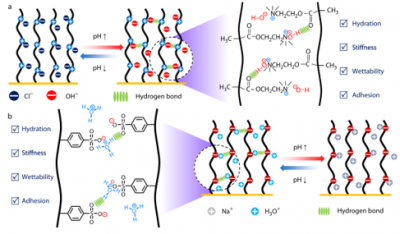
To uncover the role of thickness, the researchers fabricated strong polyelectrolyte brushes with multiple well-defined thicknesses while keeping surface grafting density constant. Two representative systems were examined: a cationic brush and an anionic brush. Using quartz crystal microbalance measurements, the team tracked how hydration and viscoelastic properties changed as pH varied. Thicker brushes exhibited markedly stronger pH-induced dehydration or hydration, accompanied by larger changes in stiffness. This scaling behavior indicates that pH effects accumulate throughout the bulk of the brush layer rather than being confined to the surface.
In contrast, contact-angle and adhesion measurements revealed a strikingly different trend. Regardless of thickness, the pH-dependent changes in wettability and adhesive force remained nearly identical. This suggests that these properties are governed primarily by molecular interactions within a shallow subsurface region, rather than by the overall brush thickness.
The results were consistent for both positively and negatively charged brushes, pointing to a universal mechanism. The observed pH responsiveness arises from counterion-mediated hydrogen bonding between bound ions and polymer functional groups. While increased thickness enhances the total number of such interactions and thus amplifies bulk properties, interfacial characteristics are controlled locally and remain thickness-independent.
“This work shows that thickness is not a passive geometric parameter, but an active design variable for smart polymer interfaces,” said one of the study’s senior authors. “By separating bulk responses like hydration and stiffness from interfacial properties such as wettability and adhesion, we demonstrate a new level of control over pH-responsive behavior. This insight helps resolve long-standing debates about strong polyelectrolyte brushes and opens up new strategies for tailoring surface functions without changing chemistry.”
The findings provide practical guidance for designing responsive surfaces in biotechnology, soft robotics, lubrication, and anti-fouling systems. By tuning thickness alone, engineers can selectively enhance mechanical or hydration responses to pH without altering surface adhesion or wettability. This decoupling is particularly valuable for applications where stable interfacial behavior is required alongside tunable bulk properties, such as biomedical coatings or adaptive membranes. More broadly, the study establishes thickness as a universal control knob for pH-responsive strong polyelectrolyte brushes, advancing their use in next-generation smart materials and interfacial devices.
###
References
DOI
Original Source URL
https://doi.org/10.1007/s10118-025-3464-x
Funding Information
This work was financially supported by the National Natural Science Foundation of China (Nos. 22273098, 52033001 and 22303032), the Key Project of Anhui Province Science and Technology Innovation Platform (No. S202305a12020030), and the Science and Technology Program Project of Zhejiang Province, China (No. 2025ZY01057).
About Chinese Journal of Polymer Science
Chinese Journal of Polymer Science(CJPS) is a monthly journal published in English and sponsored by the Chinese Chemical Society and the Institute of Chemistry, Chinese Academy of Sciences. CJPS is edited by a distinguished Editorial Board headed by Professor Qi-Feng Zhou and supported by an International Advisory Board in which many famous active polymer scientists all over the world are included. Manuscript types include Editorials, Rapid Communications, Perspectives, Tutorials, Feature Articles, Reviews and Research Articles. According to the Journal Citation Reports, 2024 Impact Factor (IF) of CJPS is 4.0.