AI Insight
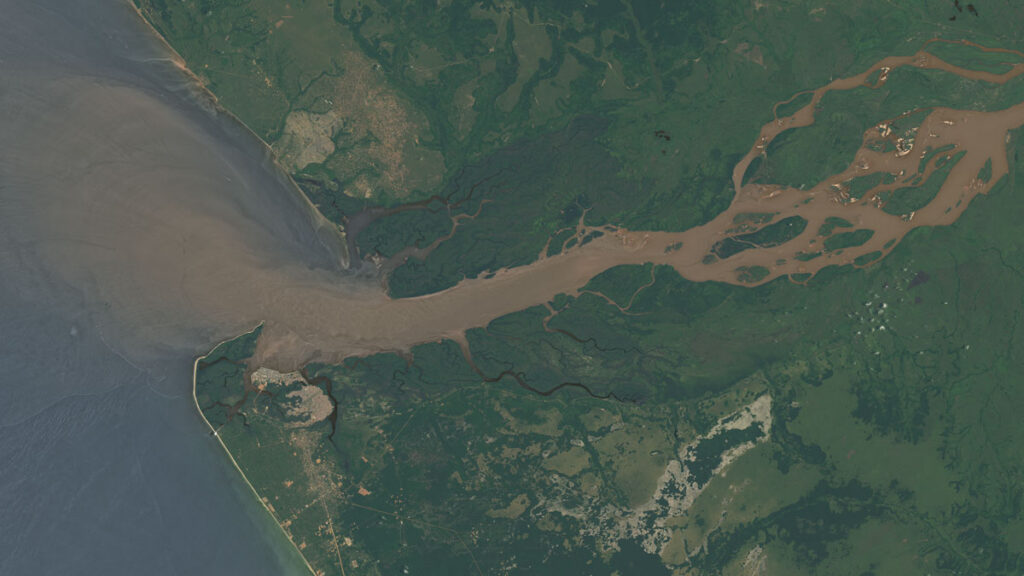
The Congo River discharges 40,000 cubic meters of freshwater per second into the Atlantic Ocean, creating an 800-kilometer plume. A new study combining oceanographic modeling and satellite data reveals that large rotating ocean currents called mesoscale eddies, rather than continuous diffusion, are the primary mechanism transporting this freshwater hundreds of kilometers offshore. In 2016, one anticyclonic eddy lasting 49 days captured low-salinity water from the river plume and transported it approximately 200 kilometers from the coast.
Why it matters
Understanding how freshwater from major rivers disperses into the ocean has important implications for regional ocean circulation patterns and marine ecosystems that depend on these freshwater inputs, including commercial fisheries in the Atlantic.
Understand the Science
Source: Journal of Geophysical Research: Oceans
This is an authorized translation of an Eos article. 本文是Eos文章的授权翻译。
刚果河是世界第二大河流,平均每秒向大西洋注入4万立方米的水量。如此巨大的流量,形成了一股绵延800公里的淡水羽流。
在雨季,这股羽流会向西南方向移动,并可能被称为“中尺度涡旋”的大型旋转洋流所捕获,这些涡旋的尺度可达上百公里。这些涡旋可将淡水输送到距离海岸数百公里之外的地方。在图卢兹空间地球物理学和海洋学研究实验室(LEGOS)及其合作实验室开展的一项研究中,Cardot等人结合模型模拟与实测数据,分析了中尺度涡旋的旋转洋流,以深入理解淡水从刚果河流入大西洋的过程。
研究人员使用了一个分辨率为3公里的海洋环流模型——NEMO(欧洲海洋建模核心模型)来模拟刚果河的流量。该研究聚焦于2016年,因为这一年间,热带大西洋预测与研究系泊阵列(PIRATA)的观测数据,以及该区域的盐度和海流卫星记录都极为丰富。研究人员利用eOdyn公司通过船舶自动识别系统(Automatic Identification System, AIS)收集的海面盐度、海面高度和表层洋流数据,对模型输出结果进行了验证。总体而言,该模型能够成功复现刚果河淡水羽流的空间范围、地理位置及其季节变化特征。
2016年期间发生了多次中尺度天气事件。其中一次涡旋在3月和4月将大量淡水输送至海洋。该反气旋涡(在南半球呈逆时针旋转)形成于刚果河羽流附近,持续了49天,半径增长至150公里。该涡旋将羽流中的低盐度水裹挟于其核心,并将其输送至离岸约200公里处,随后逐渐消散。
粒子追踪实验追溯了被涡旋捕获的水体来源,揭示了河水向大西洋输送的具体路径。研究人员通过时间倒推,追踪了超过5000个虚拟粒子,发现这些4月被困于涡旋核心内的粒子,可追溯至3月初刚形成的刚果河羽流南部区域。这一发现表明,2016年类似事件等间歇性过程主导了淡水向海洋的输送,而非刚果河水的持续扩散。这些发现对区域海洋环流,以及依赖此类淡水输入的海洋生态系统和渔业,具有重要意义。(Journal of Geophysical Research: Oceans, https://doi.org/10.1029/2025JC023642, 2026)
—科学撰稿人Rebecca Owen (@beccapox.bsky.social)
This translation was made by Wiley. 本文翻译由Wiley提供。
Read this article on WeChat. 在微信上分享本文。e, au info