AI Insight
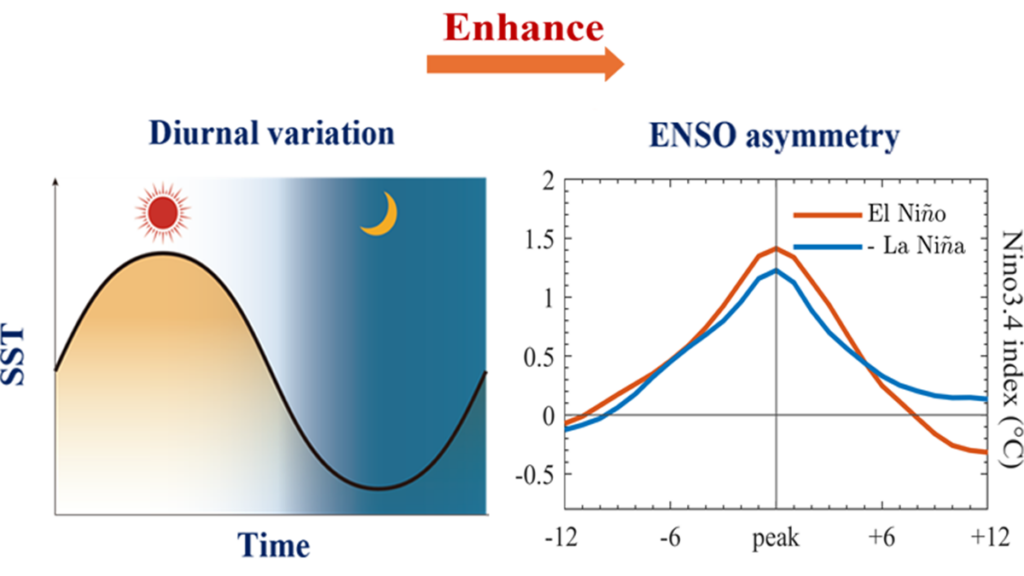
Researchers have identified that daily sea surface temperature variations significantly influence the asymmetry observed in El Niño-Southern Oscillation (ENSO) events, where El Niño warming effects are stronger than La Niña cooling effects. By analyzing 35 CMIP6 climate models, Yang et al. found that models incorporating larger diurnal temperature amplitudes better captured this asymmetry, with improvements up to 38.5%. The mechanism involves east-west temperature gradients in the central and eastern Pacific that cause uneven ocean warming over months, explaining why El Niño's warming exceeds La Niña's cooling.
Why it matters
Understanding this asymmetry is crucial for improving climate model accuracy and enhancing predictions of future ENSO events, which have significant global impacts on weather patterns, agriculture, and water resources. The findings provide practical guidance for climate model developers to better simulate large-scale climate phenomena by accounting for smaller-scale temperature variations.
Understand the Science
Source: Geophysical Research Letters
This is an authorized translation of an Eos article. 本文是Eos文章的授权翻译。
研究人员早已知道,厄尔尼诺-南方涛动(ENSO)存在不对称性,即风与洋流相互作用所引发的厄尔尼诺事件和拉尼娜事件的温差现象。然而,大规模气候模型往往未能充分反映这种不对称性,其原因尚不完全清楚。更准确地模拟导致厄尔尼诺事件变暖的机制,不仅有助于理解地球气候系统,还能提升未来ENSO事件的预测能力。
以往对厄尔尼诺-南方涛动(ENSO)不对称性的研究主要关注风应力响应和热力平流等大尺度过程,但并未完全解答这一问题。杨等人采用了一种新的方法,从更小的尺度入手,研究了昼夜海表温度变化如何影响ENSO不对称性。
研究人员比较了35个耦合模式比较计划第六阶段(CMIP6)模式,发现温度日变化幅度(DA)较大的模式能更好地捕捉ENSO不对称性。通过针对性的模式实验,他们进一步发现,这一机制的主要驱动因素是太平洋中部和东部地区日均海表温度异常响应的反向差异。这种东西向的温度差异导致海洋在数月甚至更长时间内出现不均匀升温。因此,厄尔尼诺现象对海洋的升温作用大于拉尼娜现象的降温作用。
作者指出,对于气候模型而言,采用更大的温度日变化幅度日温差幅度可将ENSO模拟中的不对称性改善高达38.5%,这凸显了海表温度日变化对厄尔尼诺等大尺度气候事件的重要性。此外,他们还强调,引入较大的DA可能从多个方面影响ENSO模拟,包括相位锁定、不对称性和振幅变化,这为其他气候模型的开发提供了有价值的指导。(Geophysical Research Letters, https://doi.org/10.1029/2026GL122494, 2026)
—科学撰稿人Nathaniel Scharping (@nathanielscharp)
This translation was made by Wiley. 本文翻译由Wiley提供。
Read this article on WeChat. 在微信上分享本文。