AI Insight
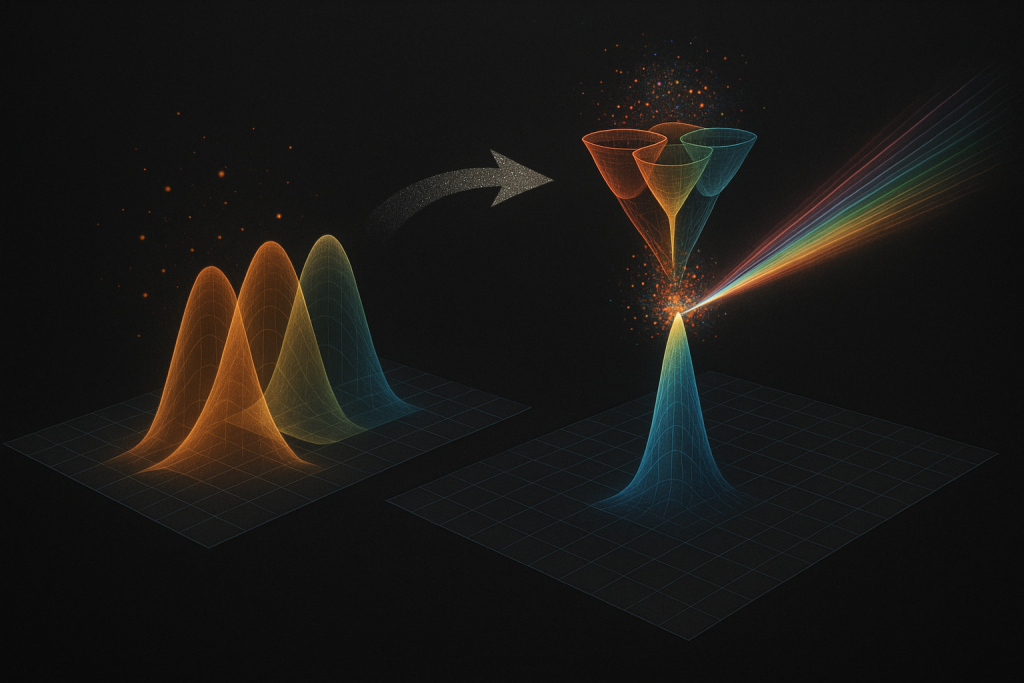
This paper presents a full-rank pileup deconvolution scheme for calorimeter online trigger primitive generation in high energy physics experiments. Unlike conventional offline deconvolution methods, which are rank-deficient and require mathematical pre-assumptions such as sparse representation, this approach exploits the specific signal availability conditions of online computation to construct a determined system where the number of equations equals the number of unknowns. By matching ADC sample counts to beam crossing counts, the authors achieve a squared, full-rank convolution matrix, enabling a more straightforward and assumption-free deconvolution process, with additional analysis of robustness over extended time windows.
Why it matters
As accelerator luminosity increases in modern particle physics facilities, pileup contamination in calorimeter signals becomes a critical challenge for real-time data processing and trigger systems. This method could improve the accuracy and reliability of online trigger primitive generation, directly benefiting experiments at high-luminosity colliders such as those at CERN.
Understand the Science
Abstract: In this document, a pileup deconvolution scheme not relying on any mathematics guessing is presented. In high energy physics experiment, as the luminosity increases, pile-up issues on detectors such as calorimeters become non-negligible. Deconvolution approaches developed for data taken from DAQ systems are usually rank-deficient or underdetermined, having less equations than unknowns, even with the ADC values from multiple beam crossings are collected. These deconvolution approaches need mathematic pre-assumptions such as Sparse Representation. For online computation tasks such as for trigger primitive creation, signal availability is significantly different as in offline data analysis stage, and therefore, it is possible to use different (yet simpler) algorithms. In this situation, number of ADC values of the calorimeter outputs is the same as the number of beam crossings (or 4 times number of beam crossings, depending on the ADC sampling rate), and therefore, the number of equations can be arranged to be the same as number of unknowns. This way, a determined deconvolution scheme with a full-rank squared convolution (and deconvolution) matrix becomes possible. The robustness of deconvolution over long time windows is also studied in this paper.
Source: A Full Rank Pileup Deconvolution Scheme Suitable for Calorimeter Online Trigger Primitive Generation