AI Insight
NGC 4449 is a dwarf galaxy approximately one-tenth the size of the Milky Way, containing only a few billion stars compared to the Milky Way's hundreds of billions. Observations by the Hubble Space Telescope reveal that NGC 4449 and similar dwarf galaxies contain less oxygen than theoretical models predict, indicating that stellar winds and supernovae in these galaxies are more efficient at expelling heavy elements than previously understood. This discovery suggests that dwarf galaxies, despite their small size, may be significant contributors to distributing heavy elements throughout the universe.
Why it matters
This finding changes our understanding of how heavy elements—essential building blocks for stars, planets, and life—are distributed across the cosmos. Since dwarf galaxies are the most common type of galaxy in the universe, their role in spreading these elements may be more important than previously recognized in models of cosmic chemical evolution.
Understand the Science
APOD
Astronomy Picture of the Day
Discover the cosmos! Each day a different image or photograph of our fascinating universe is featured, along with a brief explanation written by a professional astronomer.
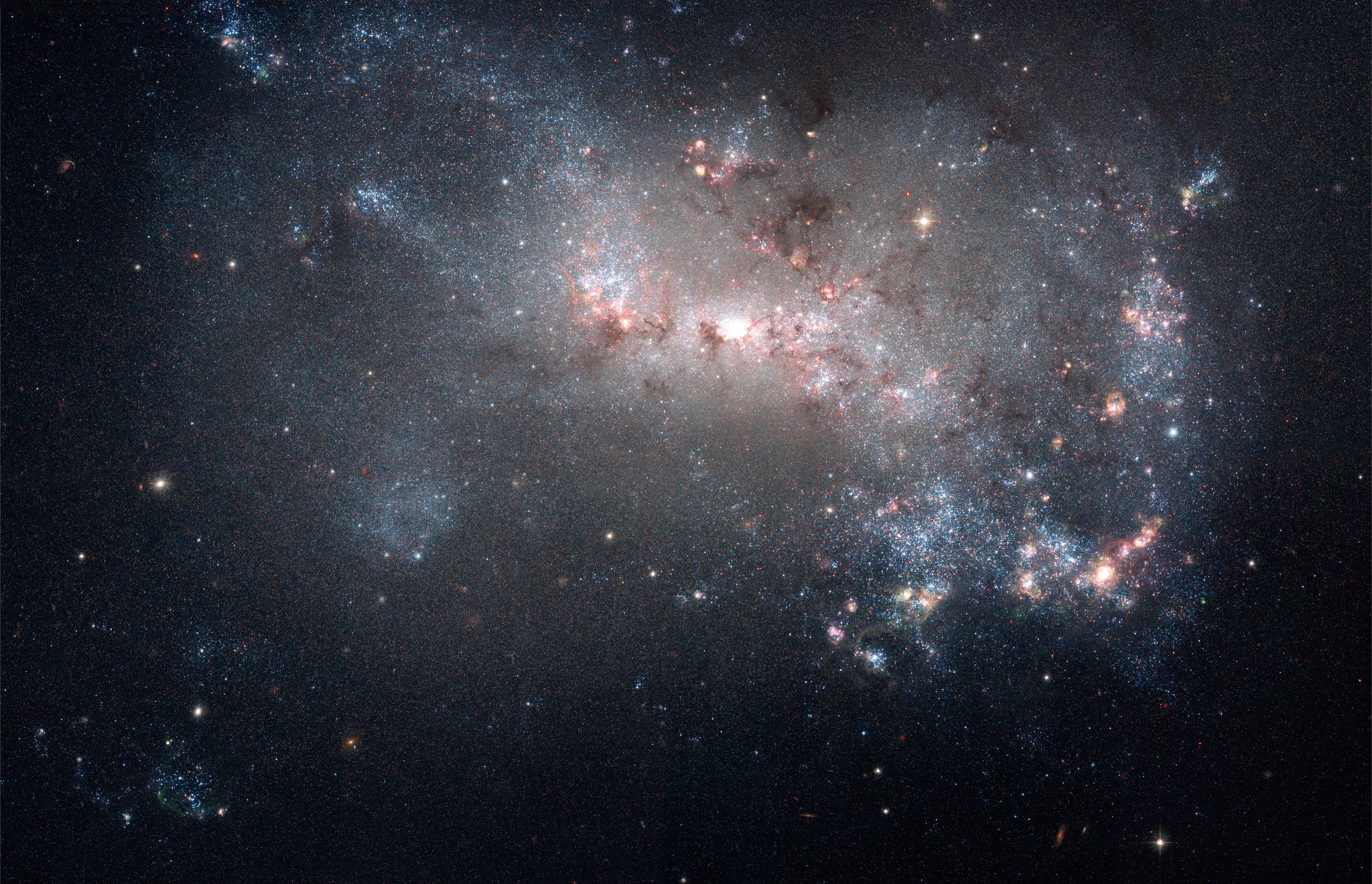
NGC 4449: Small Galaxy, Big Impact
Explanation: Don’t judge a galaxy by its size. Our home galaxy, the Milky Way, is about 100,000 light years across. This huge expanse of space contains hundreds of billions of stars! The smallest galaxies, called dwarf galaxies, are about 1/10th the size of the Milky Way and only contain a few billion stars. They are also the most common type of galaxy in the whole universe. Today’s image shows one such dwarf galaxy, NGC 4449, captured by the Hubble Space Telescope. NGC 4449 and similar dwarf galaxies are missing more oxygen than models predict. This suggests their stellar winds and supernovae are surprisingly effective at blowing away oxygen and other heavy elements. Turns out these tiny galaxies may play a big role in spreading heavy elements — the building blocks of stars, planets, and life — throughout the universe!

Tomorrow’s picture: a date in Poland
| Date: | November 11, 2026 |
|---|---|
| Credit: | NASA, ESA, A. Aloisi (STScI/ESA), and the Hubble Heritage (STScI/AURA)-ESA/Hubble Collaboration |
| Authors & editors: | Keighley Rockcliffe, Robert Nemiroff, Jerry Bonnell, Cecilia Chirenti |
| A service of: |
ASD at NASA / GSFC, NASA Science Activation & Michigan Tech. U. |
Source: APOD: 2026 November 11 – NGC 4449: Small Galaxy, Big Impact