AI Insight
This visualization from a computer simulation shows how dark matter forms web-like filaments throughout the universe, with ordinary visible matter (baryonic matter) collecting in relatively rare clumps along these structures. Dark matter's gravitational influence explains observed phenomena including galaxy rotation speeds, galaxy cluster dynamics, gravitational lensing effects, and the distribution of visible matter. The simulations match astronomical observations and reveal that while dark matter remains mysterious, dark energy—a repulsive force driving universal expansion—is now considered an even stranger component of the cosmos.
Why it matters
Understanding dark matter distribution is fundamental to comprehending how the universe evolved and how galaxies formed and behave. These computer simulations provide crucial tools for testing cosmological theories against observational data and help explain the large-scale structure of the universe.
Understand the Science
APOD
Astronomy Picture of the Day
Discover the cosmos! Each day a different image or photograph of our fascinating universe is featured, along with a brief explanation written by a professional astronomer.
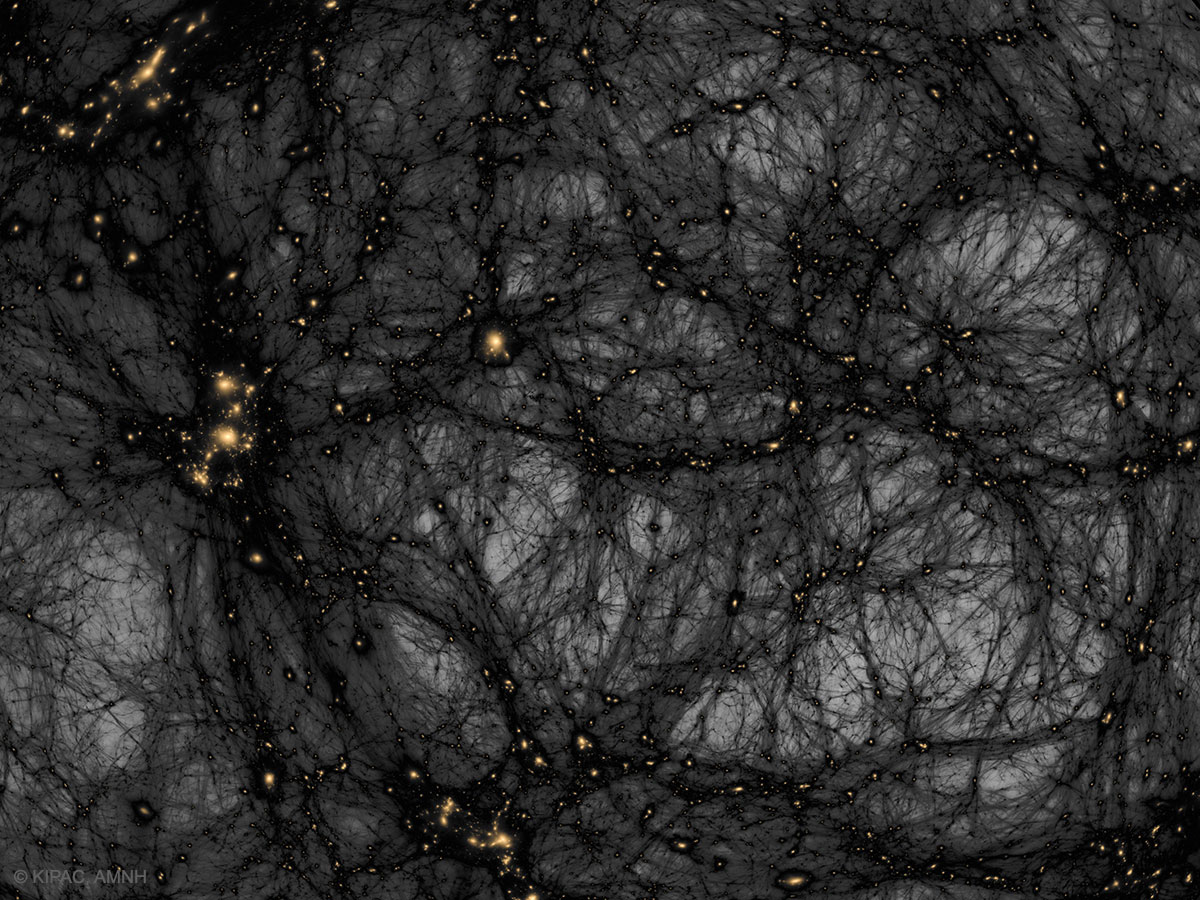
Dark Matter in a Simulated Universe
Explanation: Is our universe haunted? It might look that way on this dark matter map. The gravity of unseen dark matter is the leading explanation for why galaxies rotate so fast, why galaxies orbit clusters so fast, why gravitational lenses so strongly deflect light, and how visible matter is distributed. The featured image from the American Museum of Natural History‘s Hayden Planetarium Space Show, Dark Universe, highlights one example of how pervasive dark matter might haunt our universe. In this frame from a detailed computer simulation, complex filaments of dark matter, shown in black, are strewn about the universe like spider webs, while the relatively rare clumps of familiar baryonic matter are colored orange. These simulations are good statistical matches to astronomical observations. In what is perhaps a scarier turn of events, dark matter — although quite strange and in an unknown form — is no longer thought to be the strangest source of gravity in the universe. That honor now falls to dark energy, a more uniform source of repulsive gravity that seems to now dominate the expansion of the entire universe.
Tomorrow’s picture: Orion the Great
| Date: | October 25, 2026 |
|---|---|
| Credit & Copyright: | Tom Abel & Ralf Kaehler (KIPAC , SLAC), AMNH |
| Authors & editors: | Robert Nemiroff, Jerry Bonnell, Cecilia Chirenti, Keighley Rockcliffe |
| A service of: |
ASD at NASA / GSFC, NASA Science Activation & Michigan Tech. U. |
Source: APOD: 2026 October 25 – Dark Matter in a Simulated Universe