AI Insight
This article describes a lunar eclipse photographed from Portugal, showing the Moon during eclipse with an airplane silhouetted in the foreground. Lunar eclipses occur when Earth passes between the Sun and Moon, are visible from half the Earth facing the Moon, and can be safely observed with the naked eye without special equipment. These events typically last for hours and are among the most commonly witnessed and photographed astronomical phenomena because, unlike solar eclipses, observers do not need to look toward the bright Sun.
Why it matters
Lunar eclipses are accessible astronomical events that require no special equipment or safety precautions, making them ideal for public engagement with astronomy and scientific observation. Their long duration and visibility from entire hemispheres allow millions of people to simultaneously witness the same celestial phenomenon.
Understand the Science
APOD
Astronomy Picture of the Day
Discover the cosmos! Each day a different image or photograph of our fascinating universe is featured, along with a brief explanation written by a professional astronomer.
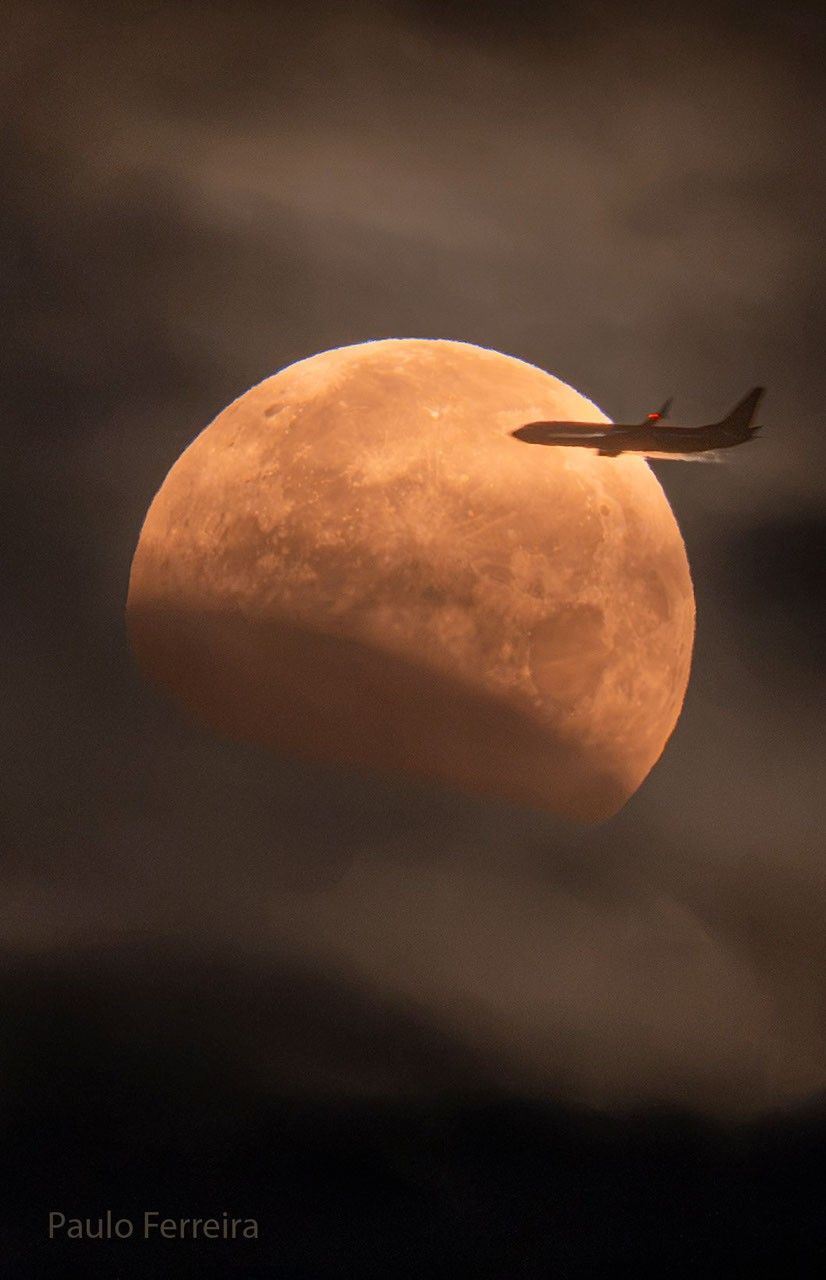
A Plane Lunar Eclipse
Explanation: Did you need to be on the right side of this airplane to see this eclipse? No. Lunar eclipses are routinely seen from the half of the Earth facing the Moon when the eclipse occurs, making them some of the most commonly witnessed astronomical events. You don’t even need any special equipment to see one — just your unaided eyes. Lunar eclipses are also some of the most photographed astronomical events because, unlike with a solar eclipse, your eyes and camera do not have to look toward the bright Sun. However, considering the featured image taken last week from Portugal, if you were on the left side of that airplane during takeoff, you might have trouble seeing it — at first. But even then, after takeoff, since lunar eclipses typically last for hours, you might soon be able to safely cross the aisle(s) to see it.
Gallery: Lunar Eclipse of 2026 August
APOD’s main NASA site is moving: From apod.nasa.gov to science.nasa.gov/apod
Tomorrow’s picture: cultural eclipses
| Date | September 1, 2026 |
|---|---|
| Credit | Paulo Ferreira |
| Authors & editors: | Robert Nemiroff, Jerry Bonnell, Cecilia Chirenti, Keighley Rockcliffe |
| A service of: |
ASD at NASA / GSFC, NASA Science Activation & Michigan Tech. U. |