AI Insight
The Cocoon Nebula (IC 5146) is a compact star-forming region located approximately 2,500 light-years away in the constellation Cygnus that visually resembles a comet due to its bright nebular head and extended dust tail. The central bright region spans about 10 light-years and features emission and reflection nebulosity powered by a central star, while the dark dusty tail extends nearly 100 light-years and contains stars currently forming within obscured regions. This wide-field astronomical photograph was captured in July from Death Valley, California, revealing the complex interplay between star formation, nebular emission, and interstellar dust clouds.
Why it matters
This observation illustrates active star formation processes and demonstrates how interstellar dust can both obscure and reveal different aspects of stellar birth depending on the wavelength observed. The extended dusty filaments serve as sites for ongoing stellar formation, providing insight into the multi-generational process of star creation in molecular cloud complexes.
Understand the Science
APOD
Astronomy Picture of the Day
Discover the cosmos! Each day a different image or photograph of our fascinating universe is featured, along with a brief explanation written by a professional astronomer.
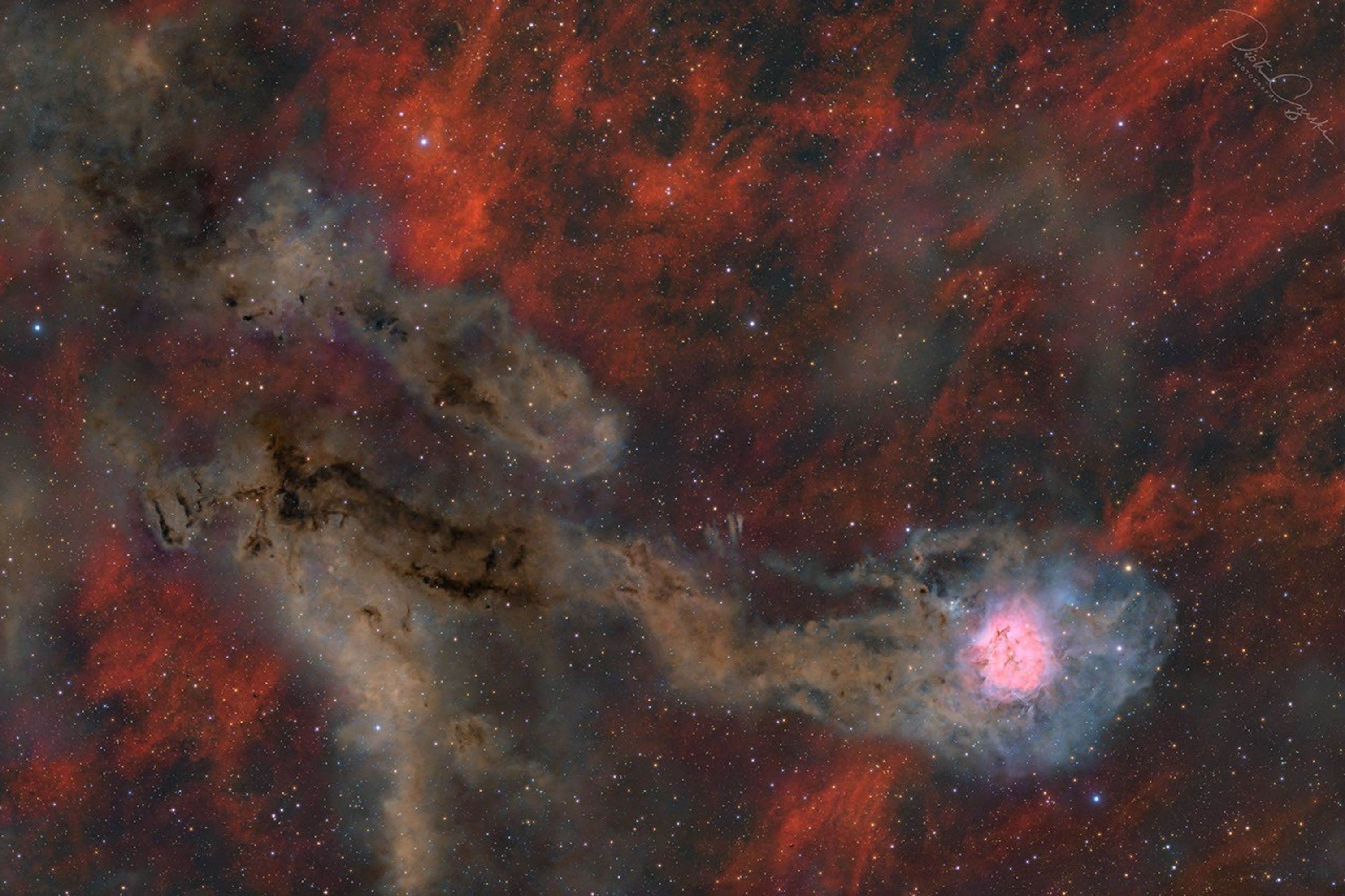
Cocoon Nebula Wide Field
Explanation: When does a nebula look like a comet? In this crowded starfield covering over two degrees within the high-flying constellation of the Swan (Cygnus), the eye is drawn to the Cocoon Nebula. A compact star forming region, the cosmic Cocoon punctuates a nebula bright in emission and reflection on the lower right, with a long trail of interstellar dust clouds to the left, making the entire complex appear a bit like a comet. Cataloged as IC 5146, the central bright head of the nebula spans about 10 light years, while the dark dusty tail spans nearly 100 light years. Both are located about 2,500 light years away. A bright star near the colorful nebula’s center likely supplies power and helps clear out a cavity. The long dusty filaments of the tail, although dark in this visible light image, hide stars in the process of formation. The featured image was captured in July from Death Valley, California, USA.
APOD’s main NASA site is moving: From apod.nasa.gov to science.nasa.gov/apod
Tomorrow’s picture: triple eclipse
| Date: | September 21, 2026 |
|---|---|
| Credit & Copyright: | Piotr Czerski |
| Authors & editors: | Robert Nemiroff, Jerry Bonnell, Cecilia Chirenti, Keighley Rockcliffe |
| A service of: |
ASD at NASA / GSFC, NASA Science Activation & Michigan Tech. U. |