AI Insight
A World Weather Attribution analysis found that human-induced climate change made the severe 2023 Canadian wildfires in Ontario and the Northwest Territories approximately twice as likely to occur. The study used climate models to analyze the Daily Severity Rating (DSR), a measure of fire suppression difficulty, finding that the worst fire weather week in the Northwest Territories was made 27 times more likely by climate change. Extreme fire events that would have occurred every 40 years without climate change are now expected every 2-6 years in the Northwest Territories and every 6-15 years in Ontario.
Why it matters
The increasing frequency of severe wildfires is overwhelming local response capabilities and causing repeated displacement of communities, while affecting air quality for over 120 million people across Canada and the United States. Understanding climate change's quantifiable contribution to wildfire risk helps communities prepare for events that are now expected multiple times per decade rather than once per generation.
Understand the Science
body {background-color: #D2D1D5;}
Research & Developments is a blog for brief updates that provide context for the flurry of news that impacts science and scientists today.
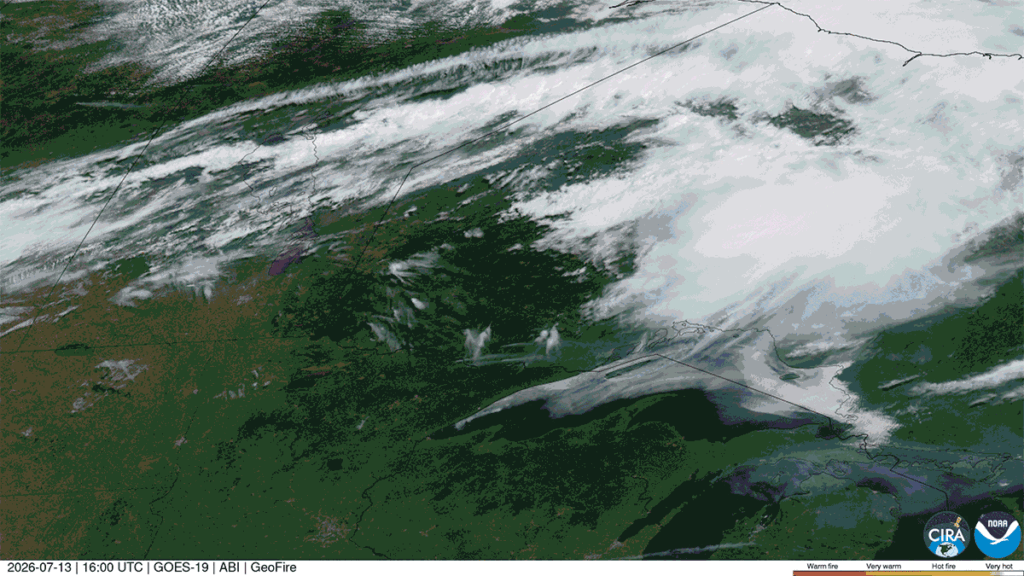
Wildfires in the Canadian provinces of Ontario and the Northwest Territories have burned more than 3.9 million hectares this summer, prompted widespread evacuation orders, and created poor air quality for not only Canadians, but more than 120 million people across the midwestern and northeastern United States. The fires spread exceptionally quickly, stressing the resources of local response agencies. About 700 fires are still active across Canada.
“The impacts of climate change are very real, and we can quantify what those are and the extent to which they have become more serious.”
According to a new analysis, human-induced climate change and its contribution to fire conditions across Canada made these fires twice as likely to occur. The report is from World Weather Attribution, an international climate science partnership.
The analysis is an attribution study, which determines the extent to which climate change is responsible for a specific extreme weather event. Current science is best at determining climate change’s role in driving extreme temperatures and precipitation events, but wildfires are more difficult to attribute to climate change due to the many factors that drive their occurrence. Still, scientists’ attribution methods have greatly improved over the past decade, according to a recent report.
“The impacts of climate change are very real, and we can quantify what those are and the extent to which they have become more serious,” said Theodore Keeping, a climate scientist at Imperial College London and coauthor of the new report.
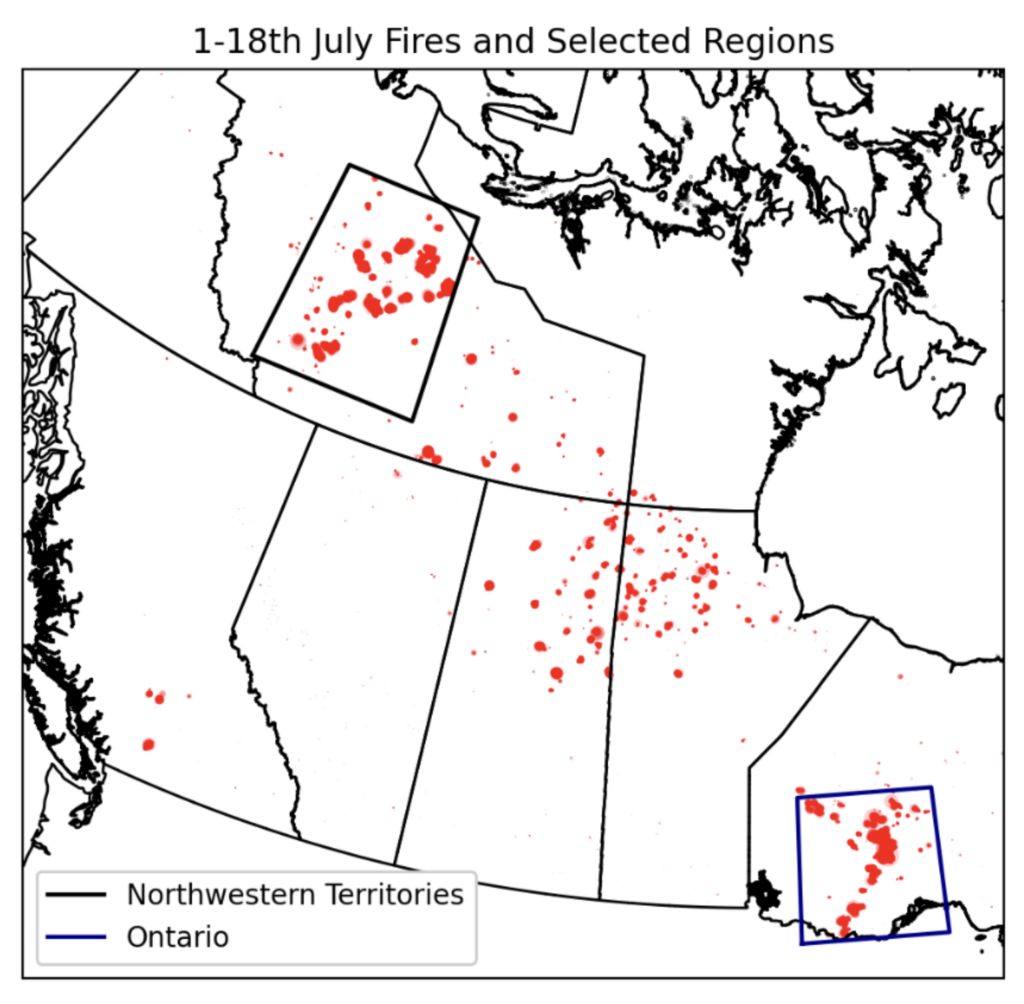
To determine the role of climate change in driving this summer’s Canadian wildfires, the research team analyzed the so-called Daily Severity Rating (DSR), a measure of fire weather that reflects how difficult it is to suppress a fire once it ignites. Using climate models, the team tested the likelihood that similar DSRs to those present in Ontario and the Northwest Territories this summer would occur in a hypothetical world without human-caused climate change.
Researchers determined that the sustained, severe DSRs present in Ontario and the Northwest Territories in July were made about twice as likely by climate change. The worst of the fire weather, a particularly high-DSR week in the Northwest Territories, was made about 27 times more likely by climate change, according to the researchers.
However, such fire weather is “no longer rare in today’s climate,” the authors wrote. In a world without human-caused climate change, similar extreme fire events would have been expected about every 40 years. In our warming world, though, such fires are expected to occur every 2-6 years in the Northwest Territories and every 6-15 years in Ontario.
Though a doubling of the likelihood of extreme fires may sound small, “a small change makes a huge difference for an ecosystem and a community,” said Frederike Otto, scientific lead of WWA and coauthor of the new report, in a press conference. The Canadian fires, she said, are “incredibly hard to suppress with the available people power and available technology. Even if [things get] just a little bit worse, it would mean that everything is stretched further.”
Frequent Fires, Vulnerable People
The increasing occurrence of destructive fires means some communities are facing displacement repeatedly, especially as the last three fire seasons in Canada have been “exceptionally severe,” the authors wrote.
Repeated extreme fire events make it difficult for communities to recover, and Indigenous communities are particularly vulnerable because they’re overrepresented in fire-prone areas. One 2024 study, for example, found that though Indigenous communities are only about 5% of Canada’s population, they made up 42% of its wildfire evacuations between 1980 and 2021. Fires in Ontario this summer have put thirteen First Nations communities under evacuation orders.
“Repeated displacement can disrupt cultural practices of Indigenous communities, as well as access to hunting grounds and traditional food,” said Chris Boyer, technical advisor and climate scientist at the Red Cross Red Crescent Climate Centre and coauthor of the new analysis, in a press conference. “Some of these communities are also dealing with the shortened response and recovery times between disasters due to the recent successive wildfires affecting longer-term resilience.”
“If you care about anyone but the super-rich, you have to stop burning fossil fuels,” Otto said. “The most vulnerable are hit hardest.”
—Grace van Deelen (@gvd.bsky.social), Staff Writer
These updates are made possible through information from the scientific community. Do you have a story about science or scientists? Send us a tip at eos@agu.org.

Text © 2026. AGU. CC BY-NC-ND 3.0
Except where otherwise noted, images are subject to copyright. Any reuse without express permission from the copyright owner is prohibited.
Source: Climate Change Made This Summer’s Canadian Wildfires Twice as Likely