AI Insight
NASA's Chandra X-ray Observatory, James Webb Space Telescope, and Hubble Space Telescope have produced a composite image of the Tarantula Nebula (30 Doradus), located 160,000 light-years away in the Large Magellanic Cloud. The nebula contains thousands of young stars embedded in a honeycomb-like structure of gas and dust. Analysis of data from these telescopes, combined with observations from the retired Spitzer Space Telescope, suggests the Tarantula Nebula may be losing energy through multiple mechanisms, including hot gas escaping from the region.
Why it matters
Understanding energy loss mechanisms in star-forming regions like the Tarantula Nebula helps astronomers better comprehend stellar evolution and the lifecycle of nebulae. This research contributes to our knowledge of how gas dynamics influence star formation in galaxies beyond our own.
Understand the Science
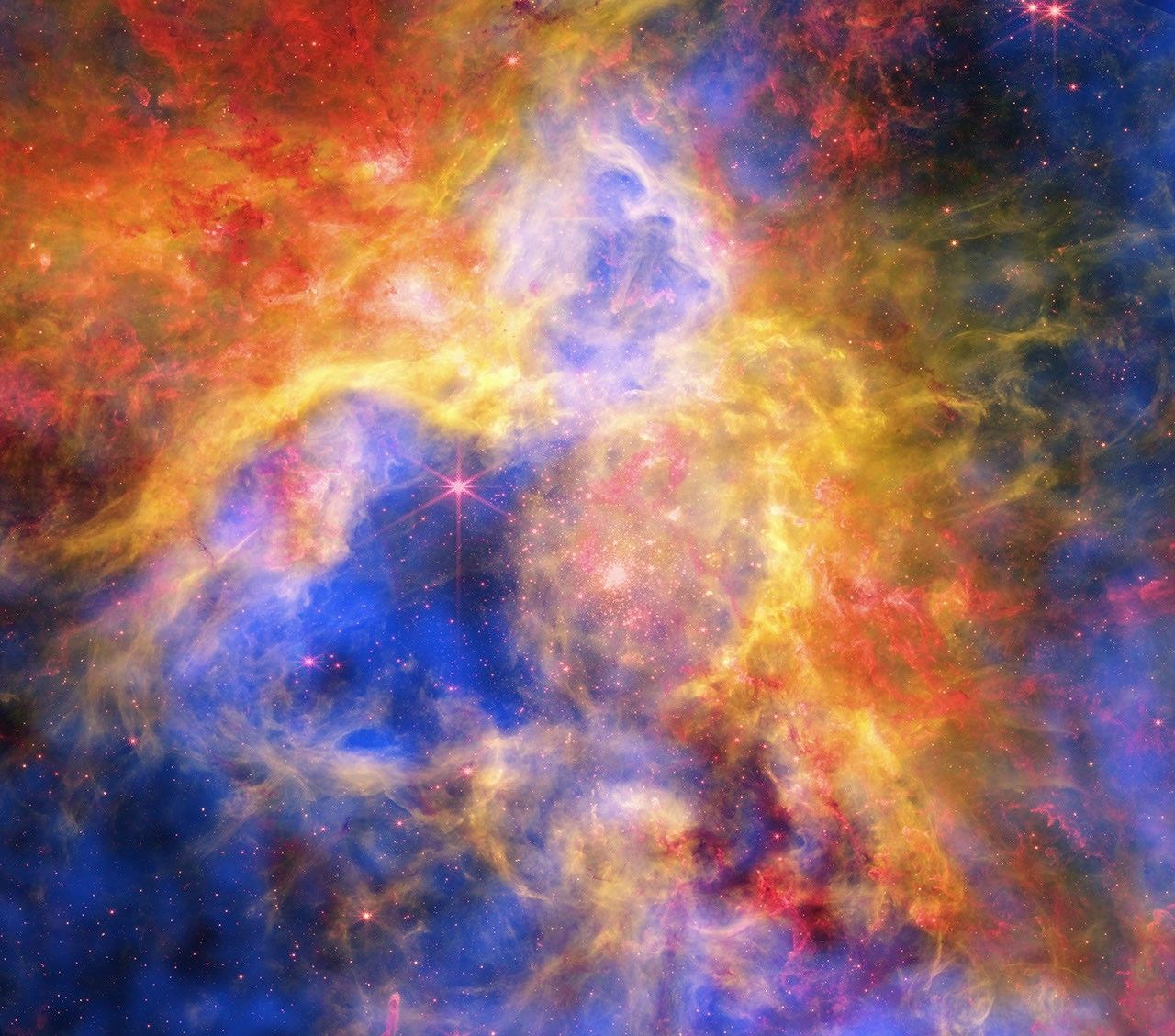
Data from NASA’s Chandra X-ray Observatory, NASA’s James Webb Space Telescope, and NASA’s Hubble Space Telescope combine to reveal a vibrant view of 30 Doradus, or the Tarantula Nebula, in this Aug. 11, 2026, image. Located in the Large Magellanic Cloud, a small neighbor galaxy to the Milky Way about 160,000 light-years from Earth, the Tarantula has thousands of young stars embedded in a vibrant honeycomb-like structure of gas and dust.
By studying the data from Chandra, Hubble, and Webb, combined with data from the agency’s retired Spitzer Space Telescope, astronomers determined that the Tarantula may be losing energy from several sources, including hot gas escaping from the nebula.
Image credit: X-ray: NASA/CXC/Ohio State Univ./J. Rodriguez et al; Infrared: NASA/ESA/CSA/STScI; Optical: NASA/ESA/STScI; Image Processing: NASA/CXC/SAO/P. Edmonds