AI Insight
NASA's Curiosity rover has observed the first high-altitude twilight clouds of the Martian autumn season above Gale Crater, marking the transition into Mars Year 39 which began at the northern hemisphere's vernal equinox in late September 2026. The rover completed drill sampling operations at "Basque Lakes" during sols 5036-5042, conducting Gas Chromatograph/Mass Spectrometry analysis while documenting seasonal atmospheric changes. These twilight clouds, illuminated by low sun angles at sunset, are bright enough to be visible in navigation camera images, unlike the typical suboptical clouds that are too thin to detect visually.
Why it matters
Tracking seasonal cloud patterns on Mars helps scientists understand atmospheric dynamics and water vapor distribution on the planet, which is crucial for planning future human missions and understanding Mars' climate cycles. The drill sample analysis contributes to ongoing geological investigations of Mount Sharp's sedimentary layers in Gale Crater.
Understand the Science
3 min read
Curiosity Blog, Sols 5036-5042: Watching the Clouds Go By

Written by Alex Innanen, Atmospheric Scientist at York University
Earth planning date: Friday, Oct. 9, 2026
Happy New Mars Year! We mark the start of a new year on Mars at the beginning of the northern hemisphere spring, or the vernal equinox. We then keep track of the seasons by counting degrees of solar longitude — each season is 90 degrees as Mars completes the whole 360 degrees of its orbit. The start of Mars year 39 at a solar longitude of 0 degrees (or Ls=0°, pronounced “ell-sub-ess-zero” if you want to sound like a Martian) came at the end of September on Earth. The new year also means it’s now autumn in Gale Crater, just south of the equator.
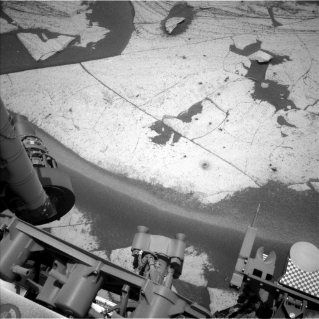
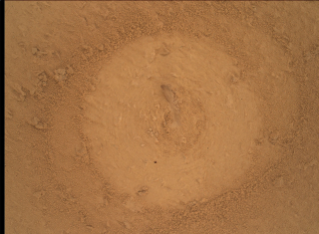
As Michelle talked about last week, we rang in the Martian new year with our drill campaign at “Basque Lakes.” This week was dedicated to wrapping up drill activities before we drive away on the weekend. After the team got a chance to see the results of last week’s lab activities, the SAM team decided on an additional GCMS (Gas Chromatograph/Mass Spectrometry) experiment. While GCMS tends to be an energy-intensive activity, we had four whole sols in Monday’s plan to play with, so we still had room for a slew of remote-sensing activities from Mastcam and ChemCam and contact science of the drill tailings — the bits of rock and minerals that are left over from our drill sample. This weekend’s plan gives us a couple more sols to wrap up drill activities at Basque Lakes and collect any last contact- or remote-science targets we want here before we begin a drive back toward the neat crystal forms we saw in the “Chiu Chiu” region.
While all this is happening, the atmosphere around us continues to go through its seasonal changes. Autumn means the return of high-altitude twilight clouds, which the low sun angle at sunset illuminates beautifully. While twilight cloud activity will pick up as the autumn progresses, our late afternoon cloud movies on Wednesday of this week already caught our first high-altitude clouds of the season, as you can see at the top of this post. Most of the clouds we tend to see at Gale Crater are suboptical, or too thin to be seen with either human eyes or with Curiosity’s robotic “eyes,” but these twilight clouds are bright enough that we can see them in the raw Navcam images. I’m looking forward to another Martian autumn of watching all these different clouds go by.
Share
Details
Related Terms
Explore More
Source: Curiosity Blog, Sols 5036-5042: Watching the Clouds Go By