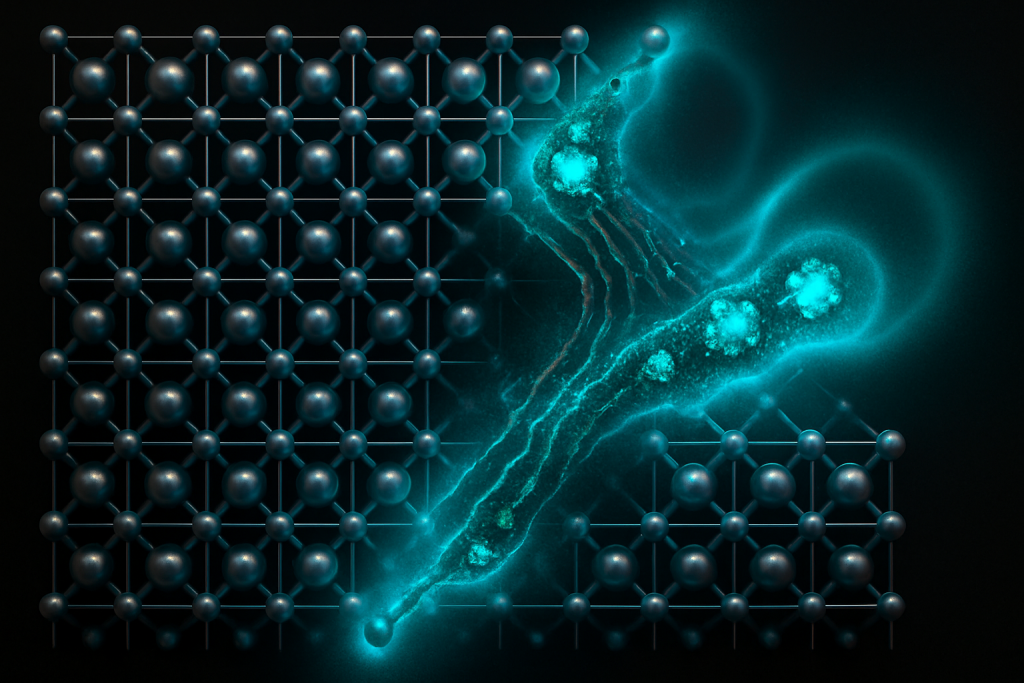
Image generated by AI
AI Insight
This study investigates how dislocations (defects in crystal structure) form and influence the exsolution process in ruthenium-doped perovskite oxide materials. The researchers found that dislocation networks create preferential pathways that control where and how metal nanoparticles emerge from the perovskite structure during exsolution. These structural defects significantly affect the distribution, size, and anchoring of exsolved ruthenium nanoparticles on the oxide surface.
Why it matters
Understanding dislocation-controlled exsolution could enable precise engineering of metal nanoparticle catalysts with improved performance and stability for applications in fuel cells, catalytic converters, and energy conversion technologies. This knowledge provides a pathway to design more efficient and durable catalytic materials by controlling defect structures.
Understand the Science
Source: Dynamics of dislocation formations and their impacts on exsolution in Ru-doped perovskite oxide