AI Insight
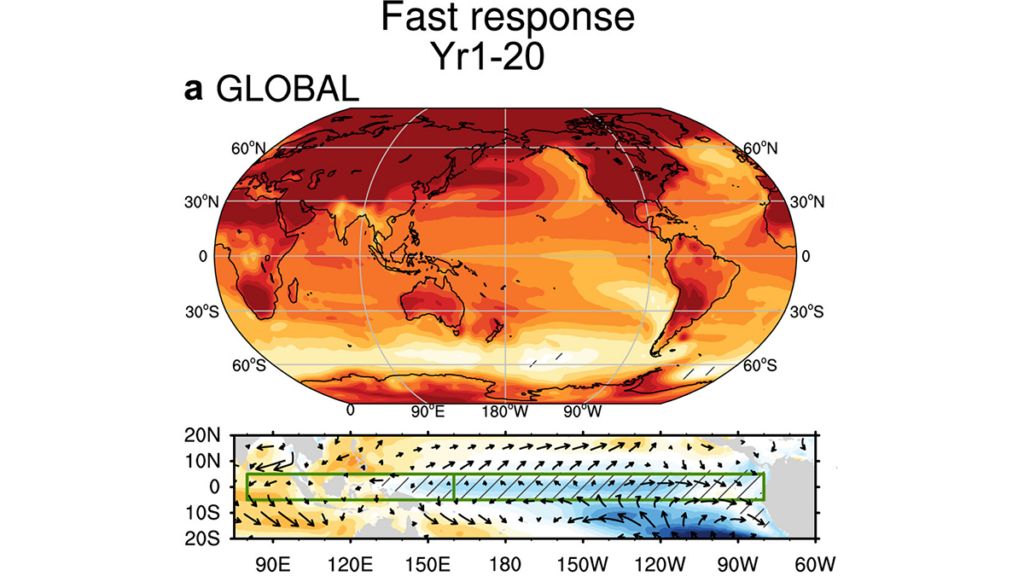
Climate models project a weakening of the Pacific sea-surface temperature gradient under global warming, yet observations show the opposite trend with cooling in the eastern tropical Pacific. Using abrupt 4x CO2 simulations, researchers identified a two-phase response: an initial strengthening of the SST gradient driven by equatorial ocean circulation changes and Northern Hemisphere atmospheric feedbacks, followed by long-term weakening through slow ocean adjustments. This discovery reconciles the apparent contradiction between models and observations by revealing that the timing of different physical processes creates distinct phases of climate response.
Why it matters
Understanding this two-phase transition is critical for improving the accuracy of climate projections, particularly for tropical rainfall patterns and global climate sensitivity. The findings explain why short-term observations may differ from long-term model predictions, providing better context for interpreting current climate trends and refining future climate scenarios.
Understand the Science
Editors’ Highlights are summaries of recent papers by AGU’s journal editors.
Source: AGU Advances
The Pacific sea-surface temperature (SST) gradient is the difference in SST across the tropical Pacific – typically warmer in the western Pacific and cooler in the eastern Pacific. It is a key control on tropical circulation, rainfall, and global climate sensitivity, making its accurate representation critical for reliable climate projections. Climate models project a decreased tropical Pacific SST gradient under global warming. In contrast, observations show the opposite with enhanced zonal SST gradients associated with cooling in the eastern tropical Pacific.
By running model simulations under an abrupt 4x CO2 scenario, Olonscheck and Kang [2026] identify a two-phase transition in equatorial Pacific warming: an initial SST gradient strengthening followed by a long-term weakening. They find that the initial strengthening is caused by both equatorial forcing involving ocean circulation changes and remote Northern Hemisphere off-equatorial forcing involving atmospheric feedbacks. These fast responses transition to weakened gradients through slow ocean adjustments. These findings shed new light on oceanic feedback after global warming and support the improvement of future projections under climate change.
Citation: Olonscheck, D., & Kang, S. M. (2026). Phase transition of CO2-driven equatorial Pacific warming pattern governed by ocean dynamics and remote forcing. AGU Advances, 7, e2026AV002437. https://doi.org/10.1029/2026AV002437
—Alberto Montanari, Editor-in-Chief, AGU Advances
Text © 2026. The authors. CC BY-NC-ND 3.0
Except where otherwise noted, images are subject to copyright. Any reuse without express permission from the copyright owner is prohibited.
Source: Equatorial Pacific Warming Pattern Mitigated by Slow Ocean Adjustment