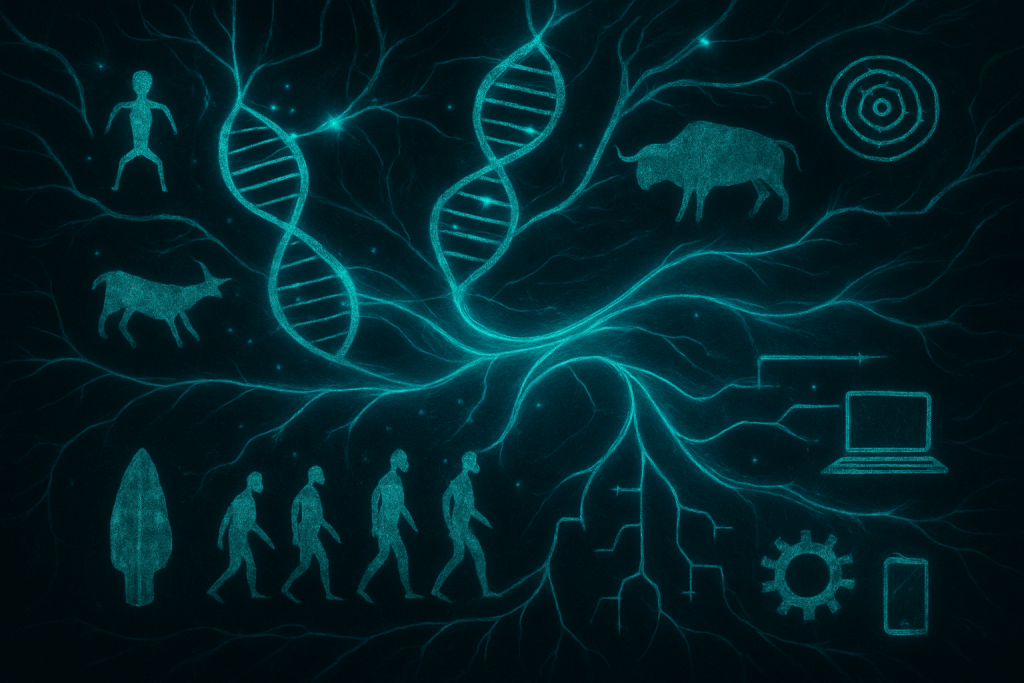
Image generated by AI
Why do humans universally prefer sweet tastes, yet cultures differ dramatically in which foods they consider delicious? Why do we find certain facial symmetries attractive across societies, but beauty standards vary wildly between continents? These puzzles hint at something profound: human preferences emerge from an intricate dance between the constraints of our evolutionary past and the creativity of our cultural present. Understanding this interplay requires insights from genetics, anthropology, neuroscience, psychology, and economics—a convergence that is reshaping how we understand ourselves.
In an era when algorithms increasingly shape our choices—from the music we listen to, the products we buy, to the partners we seek online—understanding the origins of human preferences has become urgently practical. Tech companies spending billions on recommendation systems, policymakers designing public health campaigns, and behavioral economists predicting consumer behavior all depend on grasping why we want what we want. Yet the answers to these questions remain fragmented across disciplines, each offering partial truths that only gain full power when woven together.
What Is Cultural and Evolutionary Origins of Human Preferences?
The cultural and evolutionary origins of human preferences refers to the scientific investigation of how and why humans come to like, desire, and value certain things—from foods and mates to art and ideas. This inquiry examines the extent to which our preferences are innate products of natural selection, shaped across millennia to solve survival and reproduction problems, versus learned through cultural transmission within our specific societies. Rather than treating preferences as fixed or purely random, this approach recognizes them as products of nested systems: our genes set broad parameters and biases, our developmental experiences during childhood shape what feels familiar and safe, our culture provides templates and meanings, and our individual choices reflect all of these influences simultaneously.
The modern scientific study of preferences began in earnest with Charles Darwin’s work on sexual selection in the 1870s, where he observed that animals develop preferences that seem to contradict survival logic—the peacock’s burdensome tail, for instance. However, the serious interdisciplinary study of human preferences as a unified phenomenon really took off in the late 20th century. Evolutionary psychologists like David Buss and Leda Cosmides began systematically documenting which preferences appeared universal across cultures, while anthropologists like Roy D’Andrade and cognitive scientists like Steven Pinker documented the extraordinary variability in preferences across human societies. The crucial insight emerged: universal patterns and cultural variation are not contradictory but complementary, both essential to understanding the full picture.
Across the Sciences
The evolutionary dimension of preferences operates through natural and sexual selection mechanisms that shaped our ancestral environment. Consider taste preferences: humans across all cultures show an early preference for sweet and salty foods because, in ancestral environments, these tastes reliably indicated calorie-rich foods and essential minerals. Our ancestors who had genetic variations making them love these flavors survived and reproduced more successfully than those indifferent to them. Similarly, the preference for fertile-appearing mates—those with symmetrical faces, clear skin, and healthy body proportions—evolved because these traits correlate with genetic quality and reproductive value. Neuroscience has revealed that these preferences activate ancient reward pathways in the brain, suggesting they tap into motivational systems that predate human consciousness itself.
Yet culture operates like an overlay on this evolutionary substrate, amplifying, suppressing, and transforming these basic preferences into the bewildering diversity we observe. Consider how the Japanese preference for umami flavors, the Mediterranean celebration of olive oil, or the Scandinavian love of fermented foods cannot be explained by evolution alone—they reflect centuries of culinary experimentation, agricultural patterns, trade routes, and transmitted knowledge. Or consider beauty standards: while some aspects of attractiveness (like symmetry) show cross-cultural stability, the ideal body weight ranges from extremely thin in some contemporary Western contexts to visibly obese in some African and Pacific Island cultures, depending on what signals wealth, health, and status in that particular economic environment. Anthropology and cultural evolution theory have demonstrated that these patterns spread through communities not through genetic change but through imitation, prestige bias, and conformity—people adopting preferences because respected individuals have them or because everyone around them does.
Think of it like a recipe passed through generations. The basic ingredients—our taste buds’ sensitivity to sweetness, our visual system’s attraction to symmetry—are evolutionary givens. But the actual dishes served at the table, the combinations considered delicious or disgusting, the elaborate presentation and social meanings attached to food—these are entirely cultural. A infant raised in Japan develops a preference for umami through exposure and learning, yet that same child’s evolutionary taste machinery would develop the same preference for sweetness if raised on a Western diet. Neither preference cancels out the other; they coexist, reflecting both our common human heritage and our specific cultural inheritance.
Why This Matters for the Future
Understanding the dual origins of preferences has immediate practical applications across multiple domains. In public health, recognizing that food preferences blend evolutionary and cultural origins helps explain why traditional health campaigns often fail—they ignore the deep emotional and social satisfactions that food preferences provide. Successful interventions now combine evolutionary insights (understanding why we crave certain foods) with cultural knowledge (respecting and working within local food traditions rather than against them). In artificial intelligence and machine learning, companies building recommendation systems increasingly recognize that predicting human preferences requires models incorporating both universal patterns and cultural variation; a one-size-fits-all algorithm fails because preferences are simultaneously rooted in shared biology and distributed across cultures.
Marketing and consumer psychology firms now employ anthropologists and behavioral economists alongside traditional researchers, recognizing that brand loyalty, product preferences, and consumption patterns reflect layered influences. Dating apps use algorithms informed by evolutionary psychology—men’s preferences for youth and fertility indicators, women’s for status and resources—yet must constantly adjust for cultural variation and individual idiosyncrasy. Neurotechnology companies developing brain-computer interfaces that might eventually read or influence preferences must grapple with fundamental questions about what aspects of preference-formation are universal enough to be safely manipulated and what require cultural consideration to avoid unintended harms. Policy domains from urban planning to education are beginning to incorporate preference research, asking not just what will be most effective, but what people will actually want to do.
Recent Breakthroughs in Cultural and Evolutionary Origins of Human Preferences
The past three years have seen remarkable convergences between previously separate research traditions. Genomic studies have identified specific genetic variants associated with food preferences and risk tolerance, yet simultaneously revealed that these genetic effects are dramatically modulated by cultural context—the same genetic variant might predict sweetness preference in Americans but not in populations with different childhood nutritional experiences. Large-scale cross-cultural studies using the internet and mobile technology have documented preference patterns across hundreds of societies simultaneously, revealing both surprising universals and profound cultural particularities. Researchers have found, for instance, that preferences for certain personality traits in mates show partial universals (conscientiousness and intelligence valued everywhere) but dramatic cultural variation (how much extraversion or dominance is valued), suggesting evolution set a frame that culture fills in with local meaning.
Neuroscience has made perhaps the most striking contributions by demonstrating that cultural preferences literally rewire the brain. Studies show that people who grow up eating spicy foods develop different neural responses to capsaicin than those who don’t, not because of genetic differences but because neural circuits adapt through repeated exposure—culture reshapes the very biology that evolution created. Computational approaches combining game theory, network science, and evolutionary modeling have begun mapping how preferences spread through populations, showing that cultural preferences can rapidly displace evolutionary ones when they confer social benefits. Researchers are currently investigating whether artificial intelligence trained on human preference data can predict novel cultural trends, whether gene-culture interactions might explain the origins of specific artistic preferences, and how understanding preference origins might help manage polarization and tribalism in diverse societies.
Why Cultural and Evolutionary Origins of Human Preferences Matters for the Future
As artificial intelligence systems increasingly mediate human choice—recommending products, partners, content, and ideas—the stakes of understanding preference origins have never been higher. An AI system trained only on evolutionary patterns might optimize for features that feel immediately satisfying but culturally hollow or personally regrettable. Conversely, one ignoring evolutionary realities might recommend choices that satisfy cultural narratives but leave people unsatisfied. The interdisciplinary integration of preference science offers a path toward AI systems that respect both our shared human nature and our rich cultural diversity, systems that enhance rather than exploit our decision-making. Beyond technology, as societies grapple with polarization and cultural conflict, understanding how preferences form—and how easily they can be manipulated—becomes essential for protecting cognitive autonomy and democratic choice.
Yet substantial challenges remain. We still don’t fully understand how individual development integrates genetic predispositions and cultural exposure—the precise mechanisms by which a child becomes the preferring adult they are. We struggle to predict when cultural innovations will spread versus disappear, when preferences will flip across generations. The ethical dimensions remain largely unresolved: if we understand the origins of preferences deeply enough to manipulate them, what constraints should govern such manipulation? How do we respect cultural diversity in preferences while preventing the spread of harmful ones? Current research approaches these questions, but answers remain provisional and contested across disciplines and cultures.
Key Takeaways
- Human preferences emerge from dynamic interactions between evolutionary heritage and cultural learning, not from either source alone.
- Universal preference patterns reflect adaptive solutions to ancestral challenges, while cultural variation demonstrates how these patterns are flexibly expressed through learned meanings and social contexts.
- Real-world applications including public health interventions, artificial intelligence recommendation systems, and personalized medicine increasingly benefit from integrating insights across evolutionary biology, anthropology, neuroscience, and psychology.
- Recent breakthroughs in genomics, cross-cultural psychology, and computational modeling have revealed that cultural experiences actually reshape brain biology, demonstrating the physical reality of gene-culture coevolution.
- As AI systems gain influence over human choices, understanding preference origins becomes essential for creating technologies that enhance rather than manipulate human autonomy and respect both universal human nature and cultural particularity.
Explore TED Talks on Cultural and Evolutionary Origins of Human Preferences:
TED content is used under CC BY-NC-ND 4.0. © TED Conferences, LLC.
Frequently Asked Questions
How do evolutionary and cultural factors work together to shape human taste preferences?
Evolutionary factors provide biological constraints—such as an innate preference for sweet tastes that signaled caloric value to ancestors—while cultural factors build upon and modify these foundations through learning, social influence, and environmental availability. The article illustrates this through food preferences, where universal sweet-taste attraction coexists with culturally specific definitions of what tastes delicious.
Why do humans show both universal and culturally variable preferences for facial attractiveness?
Facial symmetry appears to be universally preferred across societies due to evolutionary selection for indicators of genetic health and developmental stability, yet cultural standards of beauty vary because cultures additionally value traits reflecting their specific social hierarchies, resource distributions, and aesthetic traditions. This demonstrates that preferences operate on multiple levels—an evolved biological baseline modified by cultural interpretation.
What scientific disciplines must be integrated to fully explain human preferences?
Understanding human preferences requires convergence of genetics (hereditary components), anthropology (cultural variation patterns), neuroscience (brain mechanisms of desire), psychology (learning and decision-making), and economics (how preferences drive behavior and markets). The article argues that partial insights from single disciplines gain full explanatory power only when systematically integrated.
How can understanding preference origins improve the design of recommendation algorithms and public health interventions?
By identifying which preference drivers are universal (biologically rooted) versus culturally variable, designers can create recommendation systems and health campaigns that either leverage shared human tendencies or account for demographic and cultural differences in what audiences actually value. This scientific understanding transforms preference research from abstract theory into practical tools for technology and policy effectiveness.