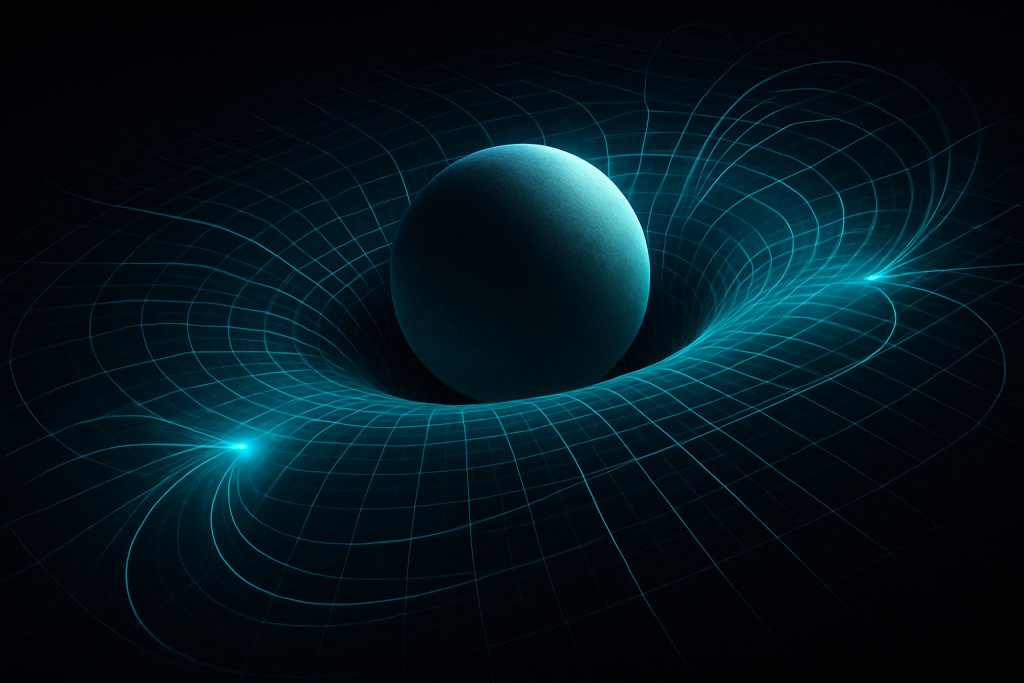
Image generated by AI
In 1915, Albert Einstein revolutionized our understanding of gravity by proposing that massive objects don’t simply pull on each other through an invisible force—instead, they warp the fabric of space and time itself. Yet more than a century later, physicists are still finding places where Einstein’s elegant theory doesn’t quite match what they observe in the universe. These discrepancies, called gravity anomalies, are some of the most tantalizing clues we have that our understanding of gravity remains incomplete.
From the puzzling orbits of distant galaxies to the subtle wobbles in spacecraft trajectories, gravity anomalies reveal cracks in our cosmic foundation. Today, as we build increasingly precise instruments and launch sophisticated satellites, these anomalies have become more than academic curiosities—they point toward potentially revolutionary physics that could reshape our understanding of dark matter, dark energy, and the very nature of reality itself.
What Is Gravity Anomalies and Tests of General Relativity?
A gravity anomaly is an observed difference between the strength of gravity predicted by Einstein’s general relativity and what physicists actually measure in the real world. Think of it like expecting your smartphone’s GPS to be accurate to within a few meters, then discovering it’s consistently off by hundreds of meters in certain locations. These discrepancies aren’t measurement errors or instrument failures—they’re reproducible observations that suggest something fundamental about our gravitational theories may be incomplete or incorrect.
General relativity, published by Einstein in 1915, has been tested thousands of times over the past century with extraordinary precision. From predicting the bending of starlight around the sun to explaining the orbital decay of binary pulsars, Einstein’s theory has passed nearly every test thrown at it. Yet in recent decades, as our measurement capabilities have improved exponentially, physicists have begun detecting small but significant deviations—anomalies that hint at physics beyond our current models.
The Basic Principle
To understand how gravity anomalies work, we first need to grasp what general relativity actually predicts. Einstein showed that gravity isn’t a force in the traditional sense. Instead, massive objects like planets and stars curve the spacetime around them, much like a heavy bowling ball creates an indentation in a trampoline. Other objects moving through space follow the curves created by these massive bodies, giving the appearance of being “attracted” to them. This simple geometric picture has proven extraordinarily successful at describing everything from planetary orbits to the collapse of stars into black holes.
When physicists measure gravity in real situations, they can calculate exactly what Einstein’s equations predict. A spacecraft orbiting Earth should follow a specific trajectory; the gravitational field around a massive galaxy should have a particular strength; the time experienced by an astronaut in space should tick forward at a slightly different rate than someone on Earth’s surface. When experiments show results that consistently deviate from these predictions, that’s a gravity anomaly. It’s as if the universe is quietly telling us that our mathematical map doesn’t perfectly match the actual territory.
Imagine you’re playing billiards, but the table is warped in places you can’t see. The physicist who designed the table (Einstein) calculated exactly how the balls should move across its surface. But when you actually play, the balls sometimes curve in ways the calculations didn’t predict. Some of the deviations might be small—a fraction of a millimeter per shot—but they’re consistent and reproducible. That’s essentially what’s happening with gravity anomalies. The “table” is spacetime, the “balls” are objects moving through space, and the anomalies are telling us that the table’s warping isn’t quite what we thought.
Why It Matters in the Real World
Gravity anomalies matter profoundly because they could point toward revolutionary new physics. Some of the most important mysteries in modern astronomy involve phenomena that general relativity alone cannot explain. Galaxies rotate far too quickly given the amount of visible matter they contain; the expansion of the universe is accelerating for reasons we don’t understand; and certain gravitational effects near massive objects behave unexpectedly. Each of these mysteries might be explained by modifications to gravity, and carefully studying gravity anomalies gives us crucial clues about what those modifications might be.
The practical implications are enormous and touch multiple scientific domains. GPS satellites, for instance, must account for relativistic effects—both from special and general relativity—to maintain accuracy. Any systematic deviations from general relativity could eventually cascade into navigation errors affecting everything from autonomous vehicles to global commerce. Gravitational wave detection, the revolutionary technology that won the 2017 Nobel Prize in Physics, relies on incredibly precise measurements of spacetime distortions. If gravity anomalies reveal that general relativity needs corrections, gravitational wave science would need to be fundamentally revised. Even quantum mechanics, humanity’s other foundational theory of physics, might need modification if gravity operates differently than we think.
Recent Breakthroughs in Gravity Anomalies and Tests of General Relativity
The past few years have witnessed several exciting developments in gravity anomaly research. In 2022 and 2023, multiple independent teams reported more precise measurements of how light bends around the sun, testing a core prediction of general relativity with unprecedented accuracy. Simultaneously, observations of supermassive black holes at the centers of galaxies—particularly through the groundbreaking Event Horizon Telescope images—have allowed physicists to test Einstein’s predictions in the most extreme gravitational environments known to exist. These observations consistently confirm general relativity’s predictions, yet subtle discrepancies in certain measurements suggest that refined versions of the theory might be needed.
Researchers are currently focusing on several frontier areas of investigation. Space-based gravitational wave detectors like the planned LISA (Laser Interferometer Space Antenna) mission promise to test general relativity in new regimes never before accessible to experiment. Meanwhile, studies of the orbits of pulsars, those rapidly spinning neutron stars that act like cosmic lighthouses, continue to reveal tiny deviations that might indicate physics beyond general relativity. The question isn’t whether gravity anomalies matter—it’s whether they represent fundamental new physics or are simply artifacts of our incomplete understanding of astrophysical systems.
Why Gravity Anomalies and Tests of General Relativity Matter for the Future
The resolution of gravity anomalies could fundamentally alter our understanding of the universe. If these anomalies point toward new physics, they might finally explain dark matter and dark energy, the mysterious components that comprise 95 percent of the universe but remain deeply puzzling to scientists. Alternatively, the anomalies might lead us to realize that general relativity needs modification only in certain extreme conditions, or that our astrophysical models of galaxy dynamics and stellar evolution are missing crucial pieces. Either way, successfully explaining gravity anomalies would represent one of the most significant breakthroughs in physics since Einstein himself.
The challenge ahead is substantial and multifaceted. We need ever more precise experiments to distinguish genuine anomalies from measurement artifacts or unconsidered astrophysical effects. We need new theoretical frameworks that can explain why general relativity is so successful in most contexts while failing in others. We need computational tools sophisticated enough to model complex astrophysical systems accurately while accounting for all known physics. These are extraordinarily difficult problems, but they’re precisely the kind of challenges that have historically driven scientific progress forward.
Key Takeaways
- Gravity anomalies are reproducible observations where gravity’s actual strength differs from what Einstein’s general relativity predicts, suggesting our understanding of gravity may be incomplete.
- General relativity describes gravity not as a force but as the curvature of spacetime caused by massive objects, a geometric framework that has been tested thousands of times with remarkable success.
- The most promising real-world applications of gravity anomaly research include explaining dark matter and dark energy, improving GPS and gravitational wave technology, and potentially discovering entirely new physical laws.
- Recent breakthroughs include increasingly precise measurements of light bending around the sun, direct observations of supermassive black holes, and plans for space-based gravitational wave detectors that will test Einstein’s theory in unprecedented ways.
- Successfully explaining gravity anomalies could revolutionize physics by revealing the nature of dark matter and dark energy, or by showing that general relativity needs modification in specific extreme conditions, fundamentally reshaping our cosmic understanding.
Explore TED Talks on Gravity Anomalies and Tests of General Relativity:
TED content is used under CC BY-NC-ND 4.0. © TED Conferences, LLC.
Frequently Asked Questions
What is the difference between what General Relativity predicts for gravity and what physicists actually measure in gravity anomalies?
A gravity anomaly occurs when measured gravitational effects differ from the predictions of Einstein's General Relativity equations, such as unexpected orbital motions of galaxies or deviations in spacecraft trajectories. These aren't random errors but reproducible, consistent observations that suggest General Relativity may be incomplete in certain conditions.
How do gravity anomalies observed in distant galaxies relate to dark matter and dark energy?
Unexplained gravitational effects in galaxy rotations and cosmic expansion rates have led physicists to hypothesize the existence of dark matter and dark energy to account for the missing gravity anomalies. These phenomena suggest that 95% of the universe's content may be invisible matter and energy not accounted for by Einstein's theory.
Why are modern satellites and precision instruments revealing gravity anomalies that weren't detected before?
Advanced technology allows physicists to measure gravitational effects with unprecedented accuracy, detecting subtle deviations from General Relativity's predictions that older instruments couldn't resolve. As measurement precision improves, even small discrepancies between theory and observation become measurable and reproducible.
Can gravity anomalies in spacecraft trajectories provide clues about physics beyond General Relativity?
Yes, unexplained wobbles and deviations in spacecraft paths, such as the Pioneer anomaly, represent direct tests of General Relativity in extreme conditions and may indicate new gravitational physics or modifications needed to Einstein's theory. These anomalies serve as empirical windows into physics that current relativistic models cannot fully explain.