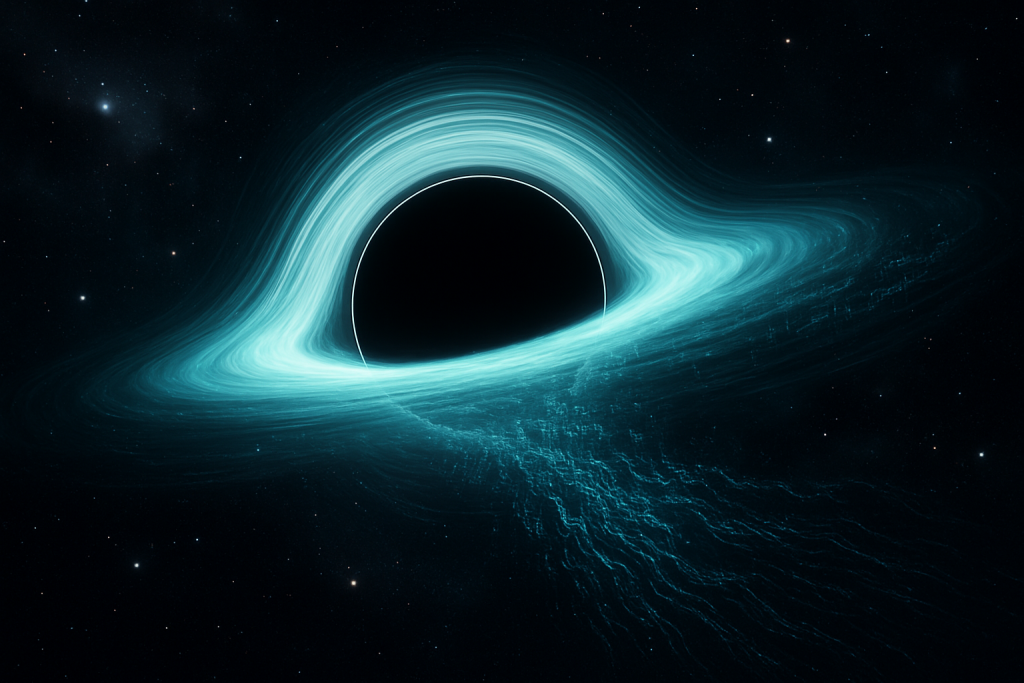
Image generated by AI
In 1974, physicist Stephen Hawking made a shocking discovery that fundamentally challenged our understanding of black holes: these cosmic vacuum cleaners, thought to be perfectly black and inescapable, actually emit radiation and slowly evaporate. Even more puzzling, this discovery created one of physics’ most stubborn paradoxes—if a black hole radiates away all its mass and disappears, what happens to all the information that fell into it? This question has haunted theoretical physics for nearly 50 years, forcing physicists to reconsider the very foundations of how information behaves in the universe.
Today, the black hole information paradox sits at the intersection of quantum mechanics and general relativity, two pillars of physics that usually refuse to play nicely together. Understanding this paradox isn’t merely an academic exercise; it could revolutionize our grasp of quantum mechanics, reshape how we think about the nature of reality itself, and even provide clues to unifying the fundamental forces of nature. Moreover, recent breakthroughs using quantum entanglement and holographic principles have brought us tantalizingly closer to resolving this ancient puzzle.
What Is Black Hole Information Paradox and Hawking Radiation?
Black hole information paradox refers to a fundamental contradiction that arises when we combine quantum mechanics with Einstein’s general relativity. When Hawking showed that black holes emit radiation and gradually evaporate, he inadvertently created a problem: quantum mechanics insists that information cannot be destroyed in the universe—it can only be scrambled or transformed—yet if a black hole completely evaporates, all the information about what fell into it seems to vanish irretrievably. This apparent violation of a cornerstone principle of quantum mechanics is the paradox. Hawking radiation, the mechanism that creates this problem, is the spontaneous emission of particles from a black hole’s event horizon caused by quantum effects occurring at the boundary between spacetime and nothingness.
Stephen Hawking unveiled this phenomenon in 1974 through a brilliant calculation that combined quantum field theory with curved spacetime. Working near Cambridge University, Hawking showed that virtual particle pairs—which constantly pop into and out of existence throughout the universe—can be separated at a black hole’s event horizon, with one particle falling into the black hole while the other escapes to infinity. From a distant observer’s perspective, this appears as radiation leaking out of the black hole. This discovery was revolutionary because it overturned the previous consensus that nothing could escape from beyond a black hole’s event horizon, yet it simultaneously created the information paradox that remains contested today.
The Basic Principle
To understand Hawking radiation and the information paradox, we must first grasp how quantum mechanics operates at the smallest scales. Quantum mechanics permits the temporary creation of particle-antiparticle pairs throughout empty space—these virtual particles appear, annihilate each other almost instantaneously, and leave no trace. However, at the event horizon of a black hole, the gravitational field is so intense that it can separate these virtual pairs before they can recombine. One particle gets sucked into the black hole while its partner escapes to infinity. To an outside observer, this appears as radiation emanating from the black hole itself, carrying away energy and causing the black hole to slowly shrink. As the black hole evaporates, it gets hotter and radiates faster in a runaway process, eventually disappearing in a cataclysmic explosion.
Consider a thought experiment with a bank vault. Normally, the vault is perfectly secure—nothing leaves once it enters. But imagine that the vault’s walls are slightly unstable at a quantum level. When a pair of identical twins—one with positive charge and one with negative charge—spontaneously materializes right at the vault’s entrance, the negative-charge twin might slip inside while the positive-charge twin bounces away outside. From a distance, an observer sees the positive-charge twin escaping and assumes the vault is leaking. Meanwhile, the negative-charge twin falling into the vault actually reduces the vault’s total charge. This mirrors how Hawking radiation works: the negative-energy particle falling into the black hole can be thought of as reducing the black hole’s mass-energy, while the positive-energy particle escapes as observable radiation.
Why It Matters in the Real World
While black holes themselves remain inaccessible to direct experimentation, the principles underlying Hawking radiation and the information paradox have profound implications for quantum computing, cryptography, and our fundamental theories of physics. Researchers studying how information behaves in extreme gravitational environments have developed mathematical frameworks that are now being applied to create more efficient quantum computers and robust quantum error correction systems. The question of whether information is truly destroyed or merely hidden drives research into the nature of quantum entanglement and the structure of spacetime itself. Understanding how information escapes from black holes could teach us about the deep symmetries underlying nature and even reveal new conservation laws.
Practical applications have already begun to emerge. Quantum information theorists working on black hole problems have developed techniques for quantum error correction that are crucial for building reliable quantum computers. Tech companies like IBM and Google are applying insights from the information paradox to protect quantum information from decoherence. Cryptography researchers are exploring how the study of quantum information in curved spacetime might lead to unbreakable encryption methods. Furthermore, astronomers have recently captured the first images of actual black hole shadows using the Event Horizon Telescope, providing the first direct visual evidence that could one day help test theoretical predictions about how information behaves near black hole event horizons.
Recent Breakthroughs in Black Hole Information Paradox and Hawking Radiation
In 2023 and 2024, the field experienced remarkable progress as physicists presented increasingly convincing evidence that information is not lost in black holes but rather encoded in subtle correlations within the Hawking radiation itself. Using sophisticated mathematical techniques from quantum entanglement theory, researchers demonstrated that the radiation emitted by evaporating black holes carries quantum information that is deeply entangled with the black hole’s interior. Juan Maldacena’s holographic principle—which suggests that a black hole can be mathematically equivalent to a quantum field theory without gravity on its boundary—has provided the most promising framework for understanding how information escapes. Recent work by physicists including Ahmed Almheiri and others has shown that the apparent “loss” of information might actually reflect our incomplete ability to decode the scrambled information in the radiation.
Current research focuses on several fronts. Theorists are working to understand the precise mechanism by which information becomes encoded in Hawking radiation, using sophisticated mathematical tools like tensor networks and quantum error correction codes. Experimentalists are designing table-top experiments using analog black holes—laboratory systems that mimic black hole behavior in controlled environments—where researchers can actually measure radiation analogous to Hawking radiation. The key open question remains: can we definitively prove that information is preserved, and if so, can we understand the exact mechanism well enough to extract information from real black hole radiation? These questions drive some of the most cutting-edge research in theoretical physics today.
Why Black Hole Information Paradox and Hawking Radiation Matters for the Future
Resolving the information paradox is essential for achieving a complete quantum theory of gravity—the holy grail of theoretical physics that would unify quantum mechanics with Einstein’s general relativity. The paradox highlights a fundamental incompleteness in our current theories: either quantum mechanics must be modified to allow information destruction, or general relativity must be fundamentally altered, or both theories must emerge from a deeper framework we haven’t yet discovered. Success in this area could revolutionize physics as profoundly as Newton’s laws were transformed by Einstein’s relativity, revealing new symmetries and principles governing reality at all scales. Moreover, understanding quantum information in curved spacetime may provide insights into the very origin of the universe and the nature of the Big Bang.
However, formidable challenges remain. Black holes are extraordinarily difficult to study experimentally, and the quantum gravity effects relevant to the information paradox occur only under extreme conditions that we cannot yet recreate in laboratories. The mathematics required to solve the paradox completely may require developing entirely new mathematical frameworks that we haven’t yet invented. Additionally, resolving the paradox might force us to abandon some cherished assumptions about the nature of spacetime, causality, or quantum mechanics itself—a prospect that makes many physicists simultaneously excited and uneasy.
Key Takeaways
- Hawking radiation allows black holes to slowly evaporate by emitting particles from the quantum fluctuations at the event horizon, a process discovered by Stephen Hawking in 1974.
- The information paradox asks whether information falling into a black hole is truly lost forever when the black hole evaporates, seemingly violating a fundamental principle of quantum mechanics that information cannot be destroyed.
- The most promising approach to resolving the paradox involves recognizing that information is preserved but becomes encoded in complex quantum entanglement patterns within the Hawking radiation itself.
- Recent breakthroughs using holographic principles and quantum entanglement theory have provided strong theoretical evidence that information is not lost, though the exact mechanism remains incompletely understood.
- Insights from studying black hole information may revolutionize quantum computing, cryptography, and our understanding of quantum gravity, potentially leading to a unified theory of all fundamental forces.
Explore TED Talks on Black Hole Information Paradox and Hawking Radiation:
TED content is used under CC BY-NC-ND 4.0. © TED Conferences, LLC.
Frequently Asked Questions
How does Hawking radiation cause black holes to evaporate?
Hawking radiation arises from quantum fluctuations near the event horizon, where virtual particle-antiparticle pairs are created and one particle escapes while the other falls into the black hole, carrying away energy and causing the black hole to lose mass over time. This process continues until the black hole eventually evaporates completely.
What is the fundamental contradiction at the heart of the black hole information paradox?
The paradox occurs because quantum mechanics requires information to be conserved and never destroyed, yet general relativity predicts that when a black hole evaporates via Hawking radiation, all information about matter that fell into it appears to be irretrievably lost. This violates a core principle of quantum mechanics called unitarity.
Why is reconciling the information paradox important for physics?
Resolving the paradox requires bridging quantum mechanics and general relativity, two fundamental theories that currently conflict at the scale of black holes, which could lead to a deeper understanding of quantum gravity and the nature of information in the universe. Success could also provide insights into unifying the fundamental forces of nature.
How do holographic principles and quantum entanglement help address the information paradox?
The holographic principle suggests that information about a black hole's interior may be encoded on its event horizon surface, while quantum entanglement research indicates that information might not be lost but rather scrambled in subtle correlations within Hawking radiation. Together, these approaches suggest pathways for information conservation even as black holes evaporate.