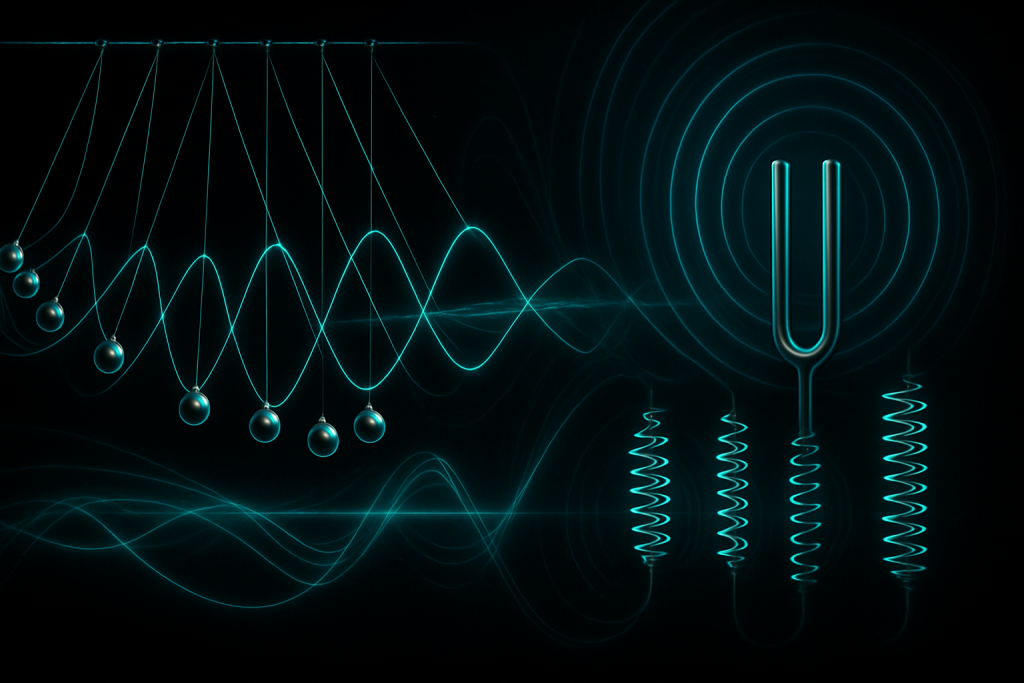
Image generated by AI
Imagine a singer hitting a note so perfectly pitched that a crystal glass shatters across the room. Or picture a suspension bridge swaying dangerously in the wind, threatening to collapse under invisible forces. These dramatic moments reveal one of physics’ most elegant and powerful phenomena: resonance. Yet resonance isn’t just the stuff of dramatic demonstrations—it’s the hidden rhythm underlying everything from the atoms in your body to the songs you hear, the bridges you cross, and the wireless signals that connect your phone to the world.
Understanding resonance and oscillatory systems is more than academic curiosity. As our technology grows more sophisticated and our infrastructure more complex, resonance shapes everything from how we build safer buildings to how we develop new medical treatments and quantum computers. Scientists and engineers who master these principles can harness nature’s rhythms to do remarkable things—and avoid catastrophic failures that come from ignoring them.
What Is Resonance and Oscillatory Systems?
At its core, a resonance occurs when an oscillating system is driven at its natural frequency—the rate at which it “wants” to vibrate on its own. An oscillatory system is any object or phenomenon that moves back and forth in a repeating pattern: a pendulum swinging, a drum head vibrating, a spring bouncing, or even electrons orbiting atoms. Every such system has a special frequency at which it naturally oscillates, called its resonant frequency. When an external force pushes the system at exactly this frequency, something remarkable happens: the system absorbs energy most efficiently, and the amplitude of oscillation grows dramatically, sometimes catastrophically.
The discovery of resonance emerged gradually across centuries of observation and experimentation. Galileo noticed in the 1580s that pendulums of different lengths oscillated at different rates, yet he also observed that a single pendulum tends to swing with a consistent period regardless of how hard you push it. The formalization of resonance theory came much later, through the work of physicists like Christiaan Huygens in the 1600s, who studied coupled oscillators, and more rigorously through 19th-century physicists including James Clerk Maxwell and Lord Rayleigh, who provided the mathematical frameworks still used today. By the time of the Tacoma Narrows Bridge collapse in 1940—a spectacular failure caused by wind-driven resonance—the physics community fully understood the principle, even if engineers hadn’t always applied the knowledge carefully enough.
The Basic Principle
To understand how resonance works, we need to think about energy flow. When you push a swing, you don’t get maximum effect by pushing randomly. You get the biggest results by pushing at just the right moment in the swing’s cycle—at the resonant frequency. This happens because your push aligns with the swing’s natural motion, adding energy smoothly rather than fighting against it. The swing doesn’t care how hard you push; it cares about when you push. At the resonant frequency, each small push adds to the previous ones, and the amplitude grows exponentially until damping forces (like friction and air resistance) balance the input energy.
Consider a child on a playground swing as a concrete example. The swing has a natural frequency determined by its length and the gravitational field—this is its resonant frequency. If you push once per complete back-and-forth cycle, your pushes align perfectly with the swing’s motion, and it rises higher with each cycle. But if you push out of sync, sometimes fighting the swing’s motion, you waste effort and the swing barely moves. The same principle applies everywhere in nature: guitar strings resonate at specific frequencies determined by their length, tension, and material; wine glasses vibrate at frequencies determined by their shape and size; and buildings oscillate at frequencies determined by their structure and materials. Every physical system has preferred frequencies at which it oscillates most readily.
Why It Matters in the Real World
Resonance is far more than a physics textbook curiosity—it shapes the design of nearly every engineered system we interact with daily. Engineers must calculate and often deliberately avoid or suppress unwanted resonances that could destroy bridges, buildings, and machines. Conversely, they harness resonance intentionally to make technologies work: in radios, which use resonant circuits to isolate specific frequencies; in medical imaging devices like magnetic resonance imaging (MRI), which exploits nuclear resonance to create detailed internal images; and in countless sensing and measurement applications. The economic consequences of ignoring resonance are staggering—structural failures can cost billions and claim lives—while harnessing resonance efficiently can save energy, improve performance, and enable entirely new technologies.
Modern applications span industries and disciplines. In mechanical engineering, vibration isolation systems use resonance principles to protect sensitive equipment from shaking. In telecommunications, resonant circuits form the backbone of radio transmitters and receivers. In medicine, MRI machines apply magnetic resonance to map the human body’s internal structure with remarkable precision, making them indispensable for diagnosing everything from brain tumors to torn ligaments. In quantum computing, researchers manipulate the resonant frequencies of quantum systems to perform calculations. In materials science, scientists study resonance in crystals to understand material properties. Even in music and acoustics, resonance explains why a violin’s body amplifies certain frequencies while dampening others, or how concert halls are designed to enhance sound quality through careful control of resonant modes.
Recent Breakthroughs in Resonance and Oscillatory Systems
Recent years have seen remarkable advances in how scientists manipulate and exploit resonance at scales from the atomic to the architectural. In 2023 and 2024, researchers have made significant progress in metamaterials—engineered materials designed with specific resonant properties that don’t exist in nature. Teams at institutions like MIT and ETH Zurich have developed metamaterials that can hide objects from sound waves or redirect vibrations in ways that violate intuition, all based on precisely engineering resonant frequencies into the material’s structure. Meanwhile, advances in quantum resonance have enabled new approaches to quantum sensing and quantum computing, where controlling the resonance of quantum states has become increasingly sophisticated, allowing researchers to perform measurements at limits approaching what quantum mechanics permits.
Current research frontiers include nonlinear resonance phenomena, where the behavior becomes dramatically more complex and interesting than simple linear models predict. Scientists are studying how multiple resonant modes interact with each other, what happens when resonance systems are driven far from equilibrium, and how chaos emerges from certain resonant systems. Another active area involves topological resonance, which combines ideas from topology (the study of properties preserved under continuous deformation) with resonance theory, potentially enabling new kinds of devices resistant to defects and disorder. Open questions remain about controlling resonance in biological systems, understanding resonance in complex networks, and engineering new materials with exotic resonant properties that could transform energy harvesting, sensing, and computing technologies.
Why Resonance and Oscillatory Systems Matters for the Future
As we face challenges from climate change to pandemic preparedness to energy efficiency, resonance physics becomes increasingly important. Resonance-based energy harvesting—capturing vibrational energy from bridges, buildings, or machinery and converting it to electricity—could help reduce energy consumption. Improved understanding of resonance in atmospheric and oceanic systems could enhance climate modeling and prediction. More sophisticated control of resonance could lead to more efficient power transmission, better earthquake-resistant buildings, and new medical treatments based on precisely tuned resonant frequencies. In quantum technologies, resonance control is absolutely central to developing quantum computers, quantum sensors, and quantum communication networks that could revolutionize computation, measurement, and information technology.
Yet significant challenges remain. One fundamental limitation is damping—the unavoidable loss of energy in any real system—which limits how sharply we can tune resonance and how high amplitudes can grow. Nonlinear effects become important at large amplitudes, making systems harder to predict and control. Complex coupled systems with many degrees of freedom can exhibit chaotic behavior that defies simple analysis. Engineering structures to avoid dangerous resonances while remaining economical requires balancing competing demands. And harnessing resonance in biological systems remains poorly understood, partly because biological systems are so complex and so much more nonlinear than the simple oscillators physicists traditionally study.
Key Takeaways
- Resonance occurs when an oscillating system is driven at its natural frequency, causing dramatic increases in amplitude through energy accumulation.
- Every physical system has preferred oscillation frequencies determined by its structure and properties—pushing at these frequencies produces maximum effect with minimum effort.
- Understanding resonance is critical for engineering safe buildings and bridges, designing electronics, and developing medical technologies like MRI machines.
- Recent breakthroughs in metamaterials, quantum resonance, and nonlinear dynamics are opening new possibilities for controlling and exploiting resonance in unprecedented ways.
- Future applications in energy harvesting, quantum computing, and climate modeling will increasingly depend on sophisticated understanding and control of resonant systems across multiple scales.
Explore TED Talks on Resonance and Oscillatory Systems:
TED content is used under CC BY-NC-ND 4.0. © TED Conferences, LLC.
Frequently Asked Questions
What is the natural frequency of an oscillatory system and why does it matter?
The natural frequency is the rate at which a system vibrates on its own without external driving forces, determined by its physical properties like mass and stiffness. When an external force drives the system at this frequency, resonance occurs and the amplitude of oscillation dramatically increases.
How does resonance cause a crystal glass to shatter when exposed to sound waves?
When sound waves match the glass's natural frequency, resonance causes the glass to vibrate with increasingly large amplitudes until the mechanical stress exceeds the material's strength and it fractures. The energy transfer from the sound waves to the glass is maximized at resonant frequency.
Why do suspension bridges risk collapse from wind-induced oscillations rather than from the weight of traffic?
Wind creates periodic vortices that can drive the bridge at or near its natural frequency, causing resonance with dangerously amplified vibrations that static loads cannot produce. Once resonance begins, even moderate wind can generate destructive amplitudes that exceed the bridge's structural limits.
Can resonance be controlled or dampened in engineering applications?
Yes, engineers use damping mechanisms like shock absorbers, tuned mass dampers, and flexible materials to dissipate oscillatory energy and shift natural frequencies away from likely driving frequencies. Adding damping reduces the amplitude at resonance and broadens the frequency range over which large vibrations occur.