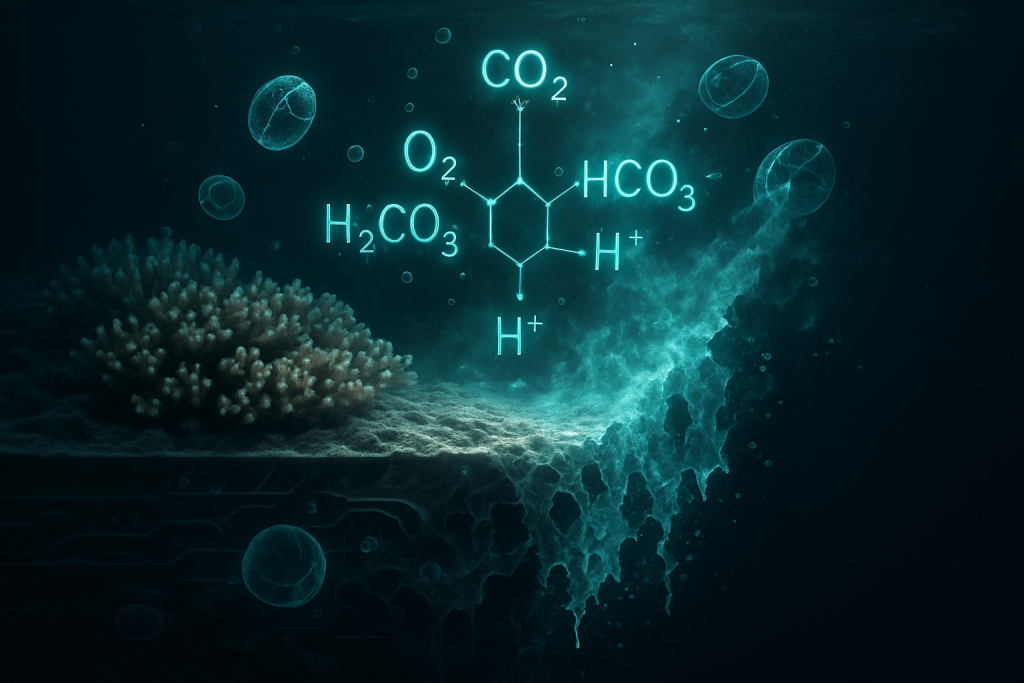
Image generated by AI
The ocean is becoming a chemistry experiment gone wrong—and we are all participants. Since the Industrial Revolution, the pH of seawater has dropped by 0.1 units, a seemingly small shift that represents a 30 percent increase in acidity. This transformation is rewriting the rules of marine biology, disrupting the physics of ocean circulation, and forcing physicists, chemists, biologists, and climate scientists to collaborate in unprecedented ways to understand what’s happening beneath the waves.
Ocean acidification represents one of the most compelling examples of how modern environmental challenges demand expertise from across the scientific spectrum. No single discipline can explain why pteropod shells dissolve in acidified water, how this affects ocean food webs, or what feedback loops might amplify climate change. Understanding ocean acidification requires us to weave together atmospheric chemistry, marine biology, geochemistry, physics, and systems science into a coherent narrative—one that reveals how interconnected our planet truly is.
What Is Climate & Environmental Science?
Climate and environmental science is fundamentally the study of how Earth’s physical, chemical, and biological systems interact to regulate temperature, weather patterns, and the chemical composition of our atmosphere and oceans. It examines the intricate feedback loops between the sun’s energy input, atmospheric gases, ocean currents, ice sheets, and living organisms. Rather than a single discipline, climate and environmental science is inherently interdisciplinary, requiring insights from atmospheric physics, oceanography, geology, ecology, and even solar astronomy. The field operates on the principle that Earth’s climate emerges from countless interactions across systems that appear, at first glance, completely separate.
The modern study of climate science began in earnest during the 19th century when scientists like Jean-Baptiste Fourier (1824) and Svante Arrhenius (1896) first proposed that carbon dioxide could trap heat and warm the planet. However, it wasn’t until the 1950s and 1960s, as ice cores and atmospheric measurements became more sophisticated, that researchers like Charles Keeling began documenting the relentless rise in atmospheric CO₂. The field truly crystallized into an urgent global concern in 1988 with the establishment of the Intergovernmental Panel on Climate Change (IPCC), which formalized the need for climate science to speak with an integrated voice across disciplines.
Across the Sciences
Ocean acidification emerges from a deceptively simple chain of chemical reactions that connects the atmosphere to the deep ocean. When fossil fuels burn, they release carbon dioxide into the air. A fraction of this CO₂ dissolves into seawater, forming carbonic acid and lowering the pH. But this is only the beginning: the change in acidity disrupts the marine carbonate system—the delicate balance between carbonate ions, bicarbonate, and dissolved CO₂ that determines whether shells and skeletons can form. A biologist studying pteropod shells, a chemist measuring pH gradients, an oceanographer tracking current patterns, and a physicist modeling atmospheric circulation are all studying the same phenomenon from different angles, and their insights only become powerful when integrated.
Think of ocean acidification as a domino cascade that starts in the atmosphere and ends in the shells of tiny marine creatures. The initial domino is an increase in atmospheric CO₂. This triggers the second domino: more CO₂ dissolves into the surface ocean, making it more acidic. The third domino falls when marine organisms with calcium carbonate shells—pteropods, corals, some planktonic foraminifera—struggle to build or maintain their skeletons in water chemistry that has shifted away from the optimal conditions their evolution prepared them for. But here’s where the interdisciplinary nature becomes crucial: the cascade doesn’t stop at the shell level. Biologists discover that these creatures are foundational to food webs, so their decline threatens fish populations that depend on them. Oceanographers realize that changing marine communities alter how carbon cycles through the ocean. Geochemists must explain how the carbonate system responds to various CO₂ levels. Climate modelers must incorporate all of this into predictions about future ocean states.
Why This Matters for the Future
Ocean acidification is projected to intensify dramatically this century, with some regions experiencing a 150 percent increase in acidity by 2100 under high-emission scenarios. This has profound implications for fisheries, food security, and coastal economies that depend on marine resources. Research teams are now combining laboratory experiments (chemistry and biology), field observations (oceanography), and computational modeling (physics and applied mathematics) to predict how specific marine ecosystems will respond. The work has already revealed that the impacts are not uniform: cold waters near the poles acidify faster than tropical waters, and some regions will experience combined stresses from warming and acidification that exceed the tolerance limits of key species.
Real-world applications of this interdisciplinary research span from aquaculture management to policy design. Oyster hatcheries along the Pacific coast have already had to adapt their operations after acidified upwelling water caused mass larval die-offs—a crisis that forced marine biologists to work with chemists to understand water chemistry and with engineers to develop better monitoring systems. Insurance companies and investment firms are now factoring ocean acidification into risk assessments for coastal properties and fishing industries. Governments from New Zealand to the European Union are funding research initiatives that explicitly bring together oceanographers, molecular biologists, economists, and policy experts to design adaptation strategies.
Recent Breakthroughs in Climate & Environmental Science
Between 2022 and 2024, several major advances have refined our understanding of how acidification spreads through ocean ecosystems. A landmark study using paleontological data revealed that the current rate of ocean acidification is occurring 10 times faster than during past natural acidification events 56 million years ago, suggesting that organisms today may lack evolutionary buffers against such rapid change. Simultaneously, marine biologists discovered that some organisms possess unexpected physiological mechanisms for coping with acidification—certain fish can regulate pH in their blood, and some algae species thrive in acidified conditions—suggesting that adaptation may be possible, though not universal. Advanced isotope geochemistry has also clarified how acidification affects trace metal cycling, which influences nutrient availability and thus productivity throughout the ocean food web.
Current research frontiers remain remarkably open and interdisciplinary. Can genomic analyses identify which populations possess genes conferring resistance to acidification, and over what timescale could natural selection work? How do acidification, warming, and deoxygenation—three simultaneous ocean stressors—interact synergistically? Are there tipping points in marine ecosystems where small changes in pH trigger abrupt reorganizations of entire food webs? And crucially, how can this science inform engineering solutions, from geoengineering proposals to carbon removal technologies? Each of these questions demands expertise from multiple fields working in genuine collaboration rather than parallel isolation.
Why Climate & Environmental Science Matters for the Future
The urgency of climate and environmental science extends far beyond academic interest. Ocean acidification serves as a canary in the coal mine for planetary health—it simultaneously reveals disruptions in atmospheric chemistry, ocean physics, and biological systems. As the world grapples with climate change, biodiversity loss, and resource scarcity, the integrated perspective of environmental science becomes essential for crafting solutions. A farmer designing drought-resistant crops needs insights from agronomy, genetics, and climate modeling. An engineer building a carbon capture facility must understand thermodynamics, materials science, and the geochemistry of sequestration. A policymaker designing fisheries regulations needs to synthesize biological data, economic models, and oceanographic projections. Climate and environmental science is not a specialized niche—it is increasingly the central language through which humanity must understand and navigate our relationship with the planet.
Yet formidable challenges remain. Integrating knowledge across disciplines requires not just interdisciplinary teams but also new frameworks for how we communicate and validate findings across fields. A chemical measurement of seawater pH, a biological observation of coral bleaching, and a computational climate model projection must somehow speak the same language. Furthermore, the timescales of environmental change—from seasonal phytoplankton blooms to millennial changes in ice sheets—create modeling challenges that demand unprecedented computational power and novel mathematical frameworks. Political and economic systems have not kept pace with scientific understanding, creating a chasm between what we know and what we do.
Key Takeaways
- Ocean acidification exemplifies how modern environmental challenges require seamless collaboration across chemistry, biology, physics, oceanography, and climate science to be fully understood.
- The mechanism begins with atmospheric CO₂ dissolving into seawater, triggering a cascade of chemical changes that disrupt marine calcification and propagate through entire food webs and biogeochemical cycles.
- The most promising real-world applications include adaptive management of aquaculture, development of carbon removal technologies, and ecosystem-based conservation strategies informed by integrated science.
- Recent research has revealed both alarming acceleration in acidification rates and unexpected adaptive capacities in some organisms, opening new research frontiers in evolutionary and molecular biology.
- As climate and environmental challenges intensify, the integrated perspective of environmental science becomes essential for crafting technological, economic, and policy solutions that work across scales and systems.
Explore TED Talks on Climate & Environmental Science:
TED content is used under CC BY-NC-ND 4.0. © TED Conferences, LLC.
Frequently Asked Questions
How does a 0.1 unit drop in ocean pH result in a 30 percent increase in acidity?
pH is a logarithmic scale, meaning each 0.1 unit decrease represents a tenfold increase in hydrogen ion concentration; multiple 0.1 unit drops compound to produce the observed 30 percent overall increase in acidity. This nonlinear relationship means small pH changes correspond to large chemical changes in seawater.
Why do pteropod shells dissolve in acidified ocean water?
Pteropods have shells made of aragonite, a form of calcium carbonate that becomes chemically unstable in more acidic conditions where carbonate ions are depleted. The acidified seawater actively dissolves these shells by shifting the carbonate equilibrium toward dissolved carbon dioxide rather than solid shell material.
What feedback loops could amplify climate change through ocean acidification?
As oceans acidify, phytoplankton and other calcifying organisms produce less of the calcium carbonate shells and skeletons that normally help sequester carbon in deep ocean sediments, reducing the ocean's carbon storage capacity. Additionally, reduced marine productivity from acidification stress decreases oxygen production, potentially weakening the ocean's ability to absorb atmospheric CO₂.
How do physics, chemistry, and biology each contribute to understanding ocean acidification?
Chemistry explains the carbonate chemistry reactions driving pH changes; biology reveals how organisms are harmed and how this disrupts food webs; and physics describes ocean circulation patterns that distribute acidified water globally. Together, these disciplines show how a chemical change propagates through biological systems across the entire ocean.