AI Insight
Stream networks continuously expand and contract in response to changing water flow, a process called "breathing" that significantly affects nutrient transport and greenhouse gas emissions. Rathore et al. demonstrate that traditional empirical power law models have limitations in predicting this behavior and propose a new "asynchronous peak scaling approach" that works across watersheds of all sizes. The researchers validated their findings using physics-based simulations combined with high-resolution observational data, providing mechanistic explanations for stream network dynamics.
Why it matters
Understanding how stream lengths change with water flow is essential for predicting nutrient pollution transport through watersheds and estimating greenhouse gas emissions from freshwater systems. The new universal scaling framework enables more accurate predictions across different watershed sizes, improving water quality management and climate impact assessments.
Editors’ Highlights are summaries of recent papers by AGU’s journal editors.
Source: Water Resources Research
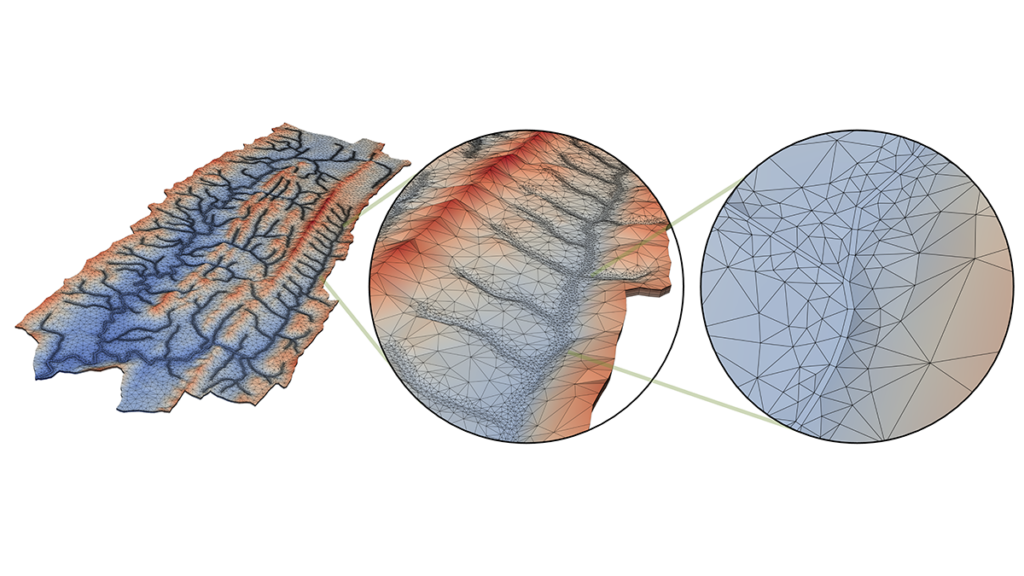
Stream networks are highly dynamic, constantly breathing by contraction and expansion, resulting in changing stream lengths. This is highly relevant for nutrient transport and greenhouse gas emissions. The interconnection of stream discharge and stream length, also termed elasticity, has been determined by measurements in small catchments experimentally and extrapolated by applying empirical power law models.
Rathore et al. [2026] demonstrate the limits of these laws using integrating modeling and a unique observational dataset. They also propose a novel asynchronous peak scaling approach which appears to be universal and provides a robust framework across scales from small to large watersheds. More importantly, the authors are able to mechanistically explain their findings from the physics-based simulations, which is highly satisfactory and lends confidence in the results.
Citation: Rathore, S. S., Gomez‐Velez, J. D., Herndon, E. M., & Painter, S. L. (2026). Hysteretic dynamics of stream network expansion and contraction revealed through high‐resolution integrated hydrological modeling. Water Resources Research, 62, e2025WR042993. https://doi.org/10.1029/2025WR042993
—Stefan Kollet, Editor, Water Resources Research
Text © 2026. The authors. CC BY-NC-ND 3.0
Except where otherwise noted, images are subject to copyright. Any reuse without express permission from the copyright owner is prohibited.
Source: How Streams Breathe: The Science of Expanding and Contracting