AI Insight
NASA's Hubble Space Telescope captured an image of LH 95, a stellar nursery located in the Large Magellanic Cloud, a dwarf galaxy orbiting the Milky Way. The region shows blue and white stars shining against a crimson background of glowing gas and dust that is heated and illuminated by young stars. LH 95 is a stellar association containing both low-mass infant stars and massive blue giant stars.
Why it matters
This observation helps astronomers study star formation processes and the evolution of stellar populations in environments different from our own galaxy. Understanding stellar nurseries in nearby dwarf galaxies provides insights into how stars of varying masses form and develop together in associations.
Understand the Science
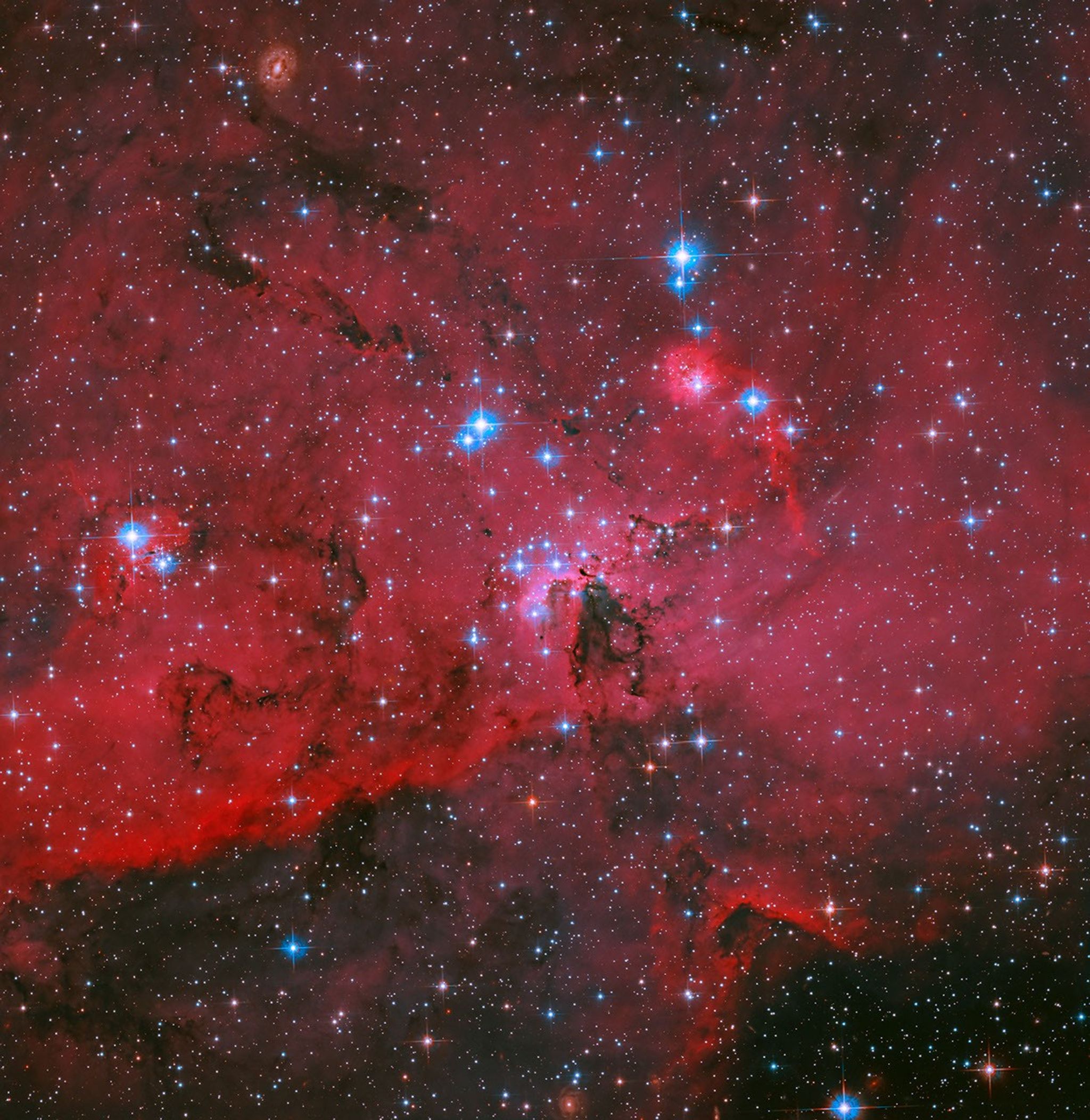
Blue and white stars shine brilliantly against a crimson background of glowing gas in this July 3, 2026, image of stellar nursery LH 95 from NASA’s Hubble Space Telescope. LH 95 is a region in the Large Magellanic Cloud, a dwarf galaxy that orbits the Milky Way. Low-mass infant stars live alongside massive blue giant stars in what is known as a stellar association, one of many in the Large Magellanic Cloud.
Image credit: NASA, ESA, and N. Da Rio (The University of Virginia), G. De Marchi (European Space Agency – ESTEC), and D. Gouliermis (Universitat Heidelberg); Processing: Gladys Kober (NASA/Catholic University of America)