AI Insight
NASA's Hubble Space Telescope captured an image of spiral galaxy NGC 4698, revealing an unusual structural configuration where spiral arms are prominent only in the outer regions of the galactic disk rather than extending to the center. Unlike typical spiral galaxies where arms wind down to the core, NGC 4698's spiral arms form a ring-like structure around the galaxy's perimeter while avoiding the central region. The galaxy contains the characteristic features of spiral galaxies including dust lanes and young blue star clusters within its arms.
Why it matters
This unusual spiral arm configuration challenges standard models of spiral galaxy formation and evolution, providing astronomers with insights into the diverse structural possibilities of galactic systems. Studying such anomalous structures helps refine our understanding of the gravitational and rotational dynamics that shape galaxy morphology.
Understand the Science
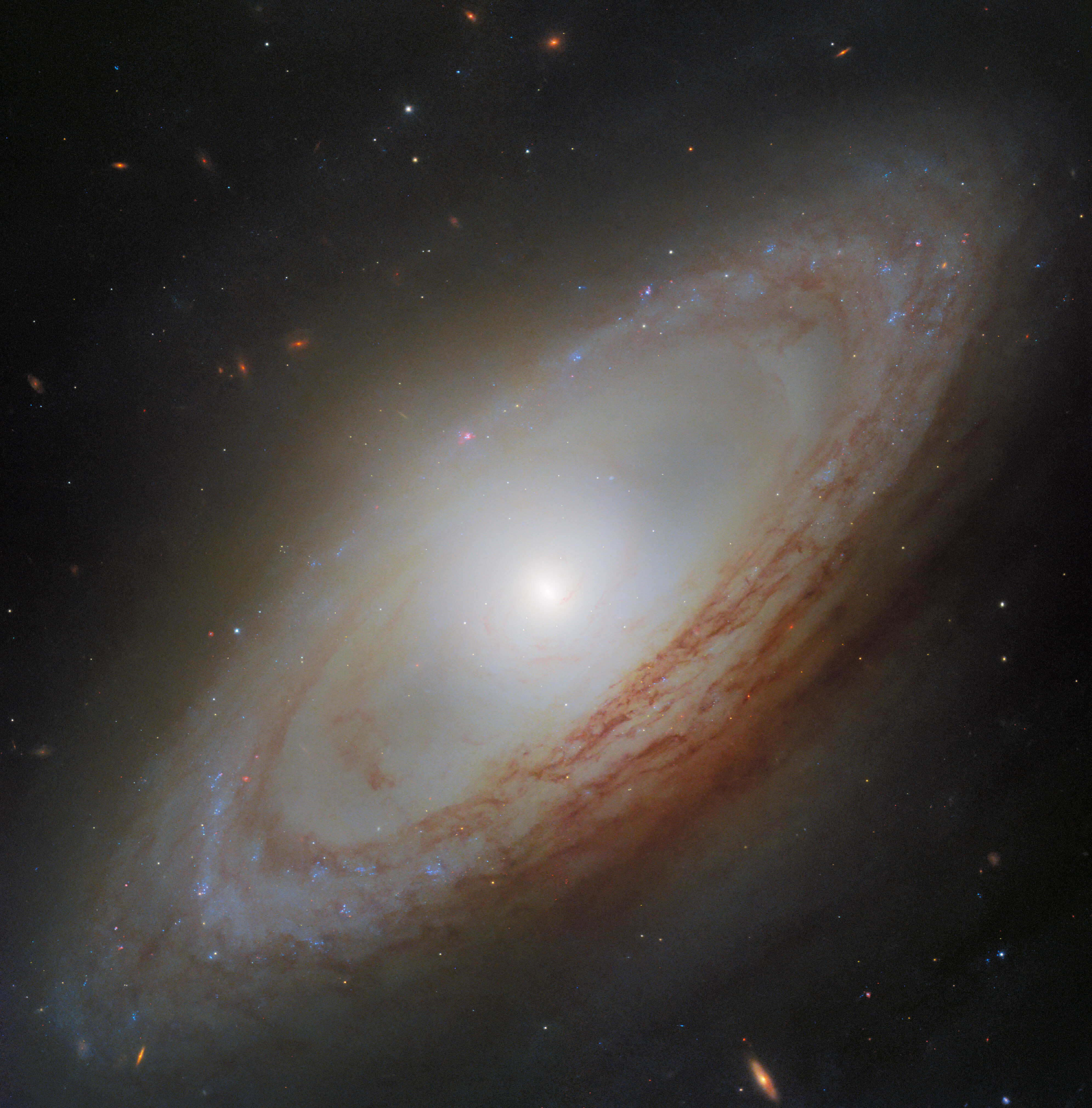
A chaotic secret hides within this seemingly serene image of spiral galaxy NGC 4698 taken by NASA’s Hubble Space Telescope and released on Sept. 18, 2026. As a spiral galaxy like our own Milky Way galaxy, NGC 4698 has spiral arms that curl around within a thin disk of stars, gas, and dust. These arms are marked by opaque clumps of brown dust and dotted with small collections of bright blue stars.
Unlike many other spiral galaxies, NGC 4698’s delicate spiral arms are only prominent in the outer reaches of the disk; spiral arms often wind down to the very center of a galaxy, but NGC 4698’s spiral arms appear to shy away from its glowing center. The arms instead hover in a ring-like structure around the perimeter of the galaxy.
Read more about this unusual spiral galaxy.
Text credit: ESA/Hubble
Image credit: ESA/Hubble & NASA, D. Thilker, the MAUVE-HST Team