AI Insight
Researchers reanalyzed seismic data from NASA's Viking 2 Mars lander (1976) and compared it to recent measurements from the InSight lander (2018-2022). They determined that one of Viking 2's two ambiguous seismic events was likely a genuine marsquake originating from the same region where InSight detected nearly 1,000 marsquakes decades later. This suggests the region has remained seismically active for at least 50 years, validating decades-old data that was previously considered inconclusive due to wind noise interference.
Why it matters
This finding confirms that certain regions of Mars have sustained seismic activity over long timescales, providing crucial information about the planet's internal structure and ongoing geological processes. Understanding Mars's seismic behavior helps reconstruct its geological history and assess past habitability conditions.
Understand the Science
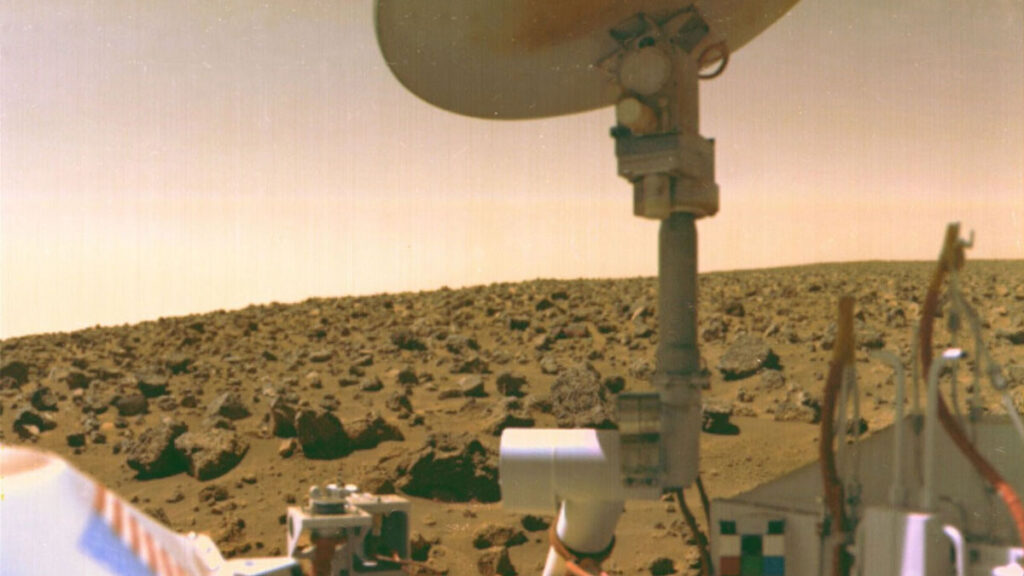
Source: AGU Advances
Earthquakes and the seismic waves they generate provide some of the best clues to Earth’s interior. To extend that success to other worlds, scientists placed seismometers on the Apollo missions to the Moon and on the Viking Mars landers, which reached Mars in 1976. Though the Apollo detectors proved a resounding success, Viking’s results on Mars were less clear: Viking 1’s seismometer failed to deploy properly, and Viking 2 recorded only two ambiguous events.
Xiao et al. reassessed these events and compared them to data collected by NASA’s InSight (Interior Exploration using Seismic Investigations, Geodesy and Heat Transport) lander, which operated on the surface of Mars between 2018 and 2022. The authors showed that one Viking 2 event could have been a real marsquake, originating from the same region where InSight recorded nearly 1,000 marsquakes decades later.
Viking was primarily a mission to search for life on Mars, but that question was closely tied to the planet’s geological evolution. Seismology could reveal Mars’s internal structure and tectonic activity, helping scientists reconstruct the history that shaped its habitability.
However, Viking 2’s seismometer was mounted on the lander’s deck, so it picked up a lot of wind noise. It remains uncertain whether either of the two ambiguous events it reported was a true marsquake or simply wind-related noise.
InSight’s seismometer, placed directly on the ground, later detected more than 1,300 seismic events. The new study suggests that one Viking event could, indeed, have been a marsquake from the same region where InSight later recorded a swarm of nearly 1,000 marsquakes—suggesting that the region was seismically active both in the Viking era and nearly 50 years later. (AGU Advances, https://doi.org/10.1029/2026AV002319, 2026)
—Matthew R. Francis (@BowlerHatScience.org), Science Writer