AI Insight
Three commonly used soil biogeochemistry models developed primarily from North Temperate region data fail to accurately predict soil organic carbon stocks in Sub-Saharan Africa, even when calibrated with local observations. The poor performance is attributed to fundamental gaps in model structure, specifically overemphasis on net primary productivity and inadequate representation of organo-mineral interactions and exchangeable calcium as controls on soil organic carbon. This suggests that current models miss key processes governing carbon storage in tropical and subtropical soils.
Why it matters
Soil organic carbon represents one of the largest carbon stocks in the biosphere, making accurate prediction of current budgets and future changes critical for climate change mitigation strategies. The findings reveal that scientific tools used for global carbon cycle predictions may be fundamentally inadequate for understudied tropical and subtropical regions, potentially leading to substantial errors in climate projections and carbon sequestration strategies for large portions of the globe.
Understand the Science
Editors’ Highlights are summaries of recent papers by AGU’s journal editors.
Source: Journal of Geophysical Research: Biogeosciences
The landscape takes up carbon (C) from the atmosphere and stores it in soils, mitigating atmospheric greenhouse gas concentrations and the impacts of climate change. Soil biogeochemistry models are the most widely used tools for predicting soil organic carbon (SOC) stocks, particularly in understudied regions that lack comprehensive observations. However, these models were developed based on the dominant processes controlling SOC in North Temperate systems and informed by their data.
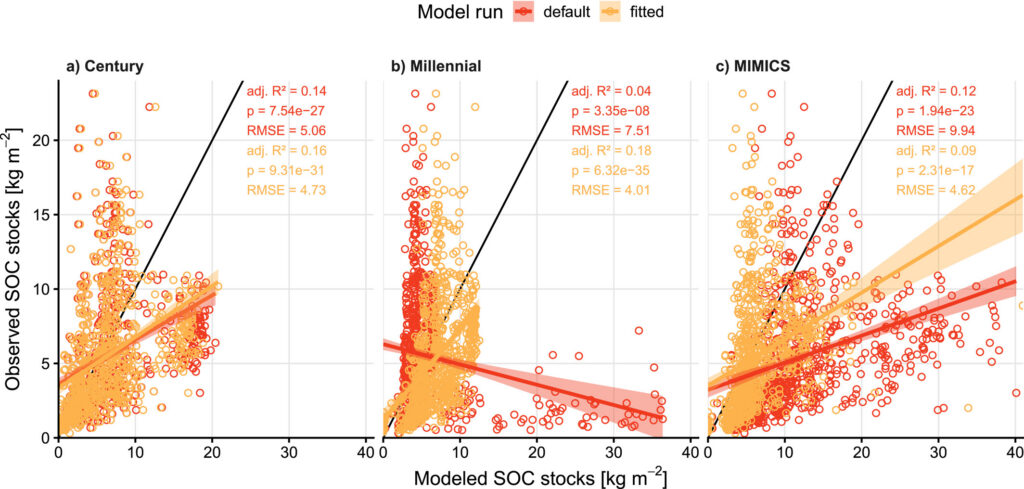
von Fromm et al. [2026] test model “transferability” (i.e., the ability to apply the model across sites or regions) to Sub-Saharan Africa, evaluating how three commonly used soil biogeochemistry models predict SOC compare to observations. The authors find that the three models perform poorly even when parameterized with local observations, suggesting that model structure is missing important processes. Upon further evaluation, the authors attribute poor model performance to an overemphasis on net primary productivity and inadequate representation of organo-mineral interactions and exchangeable calcium as controls on SOC.
While this paper’s subject is Sub-Saharan Africa, it begs the question of model transferability to other under-studied regions, either due to lack of observational data or explicit model evaluation such as is presented in this paper. Soil organic carbon sequestration is thought to be one of the largest stocks of stored carbon in the biosphere, so quantifying current soil elemental budgets and predicting future changes requires models to perform well.
Citation: von Fromm, S. F., Rocci, K. S., Anuo, C. O., Asabere, S. B., Kanyiri, J., Kengdo, S. K., et al. (2026). Evaluating soil carbon models for sub-Saharan Africa: Revealing knowledge gaps in subtropical and tropical soil biogeochemistry. Journal of Geophysical Research: Biogeosciences, 131, e2026JG009726. https://doi.org/10.1029/2026JG009726
—Ceara Talbot, Associate Editor, JGR: Biogeosciences
Text © 2026. The authors. CC BY-NC-ND 3.0
Except where otherwise noted, images are subject to copyright. Any reuse without express permission from the copyright owner is prohibited.
Source: Soil Biogeochemistry Models Omit Key Processes Due to Geographic Bias