AI Insight
Scientists have identified 13 potential source locations on Mars for the ancient Martian meteorite Teghaza 001, found on Earth. Using data from NASA's Mars Reconnaissance Orbiter and Mars Global Surveyor missions, researchers matched the meteorite's mineralogy and chemistry to specific regions in Mars' southern hemisphere highlands. While the exact origin cannot be definitively determined, these geological matches provide important clues about where this ancient rock was ejected from the Martian surface.
Why it matters
Understanding the origins of Martian meteorites helps scientists connect laboratory analyses of actual Mars samples with specific geological regions on the planet, improving our knowledge of Mars' ancient crustal composition and geological history. This information aids in identifying scientifically valuable landing sites for future Mars exploration missions.
Understand the Science
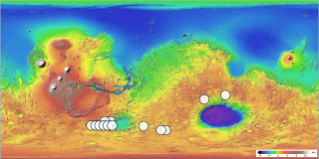
Map Showing Potential Origins of Martian Meteorite Teghaza 001

NASA/JPL-Caltech/USGS
Description
This global map of Mars shows 13 locations that match the mineralogy and chemistry of Teghaza 001, one of the most ancient Martian meteorites ever found on Earth. While scientists can never know for sure where a Martian meteorite originated, Teghaza 001 includes clues that link it to highlands in the southern hemisphere of the Red Planet.
The base map of this image was produced with data from the Mars Orbiter Laser Altimeter instrument aboard NASA’s Mars Global Surveyor mission. Scientists used data from NASA’s Mars Reconnaissance Orbiter to identify areas of the map (noted with white circles) that have similar mineralogy and chemistry as Teghaza 001.
Source: Map Showing Potential Origins of Martian Meteorite Teghaza 001