AI Insight
Researchers have developed a new friction law that incorporates both fault slip rate and multi-scale variations in fault surface roughness to better model earthquake behavior. The rate- and roughness-dependent friction (RRF) law successfully reproduces the observed relationship between fracture energy and fault slip in earthquake cycle simulations while maintaining computational efficiency through limited state variables. This approach represents a significant advancement in understanding how fault topography at multiple scales influences earthquake source processes.
Why it matters
This improved friction law could lead to more accurate predictions of earthquake energy release and source properties, which are critical for seismic hazard assessment and understanding earthquake mechanics. By incorporating realistic fault surface characteristics into models, scientists can better simulate earthquake cycles and potentially improve forecasting capabilities.
Understand the Science
Editors’ Highlights are summaries of recent papers by AGU’s journal editors.
Source: Journal of Geophysical Research: Solid Earth
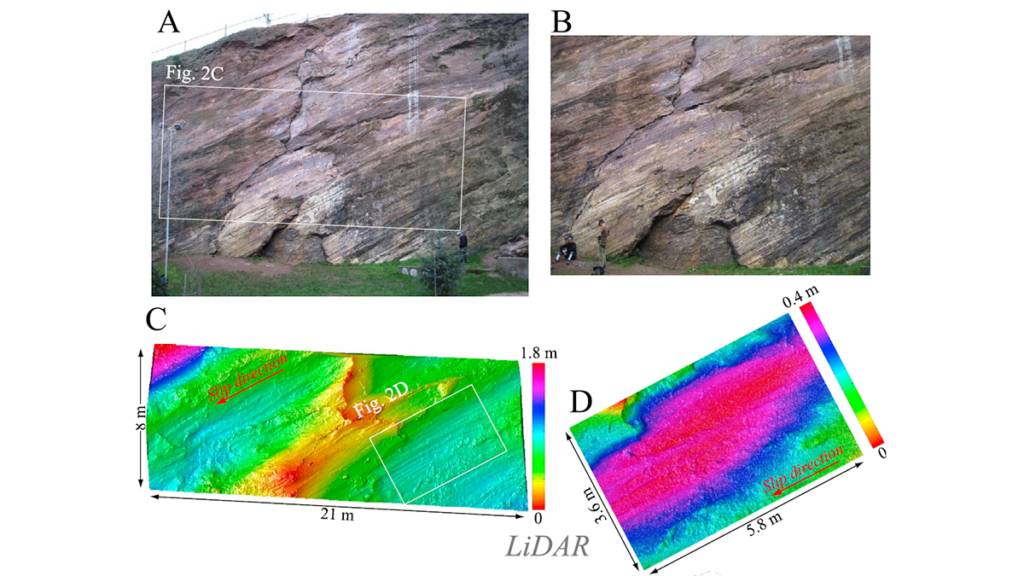
Earthquakes release energy and result in source properties defined across a wide range of scales that are not represented in conventional frictional laws. Norisugi and Noda [2026] introduce a new rate- and roughness-dependent friction (RRF) law which incorporates both effects from fault slip rate and multi-scale variation in fault topography. By limiting the number of state variables in the RRF formulation, the authors show with efficient earthquake cycle simulation that this multi-scale approach can reproduce a key observed relationship between fracture energy and fault slip.
Although further refinement is needed to better represent roughness evolution, this study marks a major advance in earthquake modeling by demonstrating the necessity and feasibility of incorporating multi-scale fault topography in the characterization of earthquake source process.
Citation: Norisugi, R., & Noda, H. (2026). Multi-scale rate- and roughness-dependent frictional constitutive law and dynamic earthquake sequence simulation. Journal of Geophysical Research: Solid Earth, 131, e2025JB033580. https://doi.org/10.1029/2025JB033580
—Yajing Liu, Associate Editor, JGR: Solid Earth
Text © 2026. The authors. CC BY-NC-ND 3.0
Except where otherwise noted, images are subject to copyright. Any reuse without express permission from the copyright owner is prohibited.
Source: Multi-Scale Fault Roughness Encapsulated in a Friction Law