AI Insight
On August 1, 1968, NASA canceled production of the Saturn V rocket, the most powerful launch vehicle of its era and the only one capable of sending astronauts beyond low-Earth orbit. This decision came nearly a year before the Apollo 11 moon landing, driven by congressional budget cuts that reduced Apollo program funding by approximately three-quarters due to federal deficits and Vietnam War expenses. NASA built only 15 Saturn V rockets total, flying 13 of them between the late 1960s and 1973, with the final unit launching the Skylab space station instead of its originally planned Apollo 18 moon mission.
Why it matters
The 1968 production halt effectively ended NASA's Apollo lunar program before it reached its peak, limiting moon missions to just six successful landings through 1972. This left the United States without a heavy-lift rocket capability for nearly 50 years until the Space Launch System debuted in 2022, significantly constraining deep space exploration options during that period.
Understand the Science
On Aug. 1, 1968, NASA canceled the production of its Saturn V moon rocket. At the time, the giant rocket was the only launch vehicle to have ever carried astronauts beyond low-Earth orbit, and it was then the largest, most powerful rocket ever.
NASA built 15 of these rockets but only flew 13 of them. When NASA made the decision to stop building the Saturn V, it was almost a year before Apollo 11 astronauts would walk on the moon for the first time.
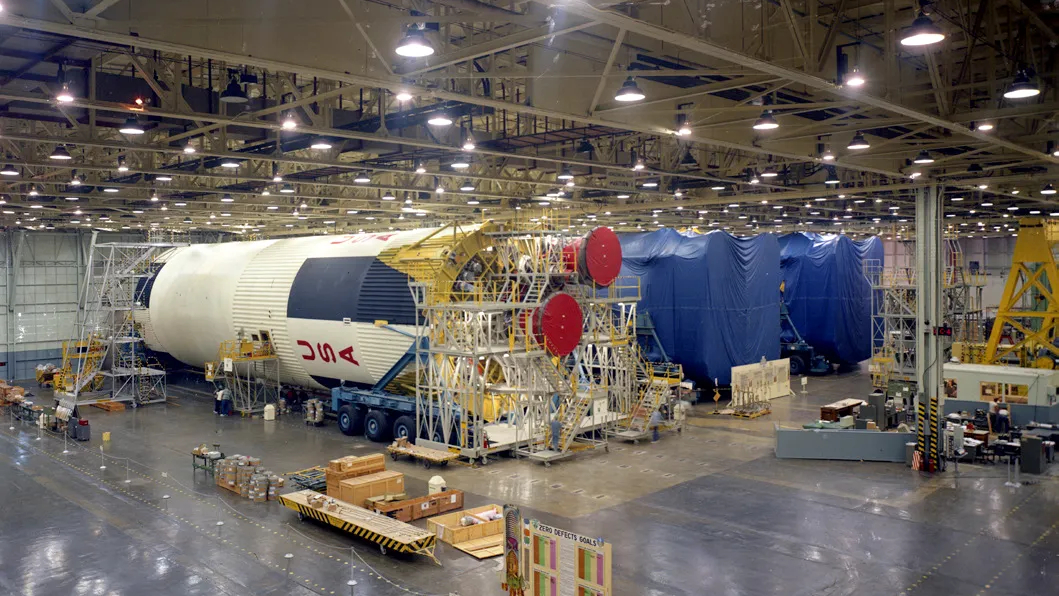
A federal budget deficit and the rising costs of the Vietnam War led Congress to slash nearly three-quarters of the funding that President Lyndon Johnson had allotted for the Apollo program.
The last Saturn V launched in 1973, and it was originally supposed to send Apollo 18 to the moon. However, that mission was canceled, and that Saturn V launched the Skylab space station instead.
Why it mattered
From start to finish, NASA spent a reported $9.4 billion on the Saturn family of rockets (which would be an estimated $118 billion in today’s dollars) to develop the Saturn V. That includes the Saturn I and Saturn IB blocks. But the decision to shut production down in 1968 over those costs spelled the end of NASA’s Apollo program to send astronauts to the moon a year before the Apollo 11 astronauts even walked on the moon in 1969.
Without a steady supply of heavy-lift rockets (the Saturn V was the most powerful of its day), NASA only had a limited number of moonshots left. The final Saturn V rocket to carry astronauts sent the Apollo 17 astronauts to the moon in 1972. The Skylab mission flew a year later, with the final Saturn IB rocket launching an Apollo command module on the Apollo-Soyuz flight in 1975.
It would not be until 2022, when NASA launched the first Space Launch System on the Artemis I mission, that the space agency had another megarocket to rival the Saturn V. In April 2026, that new rocket launched NASA’s Artemis II astronauts around the moon.
SpaceX has developed a new megarocket that is even more powerful than the Saturn V, with its Starship and Super Heavy booster.
Source: On this day in space! Aug. 1, 1968: NASA ends production of Saturn V moon rocket