AI Insight
Astronomers using NASA's Chandra X-ray Observatory have potentially identified a supernova remnant located near the supermassive black hole at the center of the Milky Way galaxy. If confirmed, this would be one of the closest supernova remnants ever discovered to our galaxy's central black hole, positioned in a region characterized by massive stars, intense magnetic fields, and rapidly orbiting dense gas clouds. The discovery was made using composite imaging data from multiple observatories including Chandra, XMM-Newton, PanSTARRS, MeerKAT, and the James Webb Space Telescope.
Why it matters
Supernova remnants are crucial sources of heavy elements such as iron, oxygen, and silicon, which are essential building blocks for planet formation and the development of life. Studying a supernova remnant in this extreme galactic center environment could provide valuable insights into stellar evolution and explosive processes under conditions vastly different from those in the outer regions of our galaxy.
Understand the Science
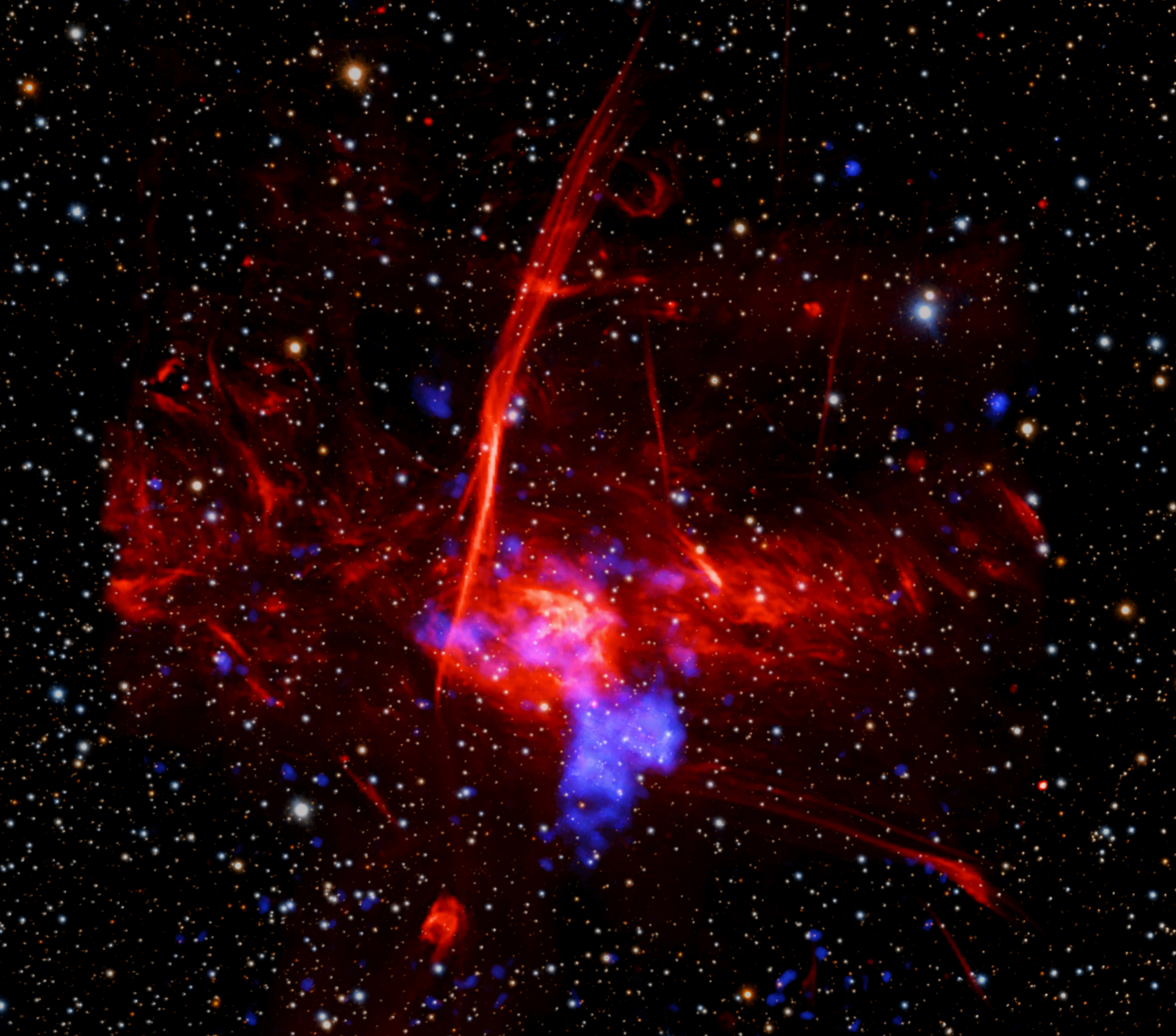
Using data from NASA’s Chandra X-ray Observatory, astronomers may have found a supernova remnant – seen in this June 11, 2026, image – in an intriguing neighborhood in the middle of the Milky Way galaxy. Supernova remnants are the expanding remains of exploded stars and provide elements like iron, oxygen, and silicon that are critical for the formation of planets and for life as we know it to form and flourish.
This new supernova remnant, if confirmed, would be one of the closest ever discovered to the supermassive black hole at the central region of our home galaxy, an exotic region crammed with massive stars, long threads of magnetic fields and dense clouds of gas orbiting rapidly around the Galactic Center.
Read more about this discovery.
Image credit: -ray: NASA/CXC/UCLA/Z. Zhu et al.; ESA/XMM-Newton; Optical: PanSTARRS; Radio: MeerKAT; Infrared (JWST): NASA/ESA/CSA/STScI; Image Processing: NASA/CXC/SAO/L. Frattare and P. Edmonds