AI Insight
NASA's INCUS (Investigation of Convective Updrafts) mission consists of three nearly identical satellites that will conduct the first space-based survey of tropical convective storm dynamics. The satellites will fly in coordinated formation in low Earth orbit, separated by 30 and 90 seconds, each carrying radar to observe vertical air and water movement (convective mass flux) during storm development. One satellite completed testing in Colorado in preparation for the mission's launch scheduled for 2027 from NASA's Wallops Flight Facility in Virginia.
Why it matters
This mission will provide unprecedented data on how tropical storms form and evolve by measuring convective processes from space, which is critical for improving weather forecasting and climate models. The coordinated multi-satellite approach will enable three-dimensional observations of storm dynamics that cannot be achieved with single satellites or ground-based systems.
Understand the Science
NASA’s INCUS Satellites Progress Toward Launch
Blue Canyon Technologies
Description
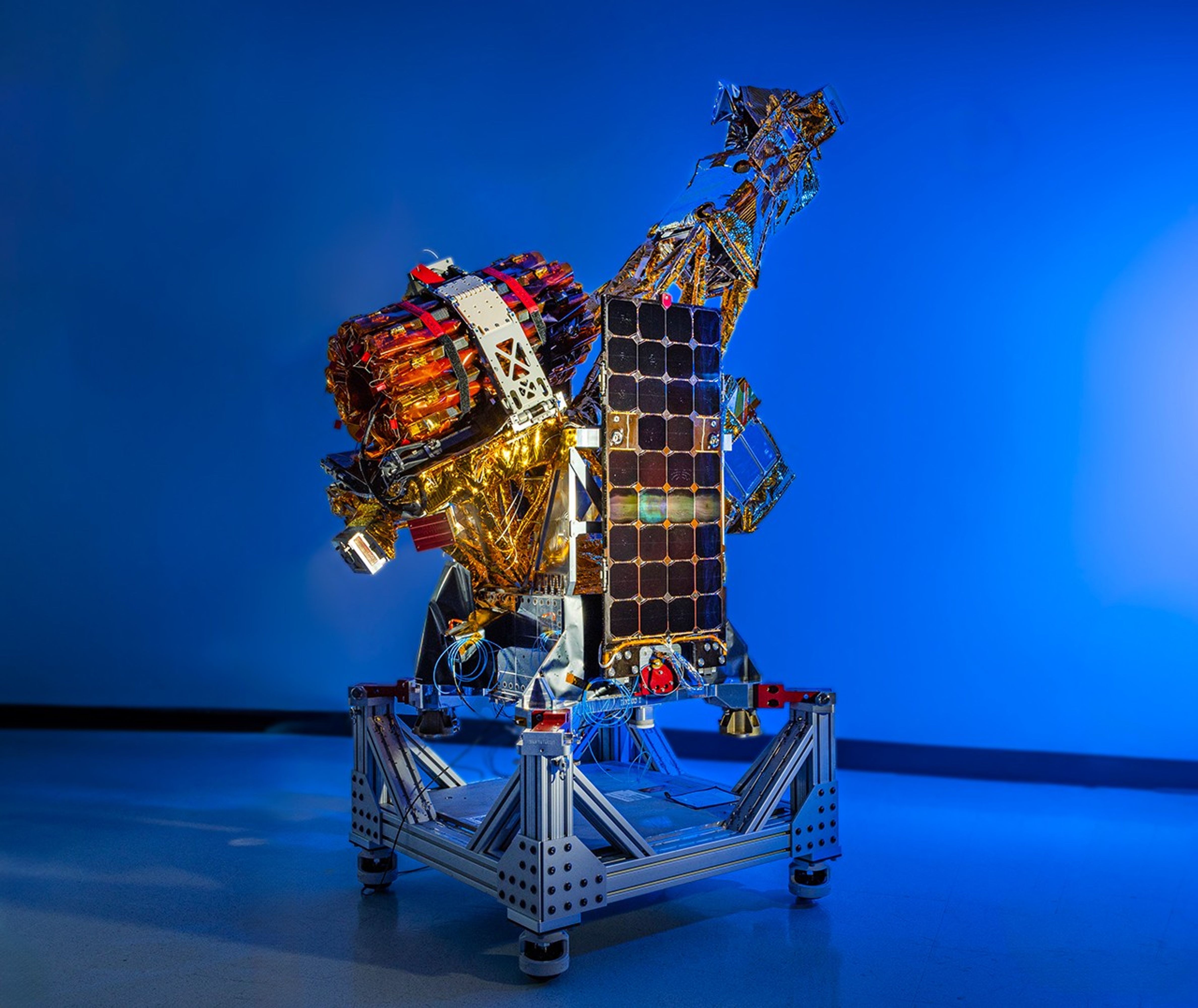
One of the three satellites that make up NASA’s INCUS (Investigation of Convective Updrafts) mission sits on a fixture at the facilities of Blue Canyon Technologies in Lafayette, Colorado. The satellite completed testing in preparation for launch in late May 2026. The mission will make the first space-based survey of the dynamics of tropical convective storms.
The three nearly identical satellites will fly in tight coordination in low Earth orbit, with the first and second satellites separated by 30 seconds, and the second and third satellite separated by 90 seconds.
Each satellites carries a radar designed to observe the vertical motion of air and water — known as convective mass flux — as storms develop and evolve. The middle satellite will also carry a microwave radiometer.
The INCUS mission is set to launch in 2027 from NASA’s Wallops Flight Facility in Virginia.
Funded through the Earth Venture Mission-3 acquisition under NASA’s Earth System Science Pathfinder Program and led by principal investigator Sue van den Heever at Colorado State University in Fort Collins, INCUS is one of several missions fulfilling the clouds, convection, and precipitation requirements of NASA’s Earth System Observatory, a set of interconnected missions set to study our home planet’s dynamic natural systems and how they interact. The mission is also part of FALCON (Fleet for the Atmosphere Linking Commercial Observations with NASA), a fleet of atmosphere-observing satellites that will combine hardware contributions from NASA centers, universities, and commercial partners.