AI Insight
NASA's Imaging X-ray Polarimetry Explorer (IXPE) conducted over 140 hours of observations of magnetar 1E 1547-5408 between March and April 2025. The observations may have captured the first direct evidence of empty space behaving in ways predicted by quantum electrodynamics for 90 years but never before observed. Magnetars are neutron stars possessing the strongest magnetic fields in the known universe, approximately one trillion times stronger than the most powerful permanent magnets created on Earth.
Why it matters
This potential first direct observation of predicted quantum vacuum behavior would confirm long-standing theoretical predictions about how extreme magnetic fields affect the fabric of space itself. The findings could advance our understanding of fundamental physics in the most extreme environments in the universe.
Understand the Science
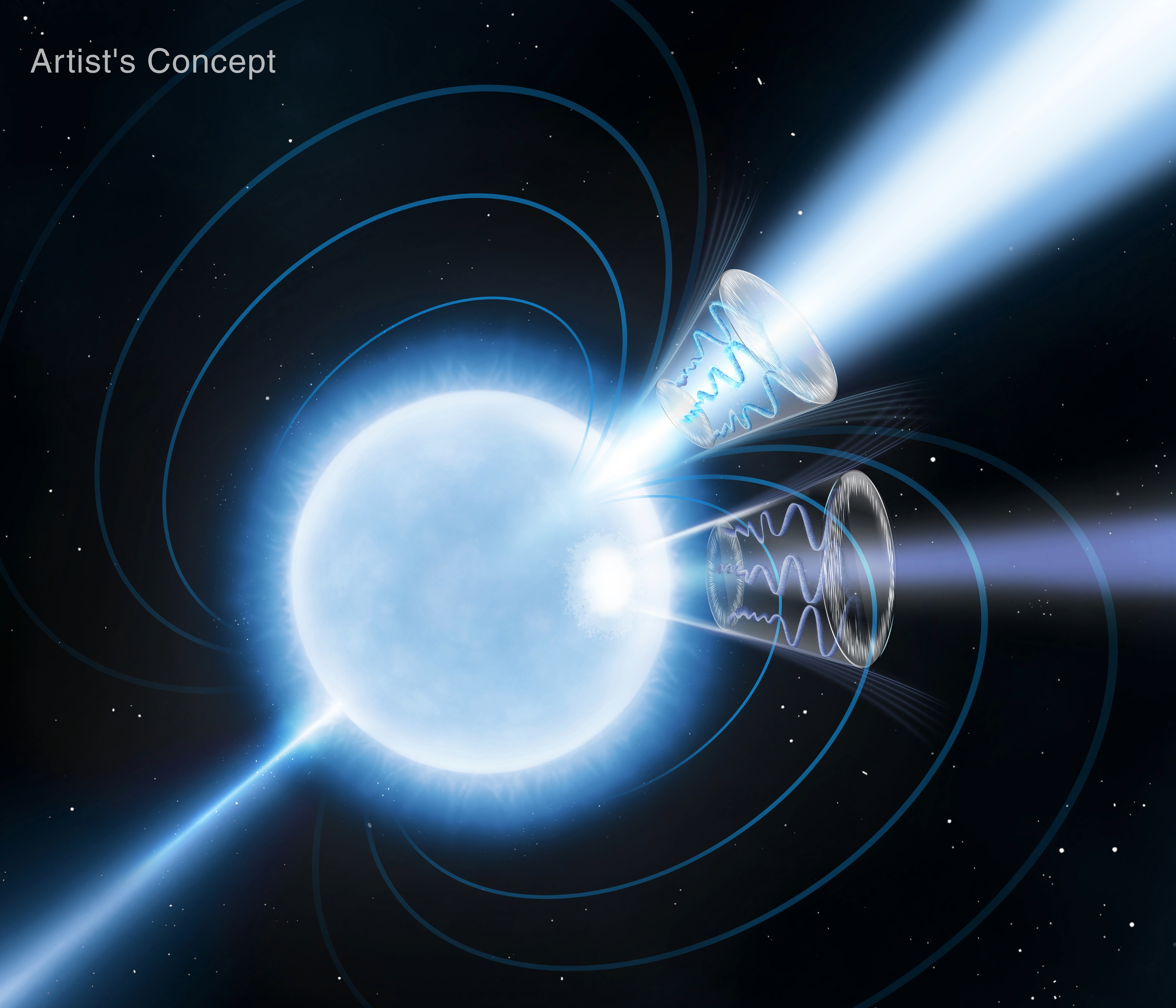
Scientists using NASA’s IXPE (Imaging X-ray Polarimetry Explorer) conducted more than 140 hours of observations of the magnetar 1E 1547-5408, shown in this Aug. 5, 2026, artist’s concept, between March and April 2025. In doing so, they may have captured empty space behaving in a way physicists have predicted for 90 years, but never directly observed.
Magnetars are a special class of neutron stars with ultra-strong magnetic fields, the strongest of any object in the observable universe, around a trillion times stronger than the strongest permanent magnets ever built on Earth.
Image credit: NASA/Pablo Garcia
Source: NASA’s IXPE Studies Magnetar