AI Insight
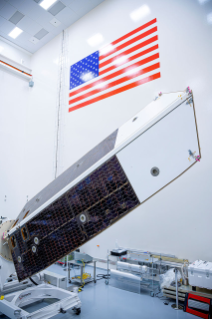
NASA's Near-Earth Object (NEO) Surveyor spacecraft sunshade underwent inspection at BAE Systems in Colorado in July 2026. The 20-foot-tall structure features two flat panels joined at a 23.5-degree angle, covered with 864 interconnected solar cells capable of generating up to 2 kilowatts of power. The sunshade completed environmental and thermal vacuum testing ahead of schedule and will enable the spacecraft to detect asteroids and comets located in the direction of the Sun.
Why it matters
NEO Surveyor will detect potentially hazardous near-Earth asteroids and comets in regions of sky that ground-based telescopes cannot effectively monitor, particularly objects approaching from the Sun's direction. This capability enhances planetary defense efforts by identifying threats that might otherwise go undetected until they pose imminent danger.
Understand the Science
NEO Surveyor’s Sunshade Gets Inspected

BAE Systems Space & Mission Systems
Description
The large sunshade of NASA’s Near-Earth Object (NEO) Surveyor is mounted on an assembly ring during inspections in a clean room at BAE Systems Space & Mission Systems in Boulder, Colorado, in July 2026.
The sunshade structure stands 20 feet (6 meters) tall and measures 8 feet (2.4 meters) wide at its base. Its two flat panels, joined at a 23.5-degree angle, were covered with 864 interconnected solar cells and then tested before arriving in Colorado. This specialized solar array can produce up to 2 kilowatts of power and will generate all the required electricity to charge the onboard batteries that power the spacecraft’s systems.
Built by Applied Aerospace in Stockton, California, the sunshade structure was outfitted with its solar cells by SolAero Technologies in Albuquerque, New Mexico, in January. Environmental testing of the sunshade and solar array was completed at a commercial thermal vacuum testing facility in El Segundo, California, in March and it was delivered to BAE Systems Space & Mission Systems ahead of schedule in May.
When in space, NEO Surveyor will seek out some of the hardest-to-find asteroids and comets, some of which may be located in the direction of the Sun — a region of sky where ground-based optical telescopes have a harder time searching.
More information about NEO Surveyor is available at: