AI Insight
Climate models predict that Pacific Ocean warming will create a counterintuitive pattern where high-oxygen subtropical waters will lose oxygen and age, while low-oxygen tropical waters will gain oxygen and become younger. This occurs because warming slows vertical water movement in two ways: it compresses the subtropical gyre reducing ventilation at depth, and Southern Ocean warming reduces upwelling of old, oxygen-poor water in tropical regions. The study identifies that both local Pacific basin heating and remote Southern Ocean forcing drive these opposing changes in water mass age and oxygen content.
Why it matters
These findings reveal how climate change will reshape ocean oxygen distribution in complex ways, with important implications for marine ecosystems and fisheries that depend on dissolved oxygen levels. Understanding these circulation changes helps predict where ocean deoxygenation will occur and where it may unexpectedly reverse.
Understand the Science
Editors’ Highlights are summaries of recent papers by AGU’s journal editors.
Source: AGU Advances
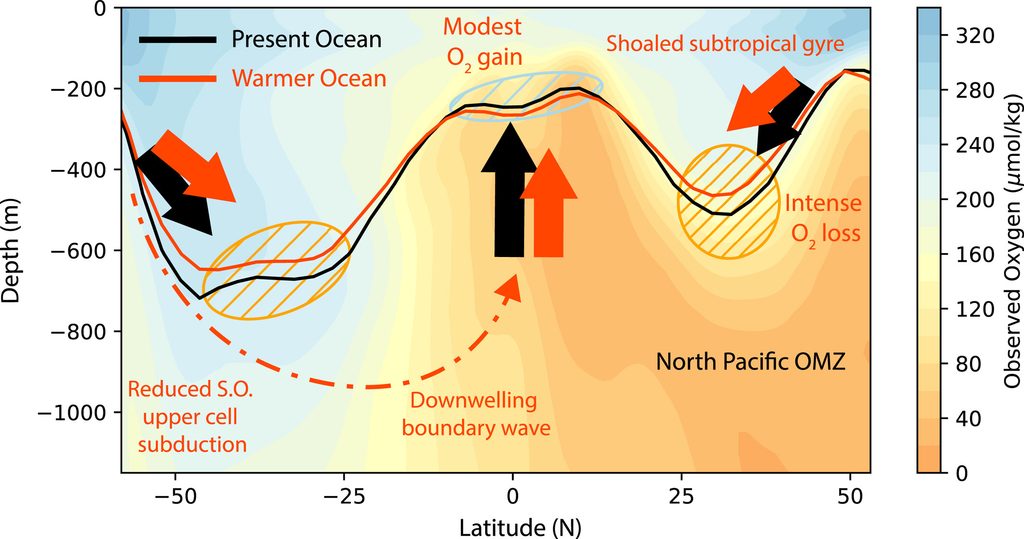
Climate model projections for the Pacific basin suggest that warming waters will cause high-oxygen regions in the subtropical North Pacific to lose dissolved oxygen and low-oxygen regions in the Tropical Pacific to gain dissolved oxygen. The meridional change in dissolved oxygen loss modifies water age, with subtropical North Pacific waters becoming older (less oxygen) and Tropical Pacific waters becoming younger (more oxygen).
In a model-based study, Taylor et al. [2026] show that this meridional contrast in oxygen and water mass age change arises from a slowdown of vertical velocities that is driven by a combination of Pacific basin and remote Southern Ocean heat forcing. Warming and stratification of the upper Pacific basin compresses the subtropical gyre, reducing ventilation along the base of the North Pacific ventilated thermocline. Warming in the mid-latitude Southern Ocean remotely reduces upwelling of old, low-oxygen water in the Tropical and North Pacific. This sets up the counterintuitive finding of “young gets older, but old gets younger.”
Citation: Taylor, B. A., Eddebbar, Y. A., Takano, Y., Talley, L. D., & Xie, S.-P. (2026). “Young get older, but old get younger”: Warming-induced circulation change explains contrasting pattern of projected Pacific deoxygenation. AGU Advances, 7, e2025AV002278. https://doi.org/10.1029/2025AV002278
—Eileen Hofmann, Editor, AGU Advances
Text © 2026. The authors. CC BY-NC-ND 3.0
Except where otherwise noted, images are subject to copyright. Any reuse without express permission from the copyright owner is prohibited.
Source: “Young Get Older, but Old Get Younger”: Counterintuitive Ocean Waters