AI Insight
NASA's Nancy Grace Roman Space Telescope has been transported to the SpaceX hangar at Kennedy Space Center's Launch Complex 39A on August 25, 2026, in preparation for integration with a Falcon Heavy rocket. The observatory is equipped with instruments designed to study dark energy and map galaxy formation, clustering, and evolution through observations of dark matter's gravitational influence. Launch is scheduled for no earlier than August 30, 2026.
Why it matters
The Roman Space Telescope will advance our understanding of fundamental cosmic phenomena, particularly dark energy which drives the universe's accelerating expansion and comprises approximately 68% of the universe's total energy density. By mapping dark matter distribution and galaxy evolution, the mission will provide critical data about the universe's structure, composition, and fate.
Understand the Science
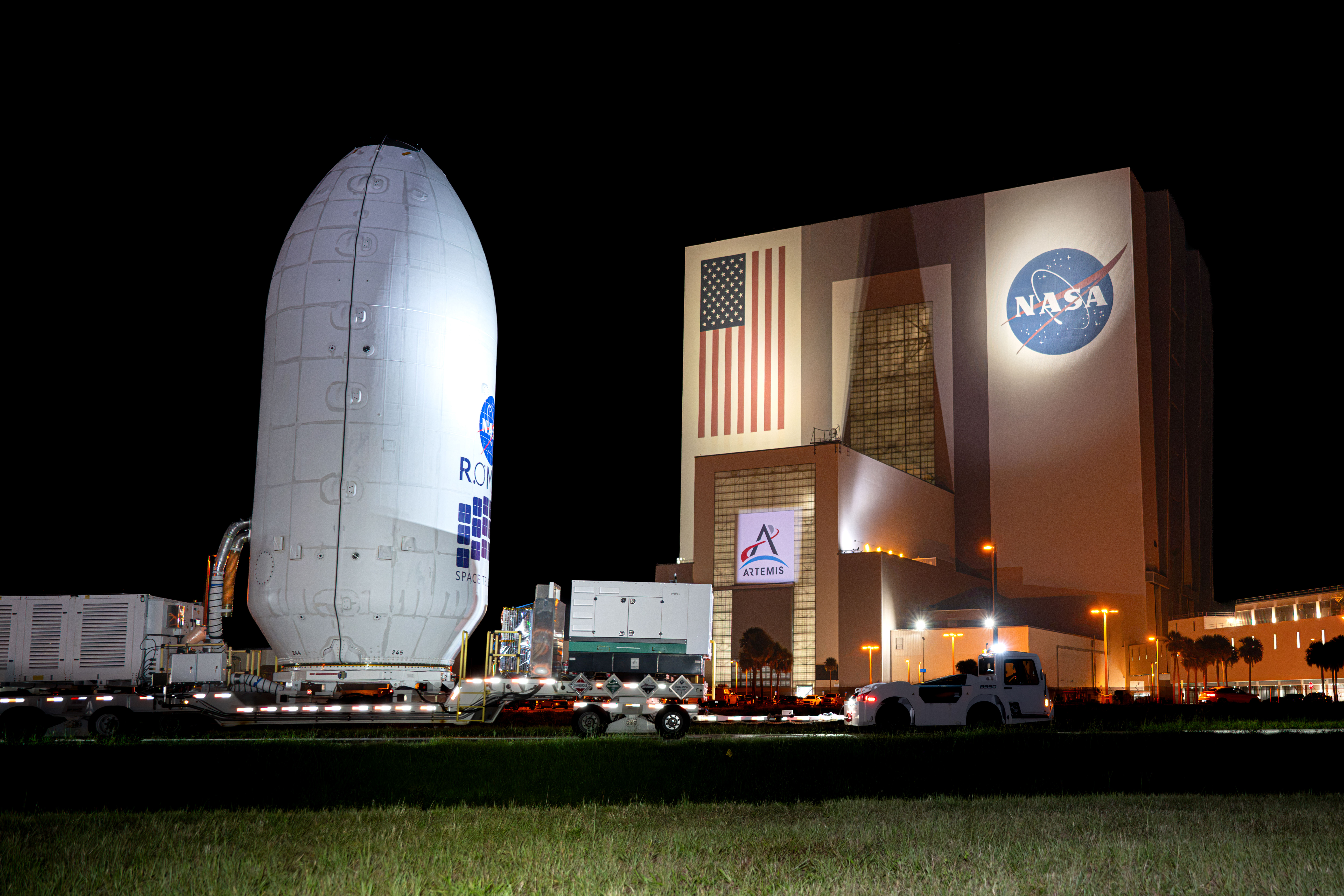
NASA’s Nancy Grace Roman Space Telescope, encapsulated in its payload fairing, travels from the Payload Hazardous Servicing Facility to the SpaceX hangar at Launch Complex 39A at NASA’s Kennedy Space Center on Tuesday, Aug. 25, 2026, ahead of mating to a SpaceX Falcon Heavy rocket.
Roman’s science instruments are designed to help researchers understand dark energy, the mysterious force accelerating the universe’s expansion. The observatory also will map how galaxies form, cluster, and evolve by tracing the influence of dark matter. Liftoff from NASA Kennedy is targeted no earlier than Sunday, Aug. 30, 2026.
Image credit: NASA/Sydney Rohde (Rocz)