AI Insight
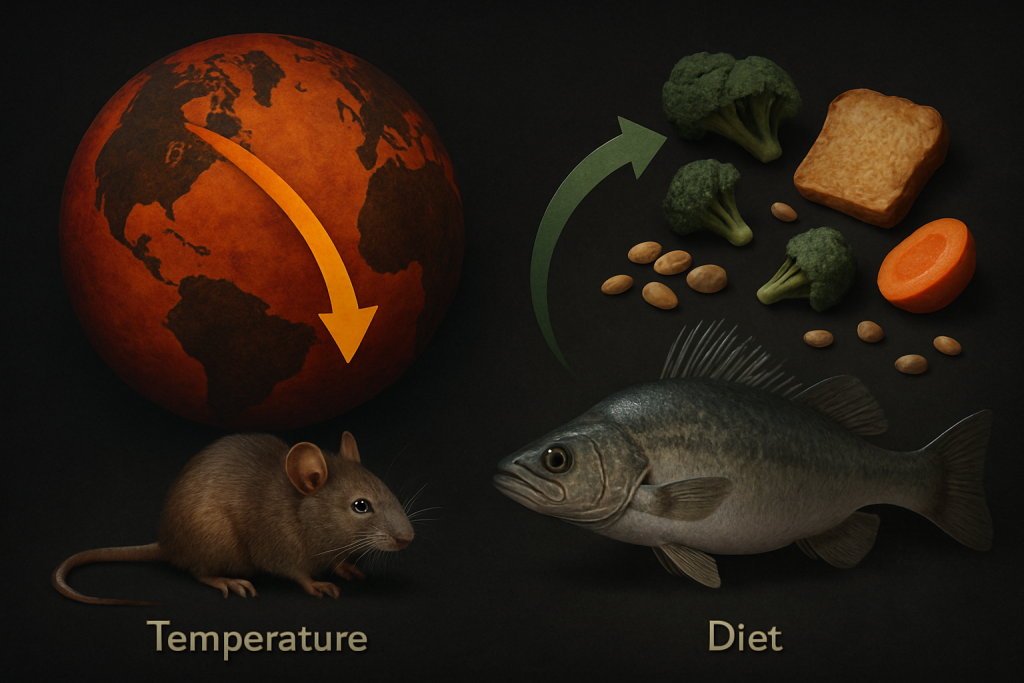
This study examined how genes control body size plasticity in fruit flies when exposed to different temperatures and nutritional conditions. Using approximately 200 genetic lineages of Drosophila melanogaster, researchers found that the genetic basis for how wing and leg sizes respond to temperature is completely independent from how they respond to nutrition, even though both environmental factors affect overall body size. The genetic variants that make flies responsive to temperature changes do not correlate with those that make them responsive to nutritional changes, suggesting separate genetic pathways control plasticity depending on the environmental factor.
Why it matters
These findings indicate that predicting how organisms will evolve in response to environmental change is more complex than previously thought, since genetic responses to different environmental stressors operate independently. This has important implications for understanding how animals might adapt to climate change and variable food availability, as selection in one environmental context may not produce predictable responses in another.
Understand the Science
⚠️ Preprint – Noch nicht peer-reviewed
Dieser Artikel wurde noch nicht von unabhängigen Experten begutachtet. Die Ergebnisse sind vorläufig und sollten mit Vorsicht interpretiert werden.
Across animals, variation in adult body size is accompanied by coordinated variation in the size of individual morphological traits. However, the same morphological trait can scale differently with body size depending on what drives the size variation. In Drosophila melanogaster, for example, wing size scales differently with body size when size varies because of developmental nutrition versus developmental temperature. Whether the genetic basis of size plasticity and scaling is shared across different environmental regulators of size remains unclear, but is central to predicting how selection acts on the developmental mechanisms that regulate trait size, plasticity, and morphological scaling. Using ~200 isogenic D. melanogaster lineages, we measured wing and leg size across nutritional and thermal treatments. For each lineage, we estimated nutritional and thermal plasticity for both traits, as well as the wing-leg individual-level scaling relationship, or ILSR, generated by each environmental source of size variation. We found extensive genetic variation in both thermal and nutritional plasticity for wings and legs, and in the slope of the ILSR between them. However, a lineage’s thermal plasticity was genetically uncorrelated with its nutritional plasticity for either trait, and we detected no genetic correlation between the slopes of thermal and nutritional wing-leg ILSRs. We also found no genetic correlation in the slope of nutritional wing-leg ILSRs across temperatures. Thus, the slope of a lineage’s nutritional ILSR at one temperature was not predictive of its slope at another temperature. Nevertheless, the overall pattern of nutritional ILSRs was conserved across temperatures. These results suggest that the genetic architecture of size plasticity and scaling depends on the environmental source of size variation. Consequently, the evolutionary response of scaling to selection in heterogeneous environments may not be predictable from genetic variation measured in any single environment.