AI Insight
Astronomers using the Hubble Space Telescope have discovered that the Andromeda galaxy's star formation rate has dramatically declined over the past 40 million years, dropping from about one-half of the sun's mass per year to about one-fifth today. By analyzing 200 million stars across two-thirds of Andromeda's disk, researchers found that this slowdown is most pronounced on the side closest to M32, a smaller neighboring galaxy located only 16,000 light-years away. The evidence suggests M32 may have collided with Andromeda, disrupting its star formation, though this causal link has not been definitively confirmed.
Why it matters
This research helps reconstruct the recent history of our nearest large galactic neighbor and demonstrates how interactions between galaxies can significantly impact their evolution and star formation processes. The findings will inform our understanding of galactic dynamics and may provide insights into the Milky Way's own future collision with Andromeda, predicted to occur in billions of years.
Understand the Science
Thanks to the Hubble Space Telescope, astronomers have shed light on a recent chapter in the history of our Milky Way’s neighboring galaxy, Andromeda.
Using Hubble Space Telescope observations of Andromeda‘s stars, a research team showed that the spiral galaxy’s rate of making new stars has dramatically slowed down in the last 40 million years. And they’ve found more evidence that one of Andromeda’s own neighbors — a smaller galaxy called M32 — may be to blame.
“We can’t explicitly say that we are seeing a decrease in star formation because of M32. But it’s right there, and it’s definitely the most likely suspect,” said Tobin Wainer, a graduate student at the University of Washington and one of the astronomers, in a statement.
Astronomers like Wainer knew from prior research that Andromeda saw a burst of star formation about 2 billion years ago (possibly as a result of a collision with an unknown galaxy). They also knew that star formation had slowed down since then. What they did not know was how quickly that deceleration had been. If they could find out, they could fill in some of the gaps in Andromeda’s history.
At 2.5 million light-years’ distance, Andromeda is near enough to Earth that Hubble can measure its stars. In the past several years, Hubble has conducted two surveys of Andromeda. While Hubble can only make out stars in Andromeda that are brighter than our sun, these two surveys still gave Wainer and colleagues a compendium of 200 million stars, covering two-thirds of Andromeda’s disk.
Wainer and colleagues parceled out this vast space into a grid of squares, 300 light-years to a side. They reconstructed the history of each square by examining the colors of its stars.
A square with many bright blue stars, for example, probably saw a lot of star formation recently, since blue stars tend to be younger. On the other hand, if a square only contains smaller, redder stars, we know those stars are longer-lived and older, and that square probably hasn’t seen a lot of newborn stars.
The astronomers mapped out a story of slowing star formation. Around 500 million years ago, on average, Andromeda turned the equivalent of our sun’s mass in gas and dust into newborn stars each year. As millions of years passed, that rate declined. About 40 million years ago, it was about one-half the sun’s mass each year. Then, it tilted into a dramatic deceleration. Today, it stands at about one-fifth the sun’s mass each year.
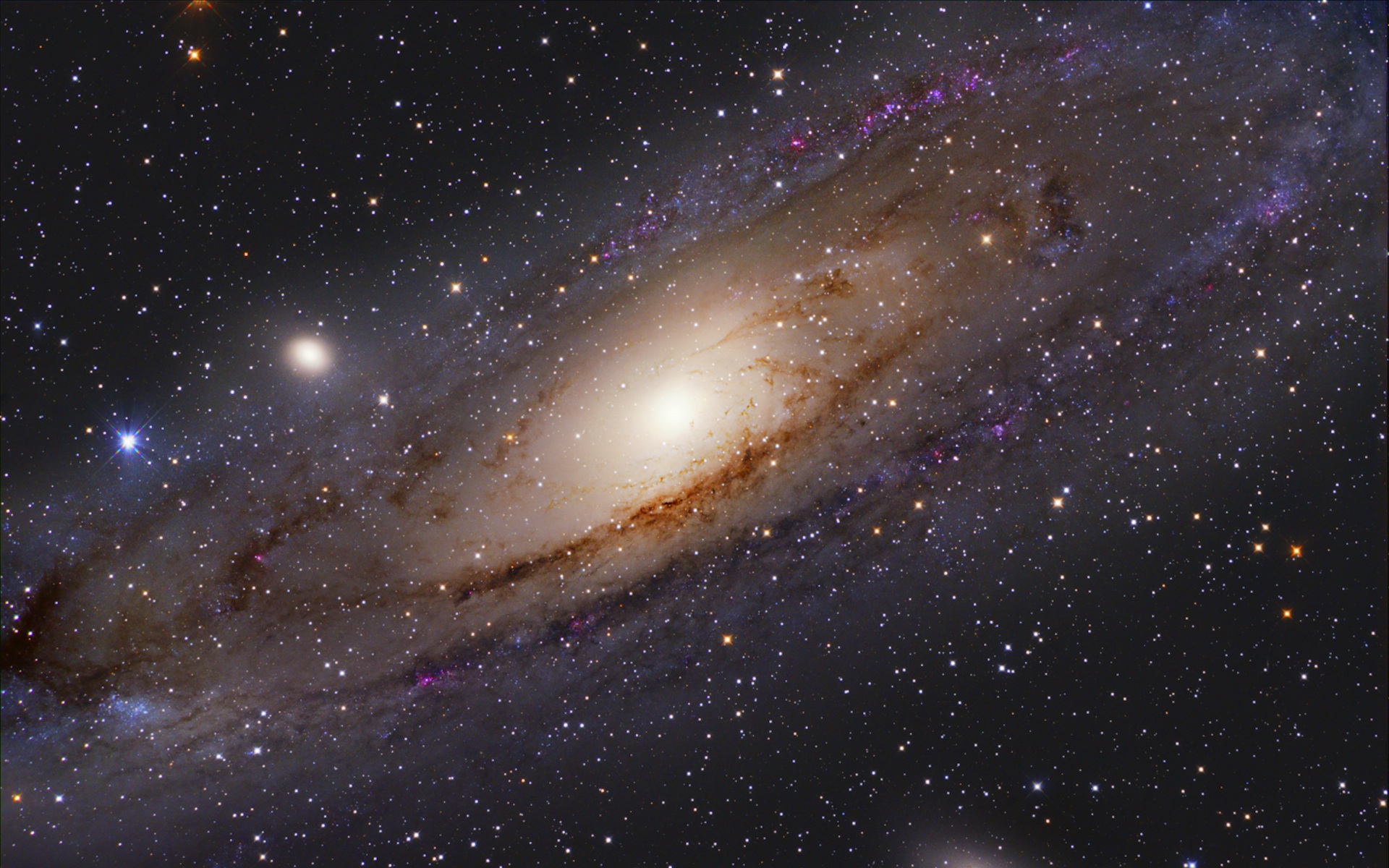
Curiously, they found that Andromeda’s starmaking slowdown is especially pronounced on one particular side of the galaxy, starting about 60 million years ago. Astronomers know this side of Andromeda is closest to another galaxy: M32.
Astronomers have eyed M32 with suspicion for some time now. M32 is only located about 16,000 light-years from Andromeda (Andromeda is formally called M31) and it looks like the rump core of a spiral galaxy that lost its arms. It’s possible that this is actually the aftermath of a collision between M32 and its larger neighbor. It’s possible, though not confirmed, that Andromeda’s slowing bears the fingerprints of this collision.
We may not need to wait long for more answers. Just as Hubble can see Andromeda’s stars, so too will the Nancy Grace Roman Space Telescope, set to launch in late August. In the coming years, Roman will be able to measure even more of Andromeda than Hubble has.
Source: The Andromeda galaxy may be getting bullied by a smaller galactic neighbor, scientists find