AI Insight
A comprehensive study analyzing 8,012 soil nitrogen measurements from 255 tidal wetlands worldwide reveals that salt marshes and mangroves function as significant nitrogen sinks, accounting for 13-15% of all marine nitrogen burial. These ecosystems store "blue nitrogen" in their soils alongside carbon, helping prevent nitrogen from entering adjacent waters where it would cause eutrophication and harmful algal blooms. However, wetland loss or degradation due to human activities and rising sea levels could reverse this function, transforming these ecosystems from nitrogen sinks into nitrogen sources.
Why it matters
This research demonstrates that tidal wetland conservation is critical not only for carbon storage but also for maintaining coastal water quality and preventing environmental problems like toxic algal blooms. The findings provide quantitative evidence supporting wetland restoration and protection policies as a nature-based solution for managing coastal nitrogen pollution.
Understand the Science
Editors’ Highlights are summaries of recent papers by AGU’s journal editors.
Source: Earth’s Future
It is always encouraging when a new study improves our understanding of a process or compartment within the global nitrogen (N) cycle. This is certainly the case of the recently published study by Langley et al. [2026].
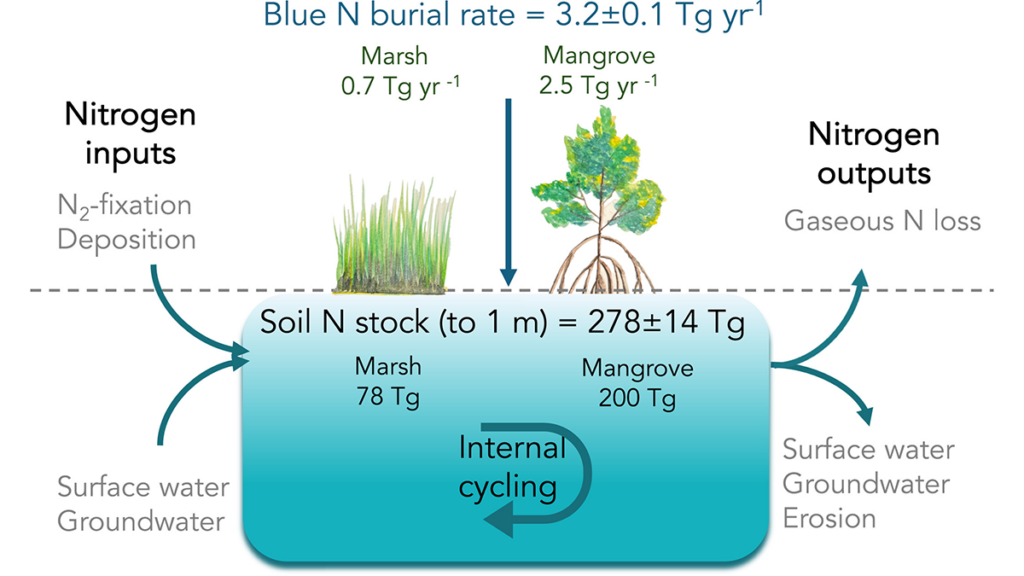
Drawing on an extensive dataset comprising of 8,012 soil N measurements from 255 tidal wetlands, including both salt marshes and mangroves, the authors show that these ecosystems act as important sinks for nitrogen. This stored nitrogen, referred to as blue nitrogen, is buried alongside carbon in wetland soils (see figure above).
The study estimates that tidal wetlands account for approximately 13-15% of marine nitrogen burial, highlighting their role as major hotspots of N accumulation in coastal environments. By retaining nitrogen that would otherwise be transported to adjacent waters, these ecosystems help mitigate harmful environmental impacts such as eutrophication, toxic algal blooms, and water quality degradation.
However, the capacity of tidal wetlands to provide this valuable ecosystem service is increasingly threatened by human-driven environmental change. Rising sea levels may enhance nitrogen sequestration in some wetlands, but only where these ecosystems can persist. If wetlands are degraded or lost, the consequences could be severe. Rather than functioning as N sinks, they may become net sources of N, releasing previously stored N back into aquatic systems and exacerbating the very problems they currently help to alleviate. Thus, conserving and restoring tidal wetlands is essential, not only for blue carbon storage, but also for maintaining their critical role in regulating the coastal nitrogen cycle.
Citation: Langley, J. A., Chapman, S. K., Wang, L., Maxwell, T. L., Rivera, P., Adame, M. F., et al. (2026). Blue nitrogen follows the fate of tidal wetlands. Earth’s Future, 14, e2025EF006747. https://doi.org/10.1029/2025EF006747
—Luis Lassaletta, Associate Editor, Earth’s Future
Text © 2026. The authors. CC BY-NC-ND 3.0
Except where otherwise noted, images are subject to copyright. Any reuse without express permission from the copyright owner is prohibited.
Source: The Role of Tidal Wetlands in the Global Nitrogen Cycle Under Global Change