AI Insight
SpaceX is preparing to launch three NASA-supported small spacecraft alongside commercial payloads on a Falcon 9 rocket scheduled for October 1, 2026, as part of the Transporter-18 mission. The three CubeSat missions—ASCENT Propulsion Dual Mode, SPRITE, and SSPICY—will test advanced propulsion systems for small satellites, investigate the movement of galactic dust and high-energy radiation through galaxies, and develop new methods for inspecting defunct satellites in orbit. The spacecraft are shown in pre-launch encapsulation configuration before being sealed in the rocket's payload fairing.
Why it matters
These missions advance critical space technologies including more efficient propulsion for small satellites and autonomous inspection capabilities that could help address the growing problem of space debris. The SPRITE mission's observations will also contribute to understanding galaxy evolution and the behavior of matter in extreme cosmic environments.
Understand the Science
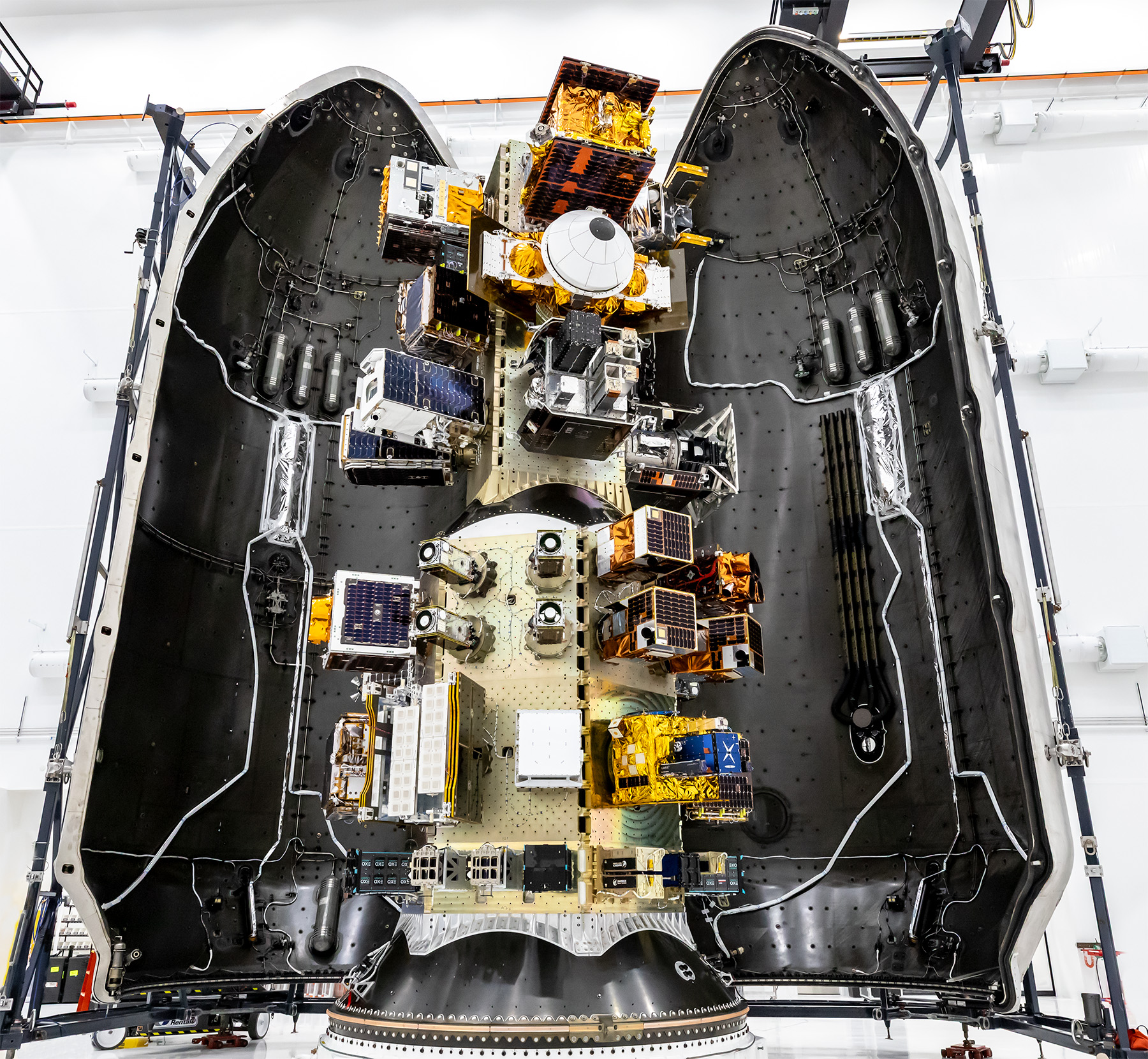
Three NASA-supported small spacecraft, along with many commercial payloads, are shown before being encapsulated in a SpaceX Falcon 9 ahead of launch on Oct. 1, 2026. The ASCENT Propulsion Dual Mode CubeSat, the Supernova Remnants and Proxies for ReIonization Testbed Experiment (SPRITE) CubeSat, and the Small Spacecraft Propulsion and Inspection Capability (SSPICY) mission will demonstrate new propulsion technologies, study how galactic dust and high-energy radiation move through galaxies, and advance capabilities for inspecting inactive satellites.
Image credit: SpaceX