AI Insight
The COP17 UN biodiversity conference in Yerevan, Armenia completed the first global review of progress toward reversing nature loss by 2030, concluding with "deep concern" that current efforts are insufficient to meet the 23 established biodiversity targets. The review urges countries to rapidly accelerate action and increase ambition to address existing gaps. Key discussions focused on mobilizing finance for developing countries to protect nature, with developed nations having failed to meet previous funding commitments and new provisions allowing non-traditional donor countries to signal interest in contributing before COP18.
Why it matters
This assessment reveals that global biodiversity protection efforts are significantly off-track, requiring immediate policy and funding interventions to prevent further ecosystem collapse. The expansion of potential donor countries and establishment of mechanisms to compensate communities for genetic resources could reshape international biodiversity finance architecture.
Understand the Science
Countries have completed the first “global review” of their progress towards reversing nature loss by 2030 at the COP17 biodiversity talks in Yerevan, Armenia.
The review “notes with deep concern” that, unless action is “rapidly accelerated”, the goal to reverse nature loss and meet a set of 23 targets by 2030 “will not be achieved”.
It “urges” countries to accelerate action, including by “increased ambition in addressing the gaps”.
Much of the discussions in Yerevan focused on how to raise the necessary funds to help developing countries protect nature.
Some major economies pushed to expand the range of nations that are expected to provide finance, with countries agreeing at the end of the two weeks of talks that non-donors that want to contribute can “signal interest” before COP18.
This came after developed countries failed to meet a target to significantly ramp up nature finance over the last few years.
It also came as a landmark fund agreed at COP16 in Colombia to pay communities for the genetic resources derived from nature stands nearly empty two years on.
The Yerevan talks marked the halfway point of the “Kunming-Montreal Global Biodiversity Framework” (GBF), the “Paris Agreement for nature” first made in 2022 and due to be achieved by 2030.
During the nearly 12-hour-long final plenary, countries voted for Quito, Ecuador, to host the COP18 nature talks, which will be held in 2028.
Countries managed to sign off on all the major negotiation texts, marking a stark contrast to COP16, which ran so far over time that the Colombian presidency lost “quorum”, forcing talks to resume in Rome months later.
Below, Carbon Brief has detailed analysis of all of the key outcomes from COP17.
Formal negotiations
Finance
Finance, predictably, was at the heart of the discord and deadlock at the Yerevan talks.
At COP17, discussions on finance had to achieve several outcomes.
The first part – to take stock of biodiversity finance mobilised so far to meet the nature deal’s goals – fell under the global review.
As the global report noted, developed countries failed to meet their commitments to raise “at least $20bn a year by 2025” for nature. Delegates pointed to falling aid levels and a sharp 27% decline in environmental funding for the 2026-30 period.
The second part was to agree on how to mobilise resources for the next four years, to meet the GBF’s goals and targets.
Calls to “broaden the contributor base” of who pays to protect nature – and whether that should include emerging economies – became the most fraught element of the talks.
Eventually, countries agreed on what Switzerland described as a “super, mega-delicate” text. It hinged on major “political compromises”, with “no major winner or loser”, according to Kenya.
Per the decision, countries that want to be included on a list of developed country donors can “signal interest” through bilateral, confidential consultations before COP18 and every alternate COP after.
Finally, countries also agreed on criteria to shape and resource a new, permanent financial mechanism to protect nature after 2030.
However, this did not immediately take the form of a new fund under the COP that biodiverse countries have demanded since 2022, deferring the mechanism’s institutional structure to COP18.
Resource mobilisation discussions at the GBF’s halfway mark were supposed to agree on how to close the “biodiversity finance gap” and to “increase resources from all sources” to “at least” $200bn per year by 2030, as set out in target 19 of the GBF.
The talks were largely dominated by a push, led by the JUSCANZ bloc of developed countries, to “broaden the contributor base”. This could see emerging economies, such as Qatar, China, Saudi Arabia and India, being added to the list of countries that pay to protect nature.
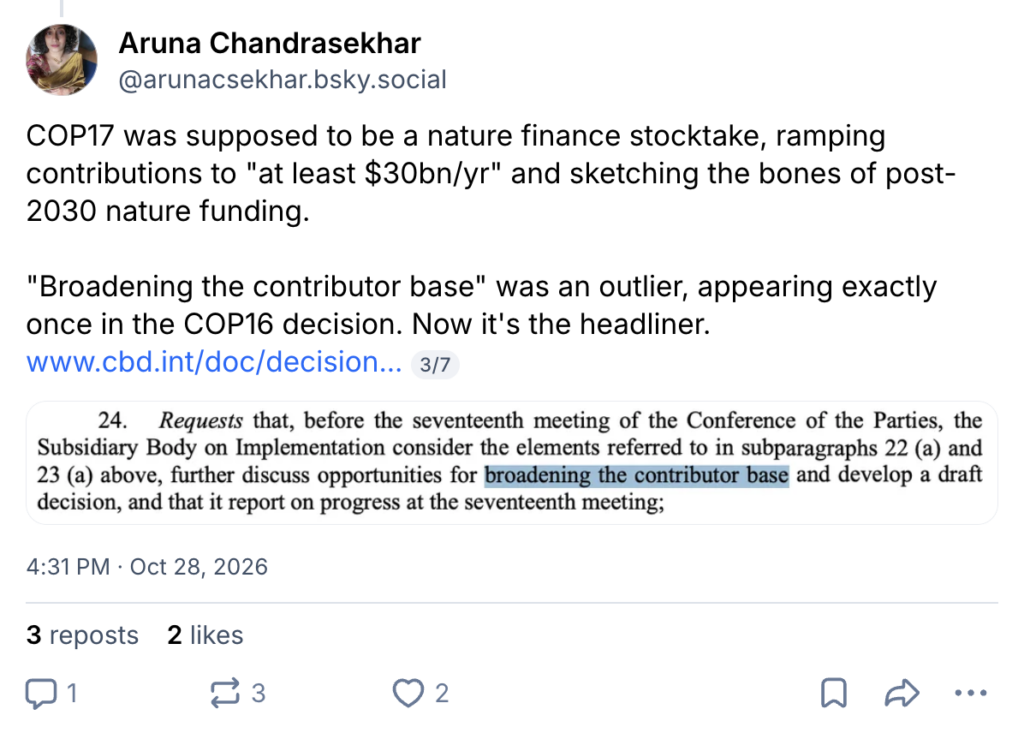
Article 20 of the UN Convention on Biological Diversity (CBD) states that developed countries “shall provide new and additional financial resources” to developing countries to meet the costs of implementing measures to protect nature.
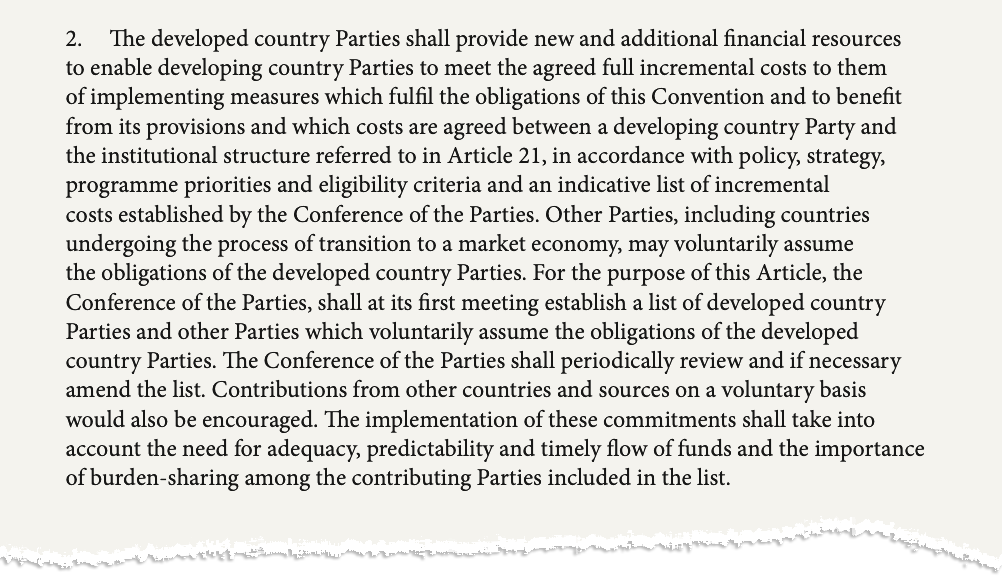
The text states that other countries – including emerging economies – may “voluntarily assume” these obligations to pay. However, it adds that this list of developed countries “shall” be reviewed periodically and amended “if necessary”.
The list was last amended in 2006.
(See this “jargon buster” which explains the specific meaning and legal weight of various terms and verbs used in UN formal documents.)
Discussions around this fraught subject had reached a dead end at intersessional talks this year, but resurfaced in Yerevan.
The first “non-paper” had four different options for expanding the contributor base. These ranged from using the World Bank’s country income groups “as a proxy” to identify high-income countries, to commissioning a study on the impacts of being included on the list.
By 21 October, the number of options swelled to eight, including two from Saudi Arabia and one from Peru.
Some countries “expressed concern” that certain options were based on a CBD secretariat study on “what constitutes a developed country”, Earth Negotiations Bulletin reported.
By the end of the first week, it was clear that the finance deadlock would have to go into informal ministerial consultations for any consensus to emerge.
At a press conference on 28 October, Christopher O’Sullivan, Ireland’s nature minister and representing the EU delegation, told Carbon Brief:
“Our position isn’t that we want to pull back in terms of contributing…but it’s been 20 years since that list was added to, times have changed and there are new realities. We just simply want those new realities reflected. I don’t fully understand why there’s so much opposition to that.”
The EU chose not to comment on which countries it would like to see on that list.
Lim Li Ching from the Third World Network, meanwhile, called the push for others to “assume the obligations” of developed countries “sheer hypocrisy”, adding that any country could make a voluntary contribution. She told Carbon Brief:
“At a forum like the CBD, this linking of income status with finance does not take into account where historical and current responsibilities lie. If you want to generate more funding for biodiversity, let’s look at sovereign debt burdens and rules, which are inequitable for developing countries. But if you can fund wars, and provide resources for your defence industry, then you know where the priorities are.”
On 29 October – at a plenary meant to adopt final texts for the most contentious subjects – Norway’s Gaute Hanssen announced that resource-mobilisation discussions would go into a smaller “friends of the chair” meeting.
Facilitated by Carolina Caceres from Canada and Imèn Meliane from Tunisia, the meeting would discuss the most contentious elements of a draft decision that had swelled to 112 brackets, denoting areas of disagreement on specific details in the text.
While the meeting was open to all, countries that were called to be present included Brazil, Canada, Chile, China, the EU, Fiji, Norway, Russia, Switzerland, Saudi Arabia, South Africa and the UK.
At the same time, a “non-paper” text by finance and environment ministers laid out countries’ red lines and compromises.
At the end of COP17, countries welcomed a final compromise text, with Kenya thanking the “strong women” co-chairs who strove to strike a “delicate” balance.
China, Saudi Arabia, Switzerland and Fiji cautioned against any further interventions, with Brazil warning: “If we open this text, we will never close it again.”
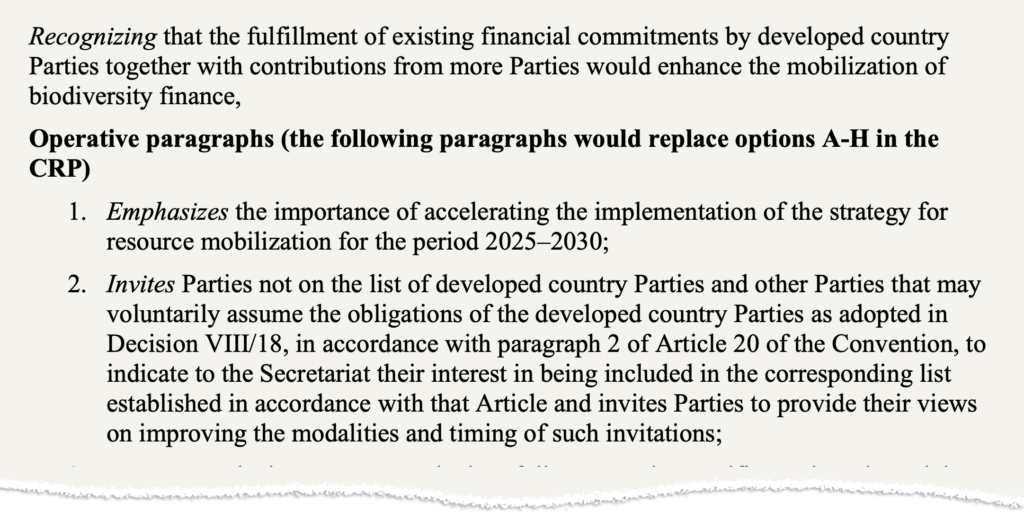
While the final decision “recognises” that “contributions from more parties would improve the mobilisation” of biodiversity finance, it steered away from issuing criteria to expand the list of donor countries.
The text makes it clear that no additions to the list would be made without inviting and confidentially consulting with interested countries, to secure their explicit consent.
Instead, the CBD secretariat “invites” countries keen to be on the list and “assume the obligations” of developed countries to “signal interest” before COP18 and at every alternate COP thereafter.
At the same time, developing countries can contribute to meeting the GBF and biodiversity convention’s goals on a “voluntary basis”, with contributions not implying inclusion on the list.
A negotiator for China told Carbon Brief at the closing plenary:
“We welcome this balanced document. It was a very long discussion that has gone [on] since [2022 nature talks in] Nairobi. But actually this time, there were a lot of sensitive issues, [there were] a lot of critical things we didn’t open in the contact groups; it mainly went to the high-level discussion.”
The decision also establishes a financial mechanism for nature funding after 2030 under the governance of the COP, a key ask from developing countries.
However, it defers decisions on what form this mechanism would take – whether this would be a new fund or based on existing arrangements – until COP18.
Oscar Soria at the Common Initiative told Carbon Brief that the decision on the financial mechanism leaves things “very open”, with “no movement” towards a new fund or money and no upgrades to existing funding arrangements.
The text acknowledges the links between debt and biodiversity eight times, mentioning how debt-related instruments can be included in biodiversity plans, but does not go further.
“It is almost as if the debt studies they called for at COP16 didn’t happen,” said Soria, who had earlier flagged serious methodological issues with the first-ever COP-commissioned report on debt and biodiversity.
Global review
In Yerevan, countries agreed on the first stocktake of progress towards the 2030 nature targets – known as the “global review”.
The review was one of the keenly anticipated outcomes from COP17 and was seen as less controversial than some of the other major negotiation strands.
It was swiftly signed off by countries at the start of the final COP17 plenary, with just one last-minute addition.
The concept of carrying out a global review on “collective progress” was set out in the GBF and its underlying documents.
The details of how this review would be carried out were supposed to be agreed at COP16, but it was not discussed before the plenary in Cali was suspended for loss of “quorum”. It was instead adopted at the resumed COP16 negotiations in Rome in February 2025.
The global review was based largely on the findings of the global report and other information provided by countries.
The final text “welcomes” and also “notes with deep concern” the findings of the global report. It then homes in on various ways countries can increase their biodiversity action to get on track to meet the targets.
As of 19 October, when COP17 officially began, the non-paper contained 152 brackets, which indicate areas of disagreement in UN texts.
Smaller “contact group” discussions took place to try and reduce the number of brackets throughout the first week. This group was co-chaired by Sanne Kruid from the Netherlands and Sivendra Michael from Fiji.
A few days into the talks, Kruid told Carbon Brief that the progress on the global review was “relatively positive”, with countries “engaging quite well”.
One contentious section of the 11-page text was paragraph 15, which “urges” countries to accelerate implementation of nature targets, “including by increased ambition” in addressing key challenges.
Some developing countries were wary of including the word “ambition” in this section, arguing that higher ambition requires more nature finance, which is already falling “far short”.
Kirsty Leong, a policy expert at WWF, told Carbon Brief:
“You have one side wanting to have very strong language and high ambition in what countries should do…and the other side of the room saying the main problem in implementation is that they don’t have the means to do it.”
But the word made it into the final text, which “urges” parties to accelerate implementation of the GBF, “including by increased ambition”, while recognising that developing countries need more support to “allow for higher ambition in their actions”.
Another hotly debated section was paragraph 26, which “encourages” countries to accelerate reform of nature-harming subsidies, “in accordance with national circumstances”.
Earlier in the talks, it was also unclear whether this would feature in the final version due to pushback from countries including Saudi Arabia and Russia. (See: Harmful subsidies)
Earlier drafts of paragraph 16 – another key section – focused on supporting increased action to address biodiversity loss, and also mentioned transforming global financial systems and economic sectors.
This was heavily stripped back in the final version, which “emphasises that accelerating implementation would need to be supported through increased action to address the underlying drivers of biodiversity loss.”
The review also “notes with deep concern” that the 2050 nature goals “may be at risk” if 2030 targets are not achieved.
The COP17 presidency and others frequently discussed a “Yerevan pathway” during the negotiations.
It was unclear whether this would feature in a separate cover decision text, similar to those agreed at climate COP summits, or in another way.
In the end, the “pathway” referred to the sections of the global review outlining calls for countries to scale up action to meet the 2030 nature targets.
A CBD statement said it “sets out a shared response to those findings [of the global report], identifying priorities for action through 2030 and areas where progress will need to be accelerated”.
Elsewhere in the global review talks, Earth Negotiations Bulletin said a small group was also set up to address references to “actors other than national governments”.
These “actors” include Indigenous peoples and local communities. Joji Carino from the not-for-profit Forest Peoples Programme called for this wording to be “discontinued”.
She told a 20 October press briefing that the phrase is a “major regression”, believing it makes it sound like “governments were always the central actor” and Indigenous peoples were “just there on the side”.
This phrase featured a number of times in the final global review document, with Indigenous peoples and local communities also highlighted several times.
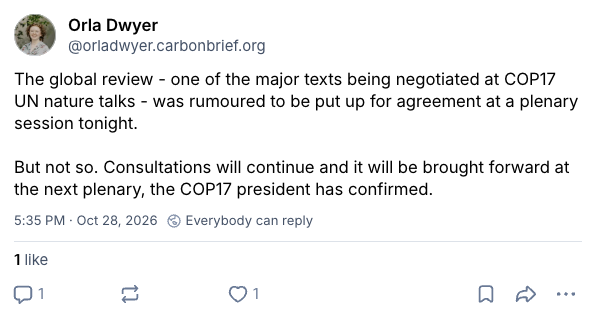
On 28 October, rumours circulated that the COP17 president, Hambardzum Matevosyan, wanted to bring the global review text for agreement at a plenary session that evening, two days before talks were due to end.
When Carbon Brief ran into Matevosyan in a lift that afternoon, he said this would only occur if countries reached a consensus on the text. They did not manage this and he confirmed in the evening plenary that consultations would continue.
Carbon Brief understands that Brazil was the main blocker on movement of the text at this stage. The issues were not necessarily with the text itself, but with progress on other texts – namely, resource mobilisation.
(Similarly, at COP16, the Democratic Republic of the Congo called for the full monitoring framework text to be put in brackets due to dissatisfaction over resource mobilisation.)
In the final plenary on 30 October, countries supported the presidency’s proposals to clear the remaining 28 brackets in the text.
Brazil made a last-minute request to mention people of African descent in paragraph 35, which “emphasises” the contributions of actions from various groups of people to the GBF.
Colombia supported the proposal, and no country objected, so the COP17 president approved the addition before gavelling through the document, saying “we have started very good”.
Daudi Sumba, the chief conservation officer at WWF International, said in a statement:
“Negotiators returning home must now turn the global review into clear dedicated action, scaling nature’s recovery by transforming the most damaging sectors and activities across our food and finance systems.”
Global report
Just ahead of COP17, the UN released a global report finding that the world is falling behind on 22 out of 23 of its nature targets for 2030.
It said that the GBF has led to “unprecedented” interest in tackling biodiversity loss, but added:
“However, unless collective implementation accelerates rapidly, the 2030 targets and mission will not be achieved.”
The global report provided a basis for the global review of progress towards meeting the targets of the GBF, which was undertaken by countries in Yerevan.
The scheduling of both the global report and the global review were agreed as part of the GBF and its underlying documents in 2022.
The global report draws on countries’ national reports, which were due to be submitted to the UN in February of this year. It also draws on countries’ national nature plans, known as “national biodiversity strategies and action plans” (NBSAPs) and national targets, which were both due in 2024.
Not all countries have met the call to publish these documents and targets. According to the UN, 45% of countries published NBSAPs in time to be considered for the report, 83% had submitted at least one national target and 66% had produced their new national report.
The first draft of the global report was published on 29 June 2026. This draft was subject to a “peer-review process”, which invited countries and observers, such as NGOs and businesses, to submit comments on all aspects of the report.
The second draft, which has been revised based on the peer review, was published on Sunday 26 July, just ahead of COP17 preparatory talks being held in Nairobi.
The final version – titled “The state of biodiversity action: The global report on collective progress” – was published on 24 September.
The second draft of the global report included a scorecard showing numerical data on progress towards each of the GBF’s 23 targets, based on different metrics. (See Carbon Brief’s article.)
Some of these figures featured in the finalised report, but a “decision was made” to leave them out of the final scorecard, the CBD confirmed to Carbon Brief.
Instead, the final scorecard solely uses a colour-coding system to rank progress on these metrics. But the colours are not that straightforward to interpret.
The rankings from worst (red) to best (green) are based on where progress on each metric ranks relative to the highest and lowest scores achieved in each instance.
This means that, for example, a poor-performing target can have certain figures coloured green on scores as low as 43%, while this same score appears as yellow in other instances.
Digital sequence information
Digital sequence information (DSI) – the genetic data derived from nature – was one of the most keenly watched “fights” by countries, companies, academia and Indigenous peoples alike.
This data is used in a wide range of industries, including pharmaceuticals and agribusiness companies, to develop products such as medicines, cosmetics, supplements and crop varieties.
At COP16, countries agreed to the first-ever global fund – the Cali Fund – to which companies using DSI “should contribute”, along with a unique multilateral mechanism to support it.
They established a steering committee to conduct studies and provide advice to the COP on the small print still left unresolved on the Cali Fund and mechanism.
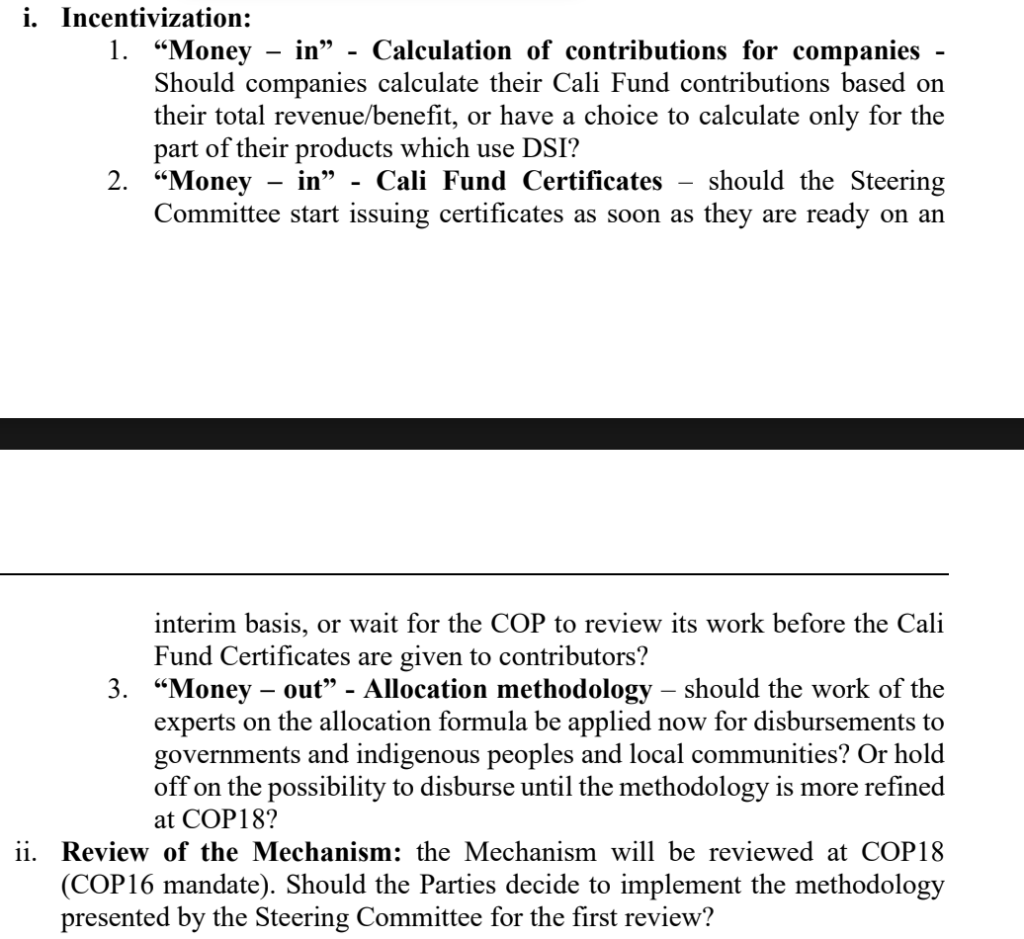
In Yerevan, countries were supposed to consider and finalise these details, such as who “should” pay into the fund and how this money would reach countries and Indigenous communities protecting the world’s genetic diversity.
However, following two weeks of deep divisions, delays and then fears of rushing crucial details in the plenary, most of this work has been pushed to intersessional negotiations leading up to COP18 in 2028.
Countries did, however, finalise a review methodology to assess how the mechanism and thinly lined fund are working by COP18.
Money in vs money out
Countries had a lot to achieve on DSI at COP17. This task list had been broadly grouped by the steering committee into two categories: “money in” and “money out”. The Cali decision gave the steering committee two years to prepare studies and documents to support COP17 deliberations on both tracks.
“Money in” refers to which – and by how much – companies pay into the fund, defined by “thresholds” and contribution rates. Thresholds mean deciding which companies – small, medium or large – “should” contribute to the Cali Fund and whether that is decided on the basis of size, revenue or their “proportional” use of DSI.
Contribution rates refer to how much companies pay. Days before COP17, the CBD secretariat submitted a 209-page study, conducted by an external consultant, on thresholds and contribution rates.
Contributions to the fund, however, are voluntary, with indicative rates already set out in the COP16 decision – 0.1% of revenue, or 1% of profits. According to a DeSmog investigation, pharmaceutical trade lobbies “challenged” these rates and called for a radical rethink of the fund itself. (See: Lobbying and influence.)
“Money out”, meanwhile, refers to how the Cali Fund’s resources are allocated, disbursed and spent.
As Carbon Brief reporting has shown, there has been barely any “money in” to the Cali Fund over the past two years. At the start of COP17, the fund had only $6,000 in it. By the end of it, pledges went up, but not by much: totalling $10,565 and less than $9,000 in actual deposits.
To date, not a single large company among the sectors identified as reliant on DSI has contributed to the fund.
Observers and government delegates across blocs told Carbon Brief that the bulk of the steering committee’s work leading up to COP17 was focused on the “money out”.
This included an emphasis on certificates and other “incentives” for companies to pay. Obtaining such a certificate for a full contribution, for instance, could indemnify companies from paying any more for DSI use that year. Right now, every voluntary contribution, no matter how small, gets a receipt from the Cali Fund.
“Money out” also comprises how funds would be allocated and disbursed to countries and Indigenous communities, as well as transparency on how it would be spent.
At the talks, Brazil – supported by other developing countries – called for Cali Fund contributions to reach at least $200m in its pilot phase before discussing allocation.
Dr Siva Thambisetty, associate professor of law at the London School of Economics, told Carbon Brief:
“We seemed to collapse the entire question to certificates. I question whether we should have spent so much time on allocation strategies when the ‘money in’ has been so insignificant.”
Through most of the talks, industry – supported by the EU and UK – sought “legal clarity” on “certificates” for potential contributions.
At an informal dialogue on DSI on 23 October attended by Carbon Brief, industry representatives echoed calls for more “legal certainty” before they would pledge more. They also warned of “obligation stacking” from having to share benefits from using genetic resources under other treaties.
While the first non-paper on DSI on 20 October had 154 brackets, countries worked over the weekend to remove contentious elements.
However, disagreements on these details underpinning the text were still substantive. At 6am on 28 October, the COP president sent out a letter calling for informal ministerial consultations, steered by Canada and Zimbabwe. The letter also set out “overarching questions” to resolve.
The penultimate DSI text only emerged late on the final day of COP17, with parties such as Fiji saying that many countries had very little time to read it.
After multiple interventions from countries including Fiji, India, the EU, Brazil, China and Argentina, parties could find no way forward.
The chair of a working group tasked with resolving some of the most contentious negotiations before the final plenary called for a “friends of the chair” group to determine intersessional work on DSI, led by Fiji. He urged these consultations to continue in parallel with the COP17 plenary, or risk having no COP decision at all.
At 5am on 31 October, the COP president proposed a draft decision on DSI, as the final plenary entered its seventh hour.
The text “reaffirms” the indicative contribution rates agreed at COP16. It sets out an allocation methodology on how funds from the Cali Fund will be disbursed after COP18, while “allow[ing]” the steering committee to make payments “on an exceptional basis” if contributions to the Cali Fund reach $150m.
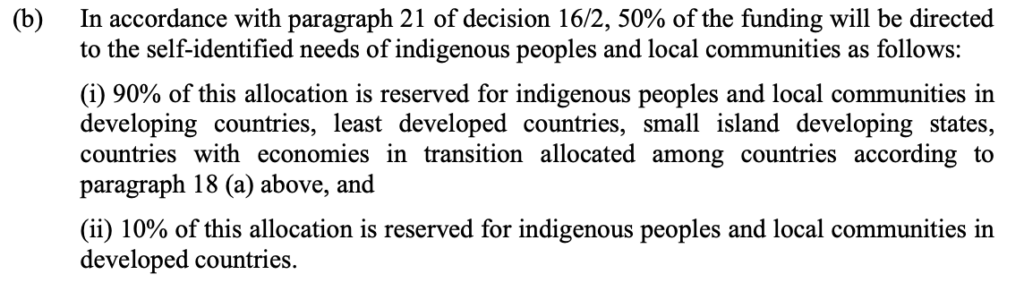
Only contributions by companies amounting to “1% of their profit or 0.1% of their revenue” will be entitled to a Cali Fund certificate for the year, it clarifies.
The president’s text was adopted without objections at 5:25am, with the emptying plenary hall bursting into applause.
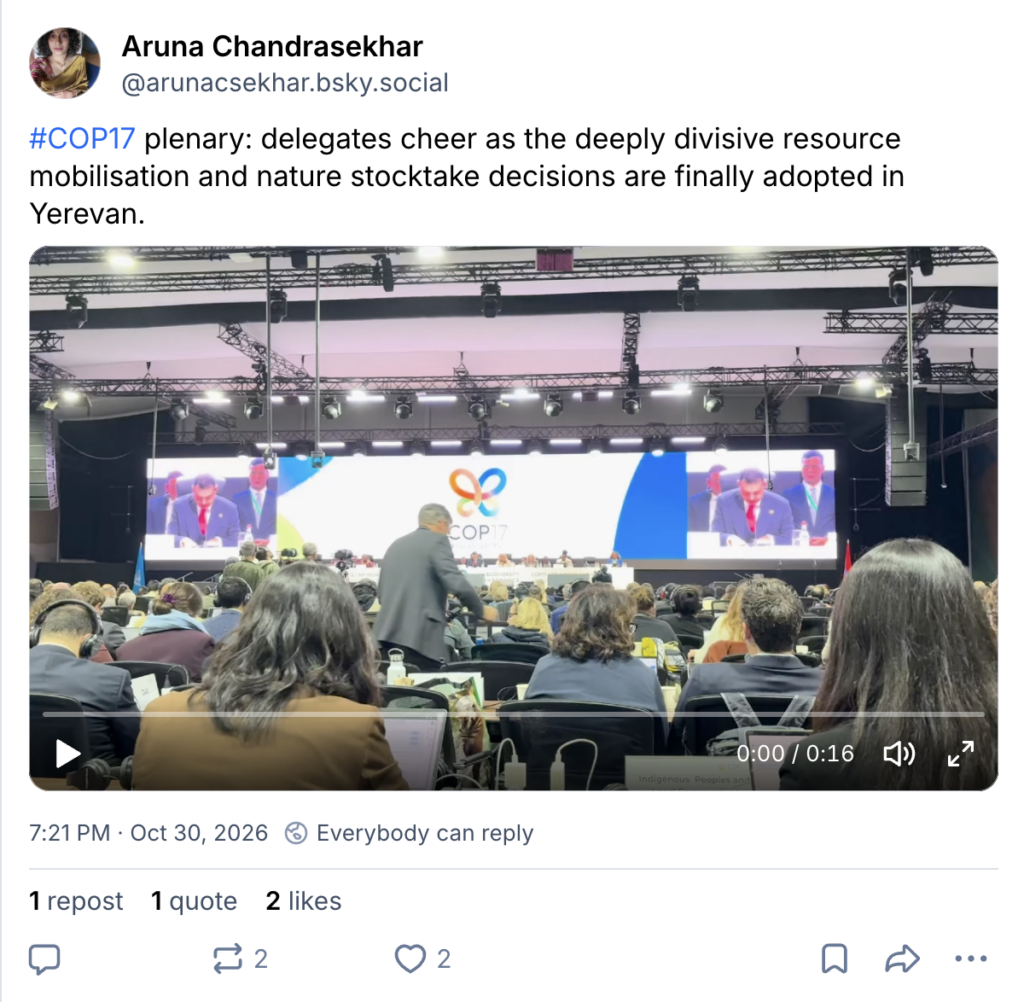
Speaking to Carbon Brief minutes after the DSI decision was adopted, Fiji’s Sivendra Michael said he was “so glad I was given the opportunity to chair and bring this decision to a close”. He added:
“It matters a lot, especially for Indigenous people back home, because any work that is done in the methodology and how benefits get distributed should respect the rights of Indigenous peoples.
“I knew I would land it before I left here. It also shows Pacific leadership in this space, because Pacific islands may be small, but our leadership has really been demonstrated across the room, when we can come in and offer bridging proposals and push countries to show what flexibility looks like.”
Despite Michael welcoming the decision, others were more critical.
Dr June Rubis, Indigenous peoples and local communities (IPLC) representative from Asia on the Cali Fund’s steering committee, said:
“Many wealthy nations asked for a voluntary fund, got one, and business has spent the last two years stalling contributions, throwing doubt on the multilateral mechanism.
“The commitment made in Cali still stands and Indigenous peoples and local communities cannot keep waiting while companies free-ride off nature’s genetic information. While setting the rules for new funds like this does take time to get right, governments need to start treating this as a matter of economic resilience and human survival.”
Thambisetty told Carbon Brief after the talks concluded:
“The Cali Fund is on life support. We leave Yerevan with an open-ended working group. It became clear that work in the run-up to COP17 was distorted by industry echo chambers, a receptive steering committee and lack of close engagement and oversight.
There is much work ahead, but we need transparency, a robust and imaginative public narrative and, inevitably, a hardening of the regulatory ecosystem by states where large DSI users are based.”
Industry-led initiatives
In addition to the work on DSI by parties, there was an industry-led initiative announced at COP17.
The proposal – seen by Carbon Brief – aims to start a separate philanthropic fund, called the Biodiversity Foundation Initiative.
This initiative argues that the Cali Fund and national benefit-sharing measures “create complex payment obligations, compliance requirements and unpredictable financial exposure”.
Rubis expressed concern that industry was “picking up on our language of ‘different pathways’” to start its own fund with the expectation it would then receive particular certificates from key governments.
While the initiative says it “intends to complement – not replace” – the Cali Fund, it also notes that it hopes to “engage key governments” and “build political support”, with little clarity on whether communities would receive benefits.
Other Indigenous leaders and academics told Carbon Brief they were being “actively lobbied” at COP17 to support this initiative, although its architects described their outreach as a “co-design” phase for the fund.
Harmful subsidies
Nature-harming subsidies were a central point of discussion throughout COP17 – both inside negotiation rooms and at side events in Yerevan.
Governments spend as much as $1.8tn each year on subsidies and incentives that could be “harmful” to biodiversity across a range of sectors, particularly fossil fuels and agriculture.
Target 18 of the GBF sets out the aim to identify – by 2025 – and then “eliminate, phase out or reform” these harmful incentives. It also outlines that subsidies should be reduced by at least $500bn each year by 2030.
Carbon Brief analysis published in July found that 84% of countries missed the 2025 identification deadline. Countries have also shown “insufficient” progress so far on target 18, according to the global report.
At an event on 26 October, UN biodiversity chief Astrid Schomaker described subsidy reform as “politically charged and socially sensitive”. This was evident throughout the negotiations, despite countries already agreeing to the terms of target 18 four years ago.
Harmful subsidies featured in several negotiated outcomes from Yerevan – most notably in the global review. (See: Global review)
Earlier versions of a subsidy-related paragraph in the review “urge[d]” stronger action on target 18.
In a non-paper released on 25 October, this was softened to “encourage” countries to scale up identification, elimination, phase-out or reform of harmful incentives, “in accordance with national circumstances”.
![Bracketed text on subsidies from a 25 October non-paper on the global review. The text says: "[26. Encourages Parties, in accordance with national circumstances, priorities and capabilities, to accelerate identification,] as well as [of] the elimination, phase out or reform of [negative] incentives, including subsidies, harmful to biodiversity and [identification of and] the scaling up of positive incentives, so as to bridge the gaps identified in para 5.]"](https://www.carbonbrief.org/wp-content/uploads/2026/10/Orla_ragout-1024x220.png)
Carbon Brief understands that Colombia, the UK, Norway, EU nations and many others were in favour of including a paragraph on harmful subsidy reform in the global review. Countries opposed to this included Saudi Arabia and Russia. Near the end of the negotiations, India also proposed removing this paragraph from the text.
The final global review text agreed at COP17 “encourages” countries to “accelerate the implementation of target 18”, but in “accordance with national circumstances”.
Eva Zabey, the chief executive of Business for Nature, said in a statement:
“This COP is a turning point on incentive reform. Through the adoption of this decision, parties have made it a key priority. Incentive reform has moved from the margins to the mainstream of the biodiversity agenda.”
Ahead of COP17, more than 130 businesses and financial organisations signed an open letter calling for governments to reform nature-harming incentives.
On 19 October, a Conservation International report estimated that harmful subsidies result in $11-24.7tn of “hidden environmental and social damage costs” every year.
COP17 also saw the launch of several initiatives focused on subsidy reform, with a number of related announcements on 26 October.
On this day, the COP17 presidency launched the “Yerevan call” on positive biodiversity incentives – a political declaration to increase action and reaffirm commitments to target 18.
It formed one of four “flagship” priorities for the COP17 presidency, with the others focused on conservation measures, mountain and freshwater ecosystems and biodiversity monitoring.
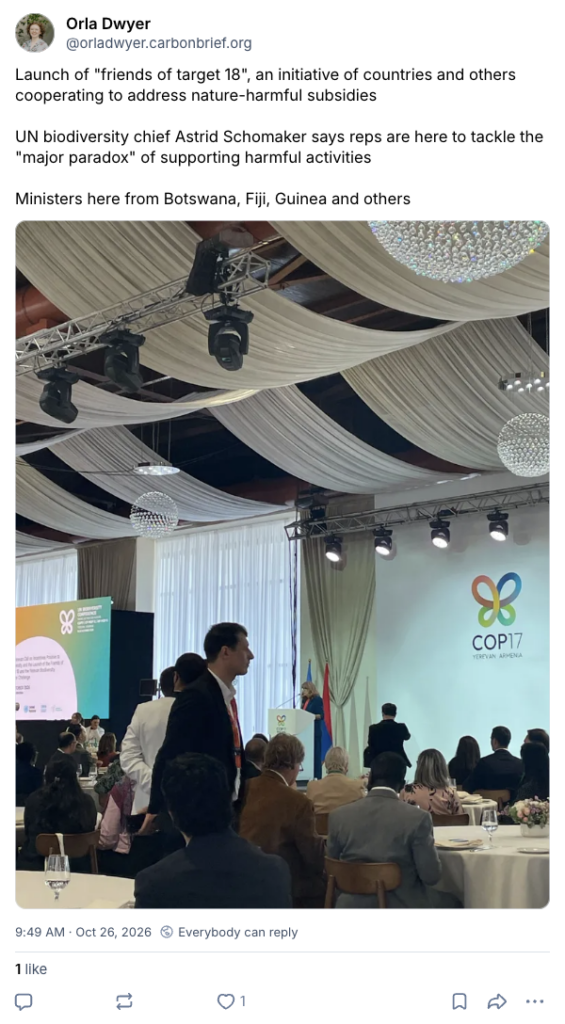
A new group called the “friends of target 18” was also announced. The initiative, put together by the International Institute for Sustainable Development (IISD), will be co-chaired by Colombia and Finland.
Armenia is the only other country currently officially involved in the group, while France, Malawi and Guinea have indicated they will join.
The “friends” group has already held several informal meetings since March 2025, said Farooq Ullah, a senior policy advisor at the IISD. He told Carbon Brief that the group intends to help countries share information and solutions on subsidy reform, and to strengthen “political will” on tackling subsidies.
Ullah said more information and the full list of countries involved will be published in May 2027, during the first planned in-person meeting of the “friends”.
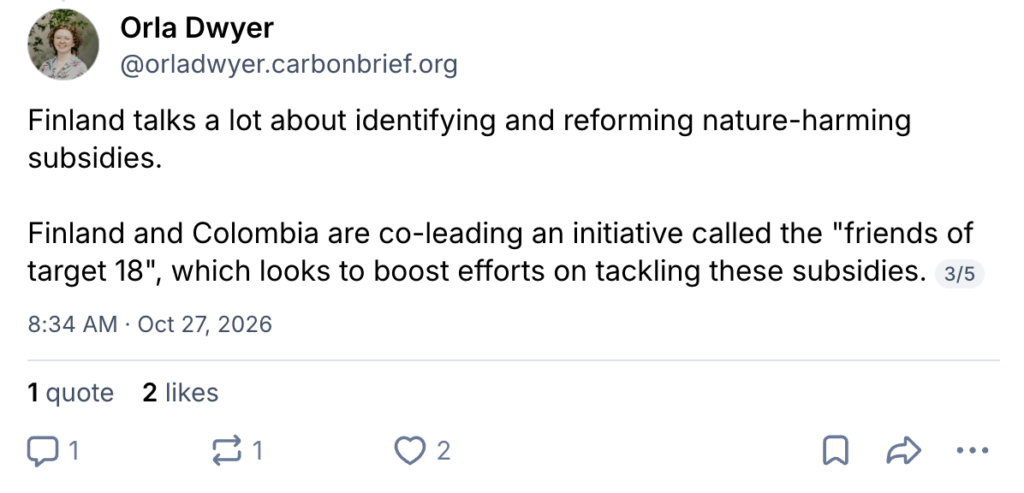
The IISD also published a report on national-level progress on target 18, finding that countries are “not on track” to meet their commitments on subsidy reform.
Throughout COP17, the narrative around harmful subsidies focused primarily on economic – rather than environmental – benefits of reform. Ullah told Carbon Brief:
“Something is different now. Governments are taking this seriously for the first time and, honestly, it may not be for environmental reasons. It is because they are out of money.”
Dozens of countries around the world increased their fossil-fuel subsidies this year to ward off energy price rises after the US-Israel war on Iran disrupted supplies flowing through the Strait of Hormuz.
Marine biodiversity
There were three main points of contention around the text on marine and coastal biodiversity in Yerevan.
The main sticking point concerned references to the agreement on marine biodiversity beyond areas of national jurisdiction, known as BBNJ, or the “High Seas Treaty”. The BBNJ agreement entered into force in January of this year and it has been ratified by more than 100 countries.
The initial non-paper presented for discussion contained six direct references to the treaty – all in brackets. While most parties were in agreement about the importance of recognising the treaty in this text, Russia remained adamantly opposed to most of these references.
Similarly, while many parties wanted to include text in the decision that “welcomes with appreciation” the treaty’s entry into force, Russia said it “could not accept” anything other than “takes note of”.
Ultimately, references to the BBNJ agreement were removed from the preambular paragraphs and several other places in the text, with the decision saying it “takes note of” the treaty’s entry into force.
Parties did agree to establish an informal advisory group on work conducted under the CBD in relation to marine areas beyond national jurisdiction.
The establishment of this group was a “very important” part of the text, said Lolita Couchene, advocacy officer at Nausicaá. Couchene pointed out that the Yerevan summit is the first CBD COP since the entry into force of the BBNJ treaty. She told Carbon Brief:
“There are really high stakes around how it will be addressed…It’s really important, because the entry into force of the BBNJ agreement is a major milestone for ocean governance, and its implementation will also depend on how it connects effectively with the other international frameworks – especially the Convention on Biological Diversity.”
The second sticking point was around one of the annexes to the decision, which concerned ecologically or biologically significant marine areas, known as “EBSAs”.
At COP16 in Cali, negotiators finally came to a decision on the process for scientifically describing EBSAs, after eight years of negotiations. Alongside this, parties requested “voluntary guidelines on peer-review processes” for describing EBSAs.
That language proved contentious in Yerevan, even though it had already been agreed two years earlier. Some parties felt that the word “guidelines” – even directly following “voluntary” – could be seen as too binding. However, many other parties were dissatisfied with the proposed alternative of “voluntary reference elements for good practice”.
As of the second week of the COP, both of these options remained bracketed in the text, along with a compromise option of “voluntary guidance”.

Ultimately, it was this third option that made it into the text adopted during the closing plenary.
The final sticking point with the text was around explicit mentions of Indigenous peoples and local communities (IPLCs), as well as women and youth. These mentions were also contested by Russia.
All of the bracketed mentions of these groups were removed before the text went to the plenary for approval, although the final decision does retain one reference that had not been bracketed.
Xiomara Acevedo, founder and director of the civil society organisation Barranquilla+20, told Carbon Brief that the “regression” on language around IPLCs, women and youth is “concerning because this is already agreed language”. She added:
“We cannot achieve global biodiversity targets by weakening the recognition of the peoples, communities and knowledge systems that have contributed to protecting biodiversity for generations.”
When the marine biodiversity text was discussed in the final plenary session, several parties noted their unhappiness with Russia’s resistance to certain elements of this text. A Chilean delegate said she had “deep concern in the steps we are taking back”. She added:
“We are erasing with our elbow what we have just written.”
Her statement was met with lasting applause in the plenary room.
Planning, monitoring, reporting and review
Alongside the global review, delegates negotiated a separate text on “further enhancing” planning, monitoring, reporting and review (PMRR).
This included additional work on the monitoring framework, which was one of the last issues to get resolved at COP16 – ultimately, it was agreed at the resumed session in Rome in February 2025.
Coming into Yerevan, there “wasn’t really a mandate to continue working on the monitoring framework”, Victoria Romero, senior policy officer for biodiversity at the International Union for the Conservation of Nature (IUCN), told Carbon Brief. Rather, she said, the discussions were very “process-oriented”.
The PMRR decision “welcomes with appreciation” parties’ efforts to provide information in a timely manner, but also “notes with concern” the “institutional, technical, capacity and resource challenges” that made it difficult for parties to do so.
Much of the discussion in Yerevan centred on those challenges. Romero told Carbon Brief:
“There’s an acknowledgement that the monitoring framework wasn’t used as much as it should have. But then one of the gaps identified – that is addressed at this COP – is this expression of needs of capacity to be able to use the monitoring framework.”
The decision “requests” that the Global Environment Facility ensure that “timely, adequate and accessible resources” are available for parties as they prepare their eighth national reports.
In a non-paper released on the first day of the talks, disagreement was clear on several issues, including the level of detail of reporting; the post-2030 work of the convention; development and addition of indicators; and specific references to Indigenous peoples and local communities, women and youth.
An annex to the decision laid out more than a dozen additional, optional indicators that parties could use to report on their progress towards the global targets. Parties were split on how to refer to these indicators, with some supporting text that “agrees” to their inclusion and some wanting weaker text that “takes note” of the additional indicators.
The entire annex was also placed in brackets at one point, but parties later agreed to remove those, with the provision that a footnote be added to clarify that the indicators themselves had not been negotiated by the COP or its subsidiary bodies, according to Earth Negotiations Bulletin.
The final text “takes note” of the additional proposed indicators, while adding that their use is “optional and subject to national circumstances”.
Parties also diverged on how to refer to the convention’s work after 2030: as a post-2030 strategic plan; a possible follow-up to the Framework; or continued implementation of the GBF towards its 2050 goals. Some parties felt it was important not to prejudge the outcome of COP19 by specifying what the post-2030 work would look like.
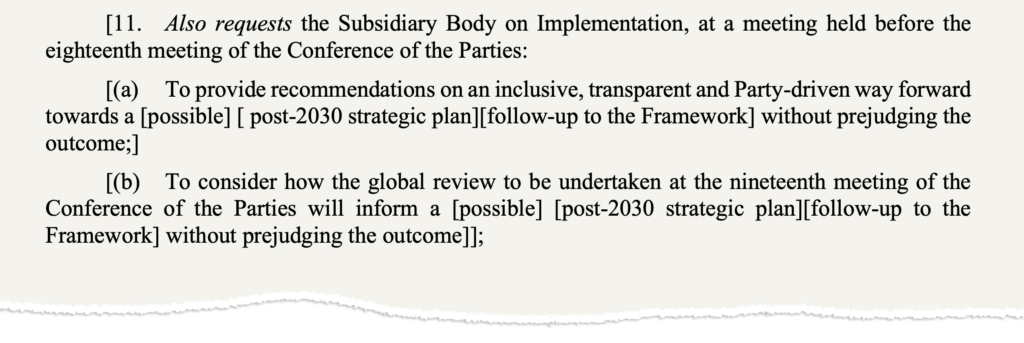
Ultimately, parties agreed to a compromise, brought forward by the EU at the final plenary, to ask the subsidiary bodies for “recommendations on an inclusive, transparent and party-driven way forward for the period post-2030 without prejudging the outcome” in reference to future work.
The decision also agreed to establish an ad hoc technical expert group on the “further operationalisation” of the monitoring framework. This group, which will support parties in preparing their eighth national reports, was a “positive outcome” from the PMRR decision, Romero said.
Article 8(j) implementation
One of the major outcomes from COP16 was the agreement to create a new permanent body for Indigenous peoples.
This would provide a space to advise and offer the views of Indigenous peoples directly at biodiversity COPs for the first time.
Discussions on the role of Indigenous peoples take place at UN biodiversity COPs under Article 8(j) of the Convention on Biological Diversity.
This mandates that countries “respect, preserve and maintain” the knowledge of Indigenous peoples and local communities related to biodiversity conservation, and to “encourage the equitable sharing of benefits”.
At COP17, countries negotiated several documents related to figuring out how this mechanism would be implemented within the CBD, its budget and other organisational matters.
At the end of the final plenary session on 30 October, countries agreed on the “modus operandi” of the permanent body. This was widely celebrated after two weeks of tense and divided negotiations.
The divisions centred on a number of things, including the composition between Indigenous peoples and local communities in a “friends of the bureau” group, plus the geographical rotation of nominations for co-chairs of the subsidiary body.
Several “contact group” negotiations took place on 8(j) at COP17, co-chaired by Jennifer Corpuz from the International Indigenous Forum on Biodiversity and Sikeade Oluwakemi Egbuwalo from Nigeria.
On 27 October, Corpuz told Carbon Brief that countries showed “constructive spirit”, but a lot of “red lines” remained. She added:
“We’re trying our best to get past them, but we know that there are very, very strong views on either side of the table.”
It would be a “failure of COP17” to not agree on the modus operandi, said the DRC on behalf of the African group in the final plenary session on 30 October.
The DRC claimed the plenary would lose “quorum” in “30 minutes” as the talks ran well into overtime, calling on countries to “show courage” on the issue.
In the end, countries signed off on the terms of how the permanent body would be implemented.
More detailed coverage of 8(j) negotiations and outcomes will be added to this article shortly.
Biodiversity and climate change
Countries in Yerevan agreed to a new text on biodiversity and climate change, which included new voluntary guidance for scaling up nature-based solutions, but left out references to a landmark legal climate opinion and new biodiversity science.
Though recognising the links between climate change and biodiversity was a key objective of the Colombian presidency in Cali at COP16, the mood at COP17 was distinctly different, observers told Carbon Brief.
In Cali, countries agreed to a text that “recognises” that biodiversity loss and climate change are “interdependent” issues that “need to be addressed urgently and in a coherent and balanced manner”.
Despite finding agreement two years ago, negotiators decided to revisit this passage again in Yerevan, explained An Lambrechts, head of the Greenpeace delegation at COP17. She told Carbon Brief:
“They actually went to having this exact same debate about some words in the text that they had at COP16. For example, if they refer to interconnected ‘crises’ or ‘challenges’ – and that kept going in circles for a long time.
“[There is] a feeling that there is some backtracking because the world has changed, compared to Cali.”
One key area of contention this year was a movement to cite the International Court of Justice’s landmark advisory “opinion” on climate change within the biodiversity and climate change text. (See Carbon Brief’s in-depth summary of the ICJ opinion.)
Several draft versions of the text contained a reference to the ICJ’s opinion in brackets (illustrated below).
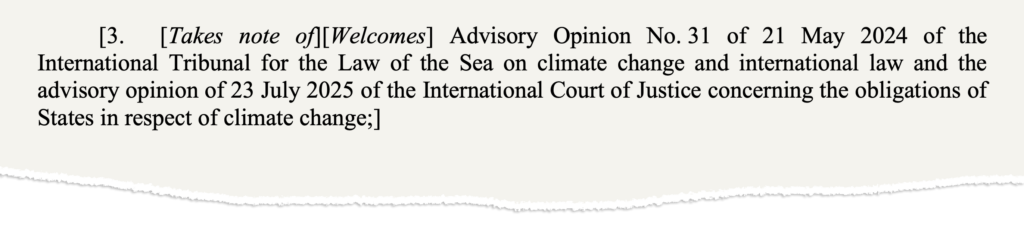
Debates on whether or not to include the reference continued into COP17’s last scheduled day.
The Pacific small island states, Panama, the EU and Brazil supported citing the advisory opinion in the text, Carbon Brief understands, with small islands indicating it was a “red line”.
Meanwhile, Russia, Saudi Arabia and India were “in favour of deletion”, an observer said.
During the final plenary, Russia restated that it would not be willing to agree to the text unless the reference to the ICJ opinion was removed, telling the presidency:
“We are just not willing to move on that, particularly at this time of night.”
Russia also asked the presidency to delete other passages of text referencing IPBES assessments on how to achieve “transformative change” for nature and on the “nexus” between biodiversity, water, food and health.
This was opposed by the UK, which noted that past COPs had “previously welcomed” new scientific assessments and reports.
In a further intervention, the UK suggested a “compromise” of deleting a reference to the transformative change assessment, but keeping a reference to the nexus assessment – arguing this was the more “relevant” report for the biodiversity and climate text.
Russia accepted this compromise.
The text was adopted without references to the ICJ opinion on climate change and the IPBES transformative change assessment.
Another key passage in the climate text refers to the development of new “voluntary guidelines” for helping countries scale up nature-based solutions to climate change.
The text “invites” countries to “consider using the voluntary guidelines” to “integrate” nature-based solutions and “social and environmental safeguards in mitigation and adaptation measures”.
It also “requests” that CBD executive secretary Astrid Schomaker “invites” countries and civil society to submit their “views and reflections” on the voluntary guidelines.
Links with other bodies
Following a strong outcome for “links with other bodies” at COP16, negotiations stalled on a number of agenda items in Armenia.
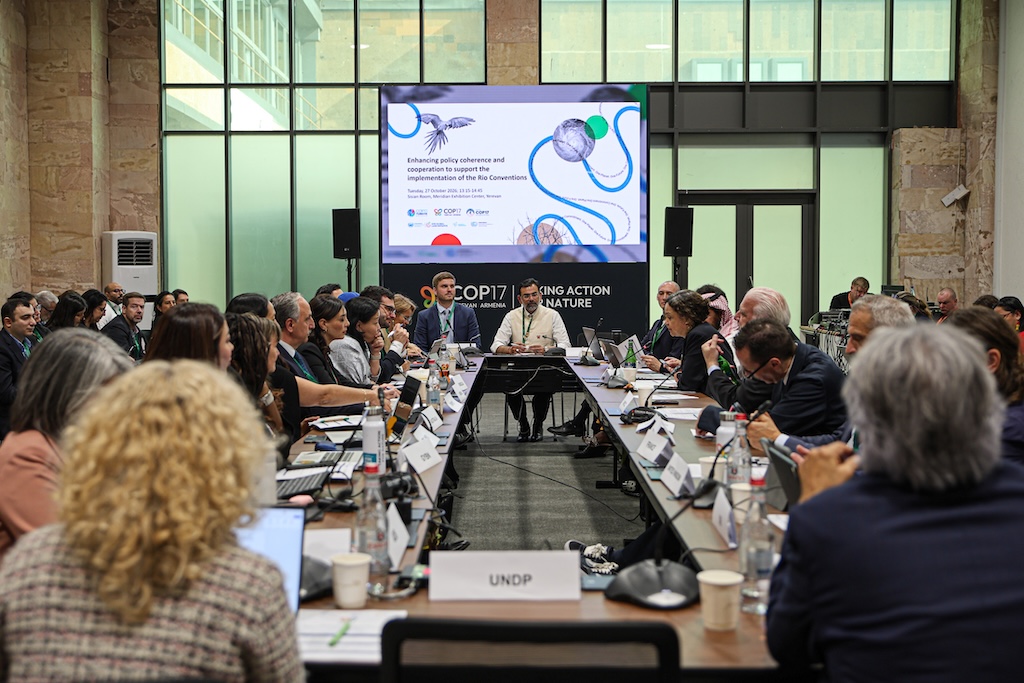
These links were discussed explicitly within agenda item 13, which covers “cooperation with other conventions and international organisations”.
However, references to other “bodies and synergies” across the three Rio conventions were also contentious across several other agenda items, including biodiversity and climate change, as well as the text on marine and coastal biodiversity.
Work mandated by the final COP16 decision led to two documents on cooperation with other bodies being produced during intersessional meetings, which formed the basis of negotiation in Yerevan.
However, not all parties supported these documents and disagreements quickly arose.
Negotiations at COP16 had led to some “really ambitious text” on synergies within the biodiversity and climate change item, according to Bethan Laughlin, senior policy specialist at the Zoological Society of London.
Laughlin told Carbon Brief:
“What we saw was real pushback against the ambition that these annexes brought to the table, with significant resistance from a small number of parties to strengthening synergies, in general. There was also resistance from some to anything that might not be in line with some governments’ national priorities…[This] manifested in the [final] decision, really whittling it down and weakening it.”
Across the first week, in discussion on links with other bodies, contentious elements included the development of a multilevel road map to enhance synergies across the Rio conventions and a “supplement to the voluntary guidelines on ecosystem-based adaptation and disaster risk reduction”.
A heavily bracketed “non-paper” published during the second week of COP17 highlighted the lack of consensus.
Observers told Carbon Brief that some parties pushed back against any references to mitigation within the voluntary guidelines text, alongside references to the recent “nexus” and “transformative” change IPBES assessments.
This mirrors a wider trend of objecting to science and implementation language, both at COP17 and within the wider multilateral space.
There was also significant pushback in the marine and coastal biodiversity negotiations on references to the agreement on biodiversity beyond national jurisdiction (the “High Seas Treaty”), which entered into force in January. (See: Marine biodiversity)
A reference to the High Seas Treaty was bracketed in early versions of the cooperation text, but remained in the final version.
Ultimately, parties decided to pass the multilevel roadmap to peer review, providing parties and stakeholders with more time to provide additional views on the roadmap.
Speaking to Carbon Brief, Camila Jardim, an international political expert at Greenpeace Brazil, said negotiators “struggled to uphold the commitments made in Cali”, adding:
“There was pushback against the synergies agenda – even regarding the use of the term ‘synergies’ itself.”
A draft text was gavelled through during the final plenary for cooperation; however, it pushed work on a number of elements into future meetings.
In the closing days of COP17, the CBD presidency alongside the presidencies of other Rio conventions – the UNFCCC’s COP31, UNCCD’s COP17 and UNCCD’s COP18 – released a joint statement declaring their intention to accelerate work on biodiversity through the use of synergies. It added:
“We call for elevating Rio convention synergies higher on the political agenda, providing opportunities for parties, other governments and relevant stakeholders to engage and contribute in an open, inclusive, transparent, balanced and participatory manner.”
Around the COP
Armenian presidency
Armenia was chosen over Azerbaijan as the host of COP17 in a vote held at the previous UN nature summit in 2024.
(At UN biodiversity talks, countries vote in a secret ballot for the next host nation, at the end of each COP.)
This year’s summit took place in the mountainous nation’s capital of Yerevan – one of the oldest continuously inhabited cities in the world.
Several delegates told Carbon Brief that the COP17 president, Hambardzum Matevosyan, was engaged and well-organised throughout the talks.
During the summit, Matevosyan, Armenia’s environment minister, kept a relatively low public profile outside the walls of the official negotiation rooms.
He spoke at high-level events and a small number of press conferences – alongside frequent Facebook updates – but remained tight-lipped to the media about how the talks were progressing.
He told journalists on 22 October that he had discussed key negotiation issues with countries in the months leading up to the summit, to expedite progress at the talks.
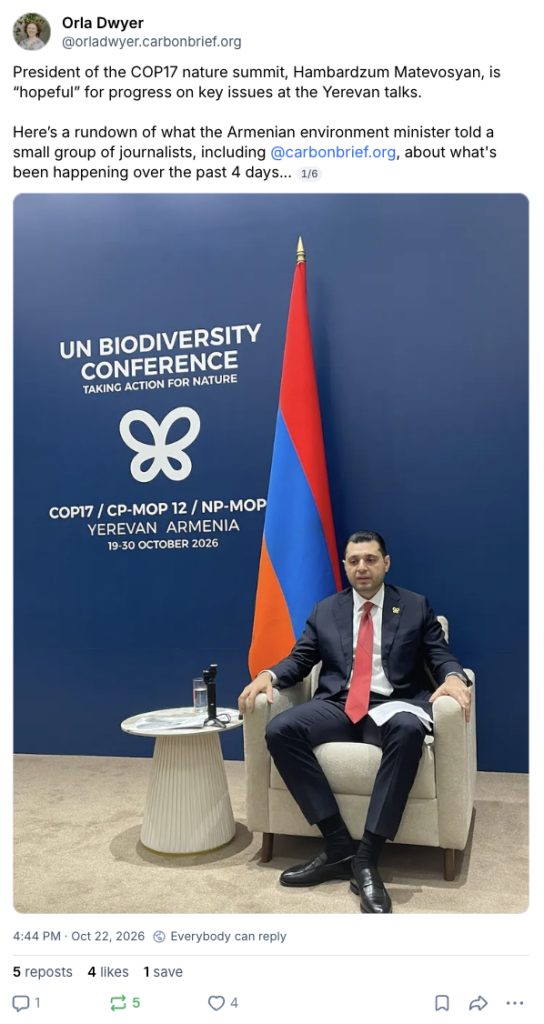
At a mid-point press briefing on 26 October, Matevosyan described “encouraging momentum” and cooperation in the negotiations. He added that he believed COP17 would be judged by its “lasting results”, beyond the final gavel falling.
Speaking at a press conference after the all-night, 12-hour final plenary session, Matevosyan said: “We have achieved more than we could have expected”.
CBD executive secretary Schomaker said the COP achieved “remarkable things at a moment when multilateralism is supposedly not functioning”.
Attendees also widely praised the logistics in Yerevan, with free buses to the conference venue and efforts to ease city congestion, including traffic restrictions and closing local schools.
However, Armenia’s hosting of the COP also drew attention to its own environmental record.
Civil-society groups criticised the launch of operations at a gold mine in the south-east of the country just over one week before COP17 began. (See: Protests)
Prime minister Nikol Pashinyan’s framing of the mine as a “success” also drew criticism, according to Armenian investigative outlet Hetq.
Mining is a key economic sector in Armenia, with the nation holding reserves of rare minerals, copper and gold. Land-use change – mainly for agriculture, but also partly for mining – is one of the key drivers of biodiversity loss.
Hetq also reported that “construction waste” from the COP17 negotiations venue “spilled” into a gorge that was recently recognised as a specially protected natural area.
Hetq said Armenia’s ministry of environment “noted that it is not a body that exercises supervisory functions over environmental protection norms”.
Protests
Protests at COP17 were muted, compared to the loud marches seen at most climate COPs, with many “silent” demonstrations inside the blue zone when negotiations were under way.
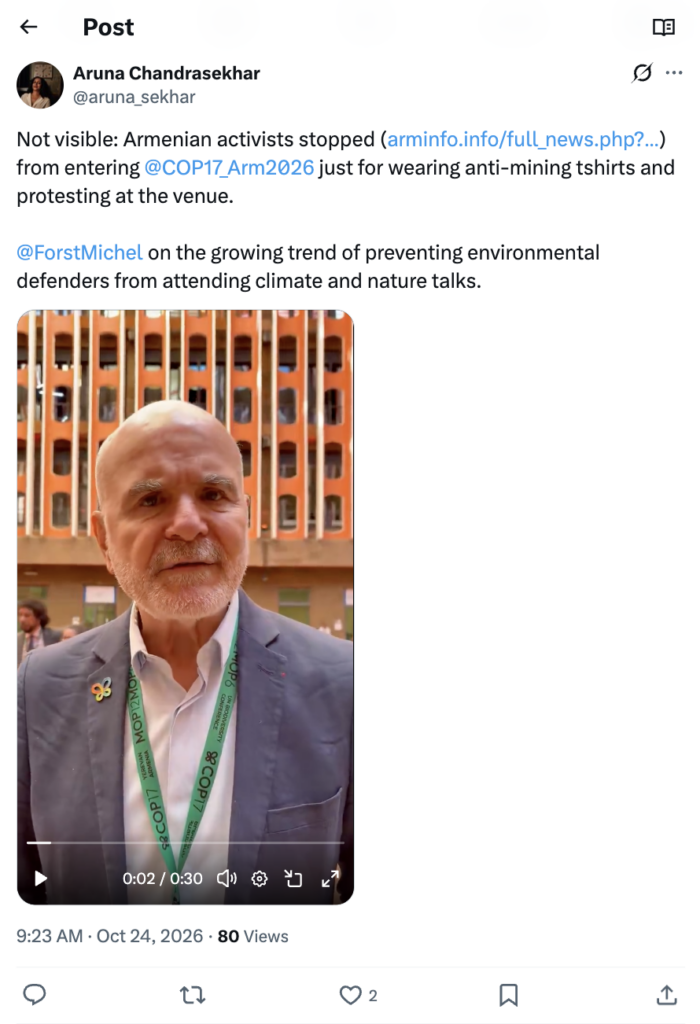
On the first day of the talks, Armenian activists wearing t-shirts and carrying signs drawing attention to the controversial Amulsar gold mine were prevented from entering the venue.
Two days later, one of the same activists, Anna Shahnazaryan, was again denied entry to the venue – although she was later allowed to speak at an event organised by the CBD women’s caucus.
In a press conference, Shahnazaryan said that the mine – which began operations one week before COP17 – “undermines and obstructs all 23 targets” of the GBF. She added:
“This is similar to the climate COPs, where the whole world gathers to discuss the climate crisis, but oil industry representatives attend and strike deals. The same thing is happening here at our COP. We must not allow the discourse on biodiversity conservation to be cynically turned into mining rhetoric.”
The UN special rapporteur for environmental defenders, Michel Forst, told Carbon Brief:
“Biodiversity [loss], climate [change] and pollution are the main threats to the planet currently. And my concern as special rapporteur is that I see many people could not participate in COP meetings. I’m there also to prevent attacks from occurring, but to ensure people have the full right to participate and express themselves safely in these premises.”
As wildfires raged in Indonesia, activists wearing pollution masks in the foyer of the COP17 venue drew attention to the extinction risk facing Tapanuli orangutans.
According to a new report by conservation NGO Mighty Earth, around 7% of the species’ population was wiped out by Cyclone Senyar, which struck Sumatra last year. The report noted that the storm was “supercharged” by climate change.
Prof Serge Wich, a primatologist who helped identify the Tapanuli orangutans as a distinct species only in 2017, said in the report:
“[Extinction of these orangutans] would be a terrible failure by humanity, the conservation community and governments. With all the knowledge and money we have in the world, if we can’t save charismatic species like this… what is the hope for all the other species that we care about?”
The largest protest by far at COP17 was held by Brazilian Indigenous groups ahead of the country’s presidential run-off election on 25 October. Protesters said the vote was crucial to “defend democracy”, Brazil’s sovereignty and biodiversity.
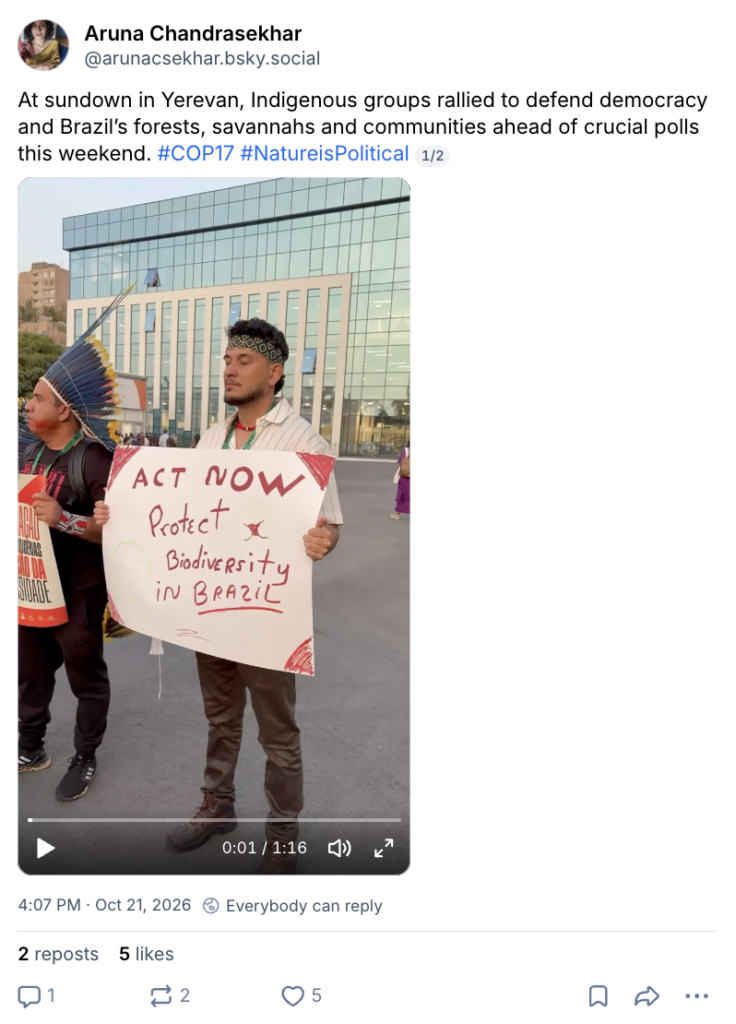
According to a statement by the Articulation of Indigenous Peoples of Brazil (APIB), the “electoral advance of the far right” in Brazil’s Congressional elections earlier this month brought back issues that are “not abstract” to Indigenous peoples, but are tied to their safety, autonomy and survival.
Prior to the election, Carbon Brief analysis showed that Lula’s third term as president prevented the deforestation of an area of Amazon rainforest roughly the size of the US state of New Jersey.
Camila Jardim from Greenpeace Brazil told Carbon Brief at a press briefing that the incoming Brazilian Congress will, nonetheless, have a stronger ability to “dismantle” environmental protections due to the large majority won by far-right parties.
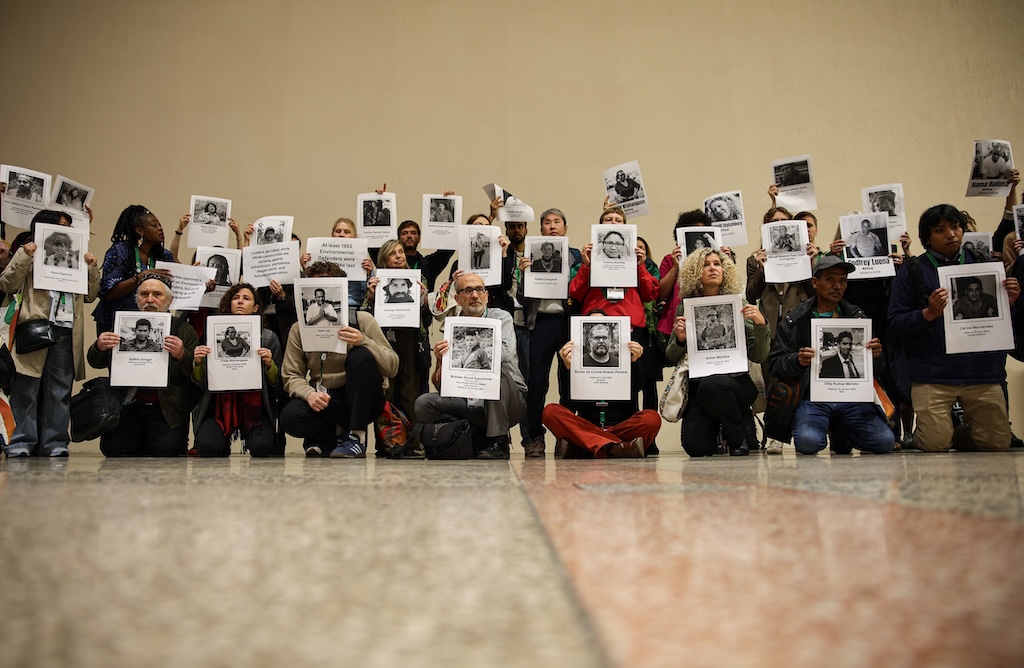
As ministers huddled behind closed doors on 29 October, human-rights organisations held a silent protest in the main hallway to draw attention to frontline environmentalists killed defending biodiversity.
Lobbying and influence
Throughout the talks, advocacy groups highlighted the role of lobbying within negotiations on key texts.
Investigative outlet DeSmog said a leading pharmaceutical group had tried to weaken the terms of the Cali Fund, since it was first announced in 2024.
DeSmog said it had seen documents in which the International Federation of Pharmaceutical Manufacturers and Associations (IFPMA) called for a “radical rethink” of the fund.
The outlet quoted Guilherme Cintra, director of innovation policy at IFPMA, saying the group had “long supported the goals of the Convention on Biological Diversity and continues to deliver against the targets set out in the Global Biodiversity Framework”.
However, DeSmog also quoted the industry group stating that the “modalities of the decision” to establish the Cali Fund should be “significantly reviewed, revised and clarified”.
Various charities raised concerns about the potential role of lobbying in the run-up to COP17, including Amnesty International, which warned in a briefing document:
“Companies and industry associations have massively stepped up their lobbying to counter and roll back biodiversity protections, which they see as limiting their business opportunities. To do this, they turn up in large numbers at the COPs, and take up space that could be used for the voices of affected communities.”
As the negotiations continued into their second week, charities continued to caution about the potential for lobbying.
For example, Greenpeace called on governments to “get their act together and…prevent corporate lobbyists from capturing the negotiations”.
Carbon and biodiversity markets
Despite controversy surrounding biodiversity offsets and credits, they are officially accepted as one of the official means of achieving the GBF’s target 19.
Amid a shortfall in international public finance for biodiversity, these markets were expected to feature prominently in Yerevan.
“One area the discussion has moved forward quite a lot is the area of biodiversity credits,” said UN biodiversity chief Schomaker at a nature finance press conference ahead of COP17 in September.
She admitted that credits were “rather controversially discussed” at COP16 and “among the messages” from Indigenous communities and civil society was the “need to really learn from carbon credits”. Schomaker added that they “remain an important instrument”, if they can be “high-integrity”.
At a press conference on the first day at COP17, Indigenous leaders opposed the use of “charismatic species” – such as lions or rhinos that are generally popular with people – as credits to “offset” biodiversity loss.
Speaking to reporters, Tom Goldtooth, Dakota environmentalist and executive director of the Indigenous Environmental Network, called biodiversity credits a “violation of the sacred, of Indigenous peoples’ values”.
Criticising “buffalo bonds” for carbon storage, Goldtooth continued:
“It’s Chevron, it’s Shell leasing trees using colonial structures of property rights. I cannot comprehend a world where they use whales as carbon sponges. We come from the buffalo, but markets do not understand this. For us, nature is not an asset class; nature is Mother Earth and Father Sky.”
On 27 October, the EU environment commissioner Jessika Roswall launched an initiative called “Friends of Credits for Nature and Biodiversity” at an event co-hosted with France and Peru.
According to the EU’s statement, the “informal” initiative aims to build “governmental support” and international cooperation on nature credits. It has been “welcomed” by Finland, Luxembourg, the Netherlands, Portugal and Spain, as well as Australia, Botswana, Canada, Chile, Indonesia, Japan and New Zealand.
When asked why the EU was focusing on “broadening the contributor base” through biodiversity markets at COP17, Roswell told Carbon Brief that nature credits were part of the EU’s attempts to close the nature investment gap as part of target 19.
She told Carbon Brief that biodiversity finance is not just a “question of will”, but also the “bigger horizontal risk” of not working on the areas. As such, Rosland said the EU is “working on a broader perspective” and looking at a range of solutions, “not only public money”.
In Yerevan, China also announced that it would be testing nature markets, with a pilot in Sichuan, reported Carbon Pulse.
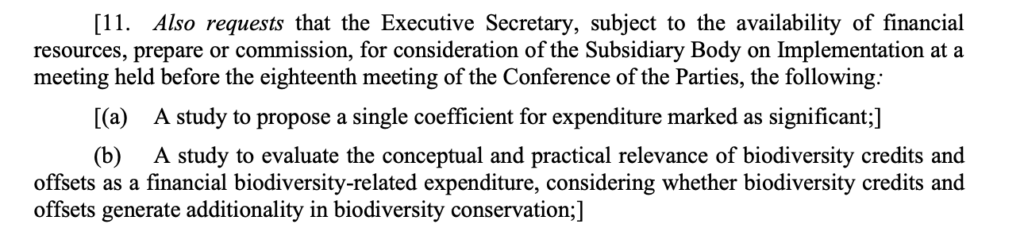
During the COP17 plenary, however, Peru called for biodiversity offsets to be scrutinised as a financial instrument listed in the GBF’s Target 19.
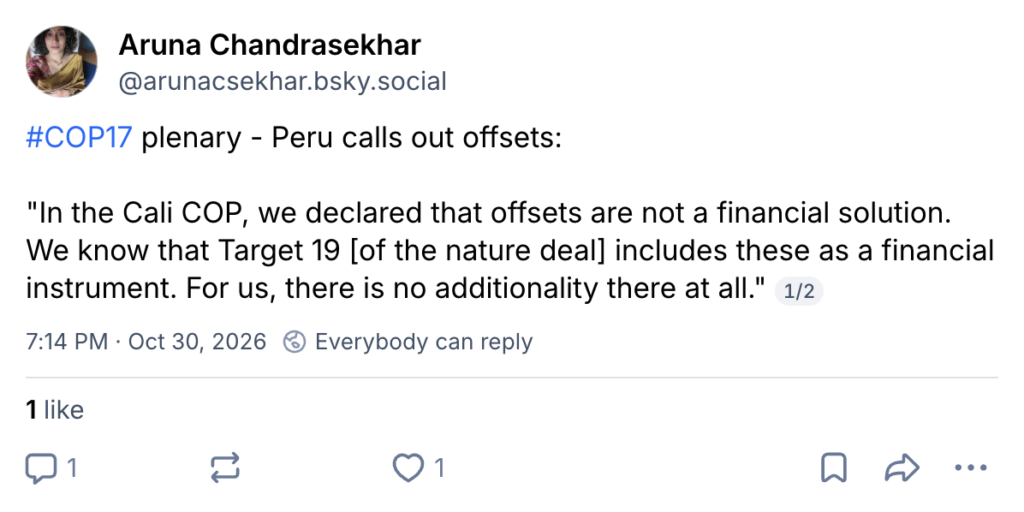
Peru’s call for a study to examine whether biodiversity credits and offsets “generate additionality in biodiversity conservation” was included in the final resource mobilisation decision.


The post COP17: Key outcomes agreed at the UN biodiversity conference in Yerevan appeared first on Carbon Brief.
Source: COP17: Key outcomes agreed at the UN biodiversity conference in Yerevan