AI Insight
Researchers developed a machine learning model that can predict sudden stratospheric warming events, which cause the polar vortex to weaken and send frigid air southward across North America and Europe. Using a conditional variational autoencoder trained on physics-based atmospheric simulations, the team identified four distinct clusters representing strong and weak polar vortex states and the transition pathways between them. Analysis of these clusters revealed an interpretable signal that can predict when polar vortex disruptions are about to occur.
Why it matters
Sudden stratospheric warming events cause dangerous temperature drops across populated regions but remain difficult to forecast with current methods. This machine learning approach could enable earlier warnings to the public about incoming cold waves, while demonstrating that artificial intelligence can effectively model and predict complex atmospheric phenomena.
Understand the Science
Source: Journal of Geophysical Research: Machine Learning and Computation
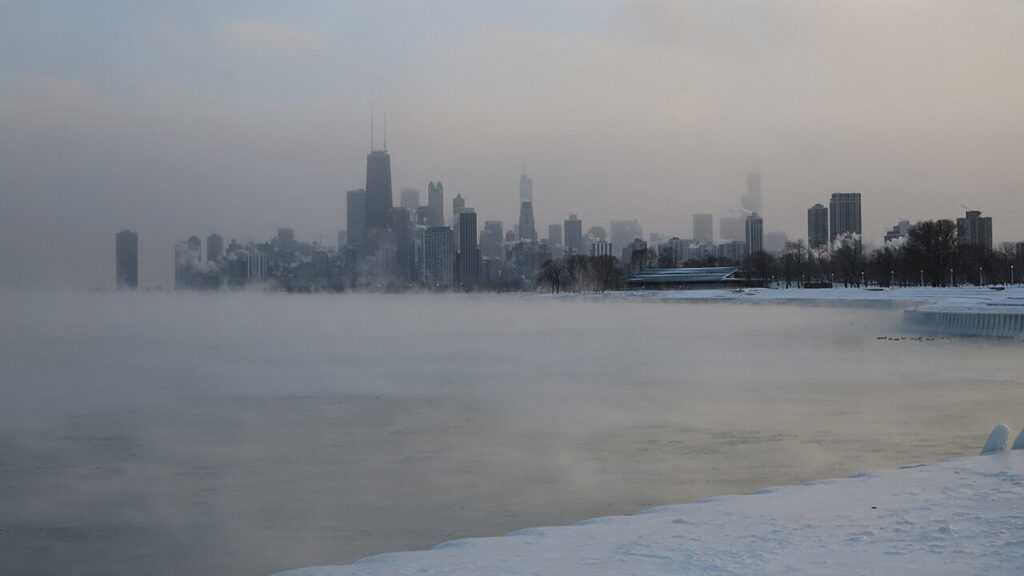
The polar vortex, a swirling mass of cold air encircling the North Pole, is sometimes disrupted by sudden stratospheric warming (SSW) events, unleashing waves of frigid air that penetrate farther south than usual. Temperatures across North America and Europe drop precipitously when this happens, but such events remain hard to predict, meaning we can’t easily warn people when SSW is imminent.
Boscu et al. used a machine learning (ML) technique to learn SSW behavior from a physics-based simulation that reproduces important atmospheric dynamics, accelerating polar vortex simulations. They went a step further by analyzing the ML model itself to understand how it represents various aspects of the polar vortex.
The authors trained their model on the Holton-Mass model of stratospheric variability, which produces two metastable regimes for the polar vortex: one weak and one strong. A transition from the strong to the weak regime is what causes SSW events. The authors first verified that their model, made using a conditional variational autoencoder, reproduced both the strong and weak regimes. Then, they conducted a principal component analysis to better understand how the model represents these features. They found four physically interpretable clusters corresponding to strong and weak states, as well as the transition pathways between them.
Hidden within these clusters, the authors say, is a clearly interpretable signal that predicts whether a disruption to the polar vortex is about to happen. This finding suggests that scientists could repurpose the ML model to better predict when future SSW events will happen in the real world. Their work also shows that complex features of the atmosphere can be modeled and understood using artificial intelligence, they add. (Journal of Geophysical Research: Machine Learning and Computation, https://doi.org/10.1029/2026JH001387, 2026)
—Nathaniel Scharping (@nathanielscharp), Science Writer

Citation: Scharping, N. (2026), Using machine learning techniques for polar vortex predictions, Eos, 107, https://doi.org/10.1029/2026EO260332. Published on 20 October 2026.
Text © 2026. AGU. CC BY-NC-ND 3.0
Except where otherwise noted, images are subject to copyright. Any reuse without express permission from the copyright owner is prohibited.
Source: Using Machine Learning Techniques for Polar Vortex Predictions