AI Insight
Researchers studied 40 acidic and saline lakes in Western Australia's Yilgarn Craton that undergo repeated wet-dry cycles, finding they share geological characteristics with lakes in Mars's Terra Sirenum region. The study documented diverse mineral deposits including salts, aluminum-rich clays, and iron oxides that form through groundwater activity and evaporation cycles, providing insights into similar water-rock interactions that may have occurred on Mars. Despite extreme conditions, these Australian lakes support microbial life, suggesting comparable Martian environments could have been habitable.
Why it matters
This research identifies Terra Sirenum as a promising target for searching for evidence of past life on Mars. The findings challenge existing theories about Martian surface formation and provide Earth-based analogs for understanding how water shaped potentially habitable environments on the Red Planet.
Understand the Science
Source: Earth and Space Science
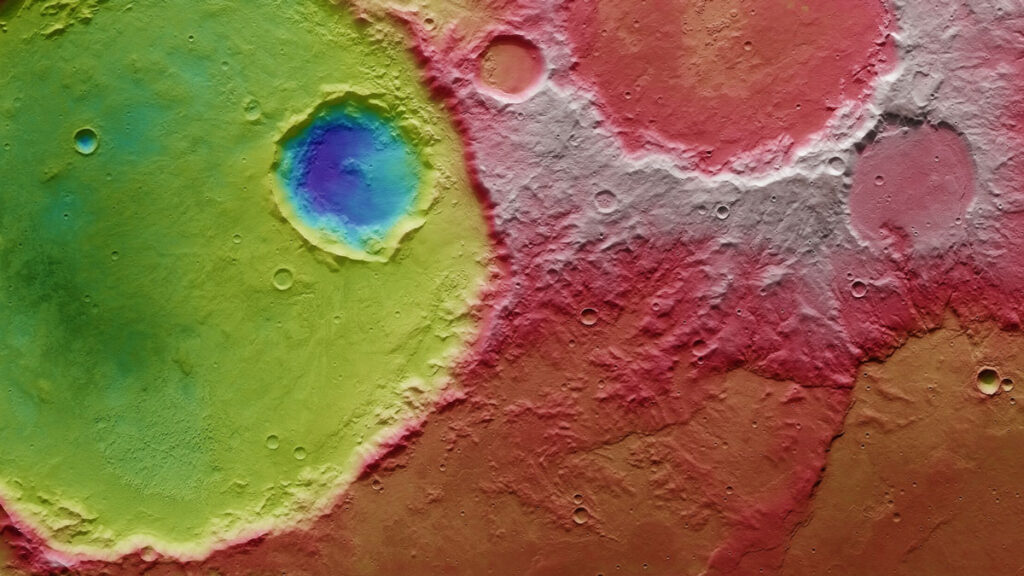
The expansive red bluffs of Western Australia’s Yilgarn Craton give the landscape a Martian appearance. It turns out the resemblance is more than superficial: The Yilgarn Craton also shares geological characteristics with lakes in Mars’s Terra Sirenum region. Plattner et al. recently characterized those shared features to shed light on the region’s aqueous history and its potential to have supported life.
The Yilgarn Craton contains thousands of acidic and saline lakes that undergo repeated wet-dry cycles. The researchers sampled 40 lakes during both the wet and dry seasons to assess how they change through time. These extreme environments are shaped by the interplay of groundwater, evaporation, and surface processes, generating a remarkable diversity of geochemical conditions. The mineral fingerprints preserved across these landscapes record long-lived groundwater activity and recurring wet-dry cycles, offering clues to how similar water-rock interactions may have shaped potentially habitable environments on the Red Planet.
The geochemistry of lake beds varied widely in response to these hydrologic fluctuations, the researchers found. In some shallow lakes, salt was the predominant mineral that accumulated. In others, a wider variety of minerals, including aluminum-rich clays and iron oxides, built up over time. Acidity and salinity levels also varied.
Some Australian lakes show depositions similar to craters in the Terra Sirenum region on Mars, suggesting that similar hydrologic processes might have taken place over the planet’s history. In some cases, the findings contradict long-held notions that magmatism must have shaped portions of Mars’s surface.
Even though these combinations of salts and acidic minerals indicate extreme lake conditions, the lakes in Western Australia still support diverse microbial life, suggesting that Terra Sirenum might be one of the best places to look for evidence of potential life on Mars, the authors wrote. (Earth and Space Science, https://doi.org/10.1029/2026EA005066, 2026)
—Saima May Sidik (@saimamay.bsky.social), Science Writer

Citation: Sidik, S. M. (2026), What Australian lakes showed us about Martian hydrology, Eos, 107, https://doi.org/10.1029/2026EO260244. Published on [DAY MONTH] 2026.
Text © 2026. AGU. CC BY-NC-ND 3.0
Except where otherwise noted, images are subject to copyright. Any reuse without express permission from the copyright owner is prohibited.
Source: What Australian Lakes Showed Us About Martian Hydrology