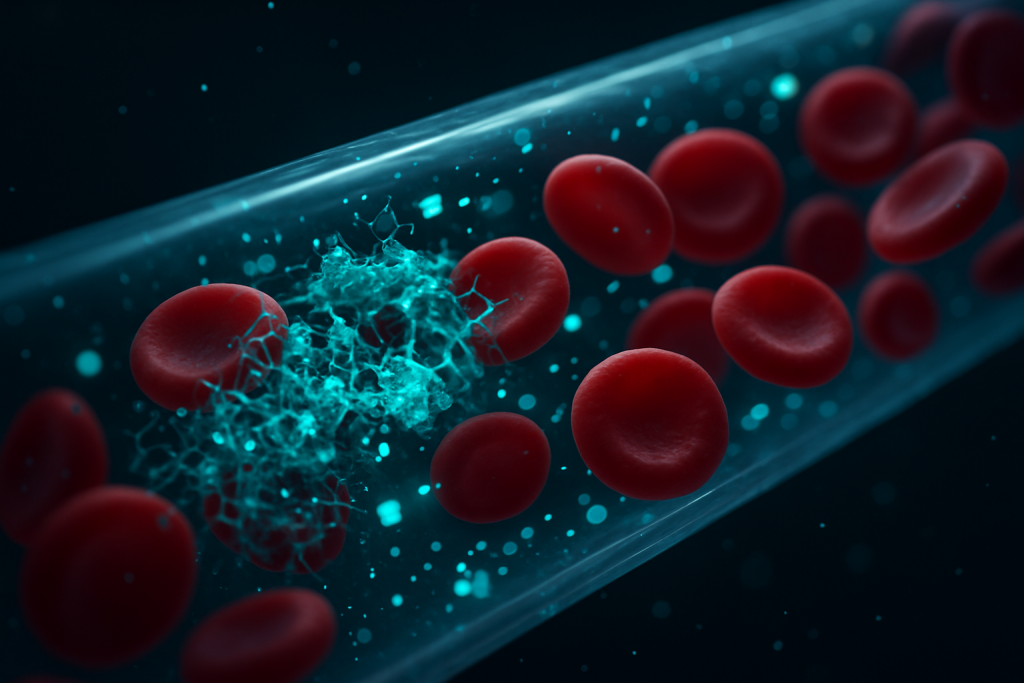
Image generated by AI
Every eleven seconds, someone in the United States suffers a stroke caused by a blood clot. Yet despite this staggering prevalence, the medications we use to prevent these life-threatening clots work through mechanisms that remain poorly understood by most people outside the medical field. Anticoagulants—drugs that thin the blood by interfering with the clotting cascade—represent one of modern medicine’s most paradoxical achievements: they save hundreds of thousands of lives each year while simultaneously requiring patients to walk a razor’s edge between preventing clots and bleeding to death. Understanding how these medications work reveals not just the elegance of our body’s coagulation system, but also the frontier of personalized medicine where genetics, chemistry, and clinical practice intersect.
Blood thinner therapy has become increasingly critical as our population ages and cardiovascular disease remains the leading cause of death worldwide. The rise of new anticoagulants over the past fifteen years has transformed treatment options, offering patients alternatives to warfarin—a drug so effective it remains in use despite being derived from rat poison. Today, millions of patients rely on these medications to prevent strokes from atrial fibrillation, to recover safely after joint replacement surgery, and to survive pulmonary embolisms that would have been fatal a generation ago. Yet questions persist about who needs these drugs, how to monitor their effects, and whether emerging therapies might eventually replace them altogether.
What Is Blood Thinner Therapy and Anticoagulation?
Anticoagulation refers to any medical intervention that inhibits the formation of blood clots—a process called coagulation. When you cut yourself, your body initiates an intricate cascade of chemical reactions involving plasma proteins called clotting factors, which ultimately convert fibrinogen into fibrin, creating a mesh-like plug that seals the wound. Anticoagulant medications disrupt this cascade at various points, preventing clots from forming or growing larger. Importantly, these drugs do not actually thin the blood in the physical sense; rather, they impair the biochemical machinery that transforms liquid blood into solid clots. Blood thinner therapy thus encompasses a range of pharmaceutical approaches, from traditional anticoagulants like heparin and warfarin to newer direct oral anticoagulants (DOACs) such as apixaban and rivaroxaban. The goal of anticoagulation therapy is to maintain a delicate balance: prevent pathological clots from forming in arteries and veins while preserving enough clotting ability to stop bleeding from cuts and wounds.
The history of anticoagulation therapy stretches back further than most realize. In the 1920s, researchers noticed that stored blood failed to clot normally, and they traced this phenomenon to a substance they named heparin—derived from the Greek word for liver, where it is naturally found. Warfarin’s discovery in 1948 came about through a bizarre route: farmers noticed that cattle fed moldy clover developed bleeding disorders, and chemists isolated the culprit—a coumarin derivative they synthesized and eventually named warfarin (from the Wisconsin Alumni Research Foundation). These discoveries laid the foundation for modern anticoagulant therapy, though for decades, physicians had limited options and crude ways to monitor drug effects. The field has accelerated dramatically since the early 2000s, when researchers developed DOACs that target specific clotting factors with greater selectivity than older drugs.
What the Research Shows
At the molecular level, the coagulation cascade operates like a biochemical relay race, where each runner hands off a baton to the next in an exquisitely choreographed sequence. The cascade begins with tissue damage, which exposes a protein called tissue factor to blood. This initiates a series of enzymatic reactions involving factors such as VII, X, V, II, and finally thrombin, which converts fibrinogen into fibrin strands. Different anticoagulants intercept this relay at different points: warfarin inhibits the vitamin K-dependent factors II, VII, IX, and X; heparin amplifies the activity of an inhibitor called antithrombin; and DOACs directly block either factor Xa or thrombin itself. Understanding these mechanisms matters clinically because it explains why different drugs have different monitoring requirements, different interactions with food and other medications, and different risks of bleeding and clotting. The coagulation system also involves natural inhibitors—proteins like protein C, protein S, and antithrombin—that normally prevent clotting from spiraling out of control. When these natural inhibitors malfunction due to genetic mutations, patients face markedly elevated clot risk, a condition called thrombophilia.
Consider an analogy: imagine your blood as a highway system where traffic accidents (clots) can occur. Warfarin acts like a traffic authority that removes certain construction materials (vitamin K-dependent factors) from the roadside, making it harder to build accidents. Heparin works like an accident-response team that immediately responds to any fender-bender (forming clot) and prevents it from escalating into a major pile-up. Direct Xa inhibitors are like police who pull over vehicles at a particular junction (factor X) before they can cause trouble. Each approach makes sense in different contexts: warfarin, with its slow onset and offset, works well for long-term prevention; heparin’s rapid action makes it ideal for acute situations; DOACs offer a middle ground with convenient dosing and faster kinetics. The body’s natural coagulation control systems—the inhibitors and regulators—represent yet another layer of sophistication that researchers are only beginning to fully exploit therapeutically.
What This Means for Patients and Science
For patients, anticoagulation therapy has transformed the prognosis of multiple common conditions. Atrial fibrillation, a heart rhythm disorder affecting millions of people, carries a five-fold increased stroke risk due to blood pooling in the irregular heart chambers; anticoagulants reduce this risk by roughly two-thirds. Following a venous thromboembolism—a blood clot in the leg or lungs—anticoagulation prevents the clot from spreading and reduces recurrence risk by more than 90 percent. Patients with mechanical heart valves, those recovering from major surgery, and those with hypercoagulable blood disorders all depend on anticoagulation to survive and thrive. Yet the therapy comes with genuine costs: major bleeding complications occur in approximately 1-3 percent of patients per year on anticoagulation, with intracranial hemorrhage representing the most feared adverse event. The art of modern anticoagulation medicine lies in identifying which patients truly benefit from treatment—where clot risk outweighs bleeding risk—and then finding the optimal dose and approach for each individual.
Current clinical practice involves several major application areas: prevention of stroke in atrial fibrillation (accounting for roughly 50 percent of anticoagulant use), treatment of acute venous thromboembolism, prevention of clots after orthopedic surgery, management of patients with mechanical heart valves, and treatment of acute coronary syndromes in combination with antiplatelet drugs. Cardiologists now routinely calculate stroke risk using validated scoring systems like CHA₂DS₂-VASc, which weighs factors such as age, hypertension, diabetes, prior stroke, and heart failure to predict who needs anticoagulation. Hematologists employ similar risk stratification for patients with thrombophilia. Technologies are emerging to individualize therapy further: genetic testing for cytochrome P450 variants that affect warfarin metabolism, point-of-care coagulation tests that provide rapid feedback, and artificial intelligence algorithms that predict bleeding risk by analyzing multiple clinical variables simultaneously.
Recent Breakthroughs in Blood Thinner Therapy and Anticoagulation
The past two years have witnessed several significant advances that promise to reshape anticoagulation practice. In 2023 and 2024, multiple trials demonstrated that apixaban and other factor Xa inhibitors may offer advantages over warfarin even in patients with mechanical heart valves—a population previously considered unsuitable for anything but warfarin due to regulatory requirements. Simultaneously, researchers have made progress in understanding why some patients experience thrombotic complications despite being on anticoagulation, leading to the recognition of “anticoagulant resistance” as a distinct clinical phenomenon. New biomarkers measuring thrombin generation, fibrin formation, and platelet activation now allow clinicians to assess coagulation status more precisely than traditional tests like the International Normalized Ratio (INR). Additionally, studies from 2023 have begun exploring combination therapies where anticoagulants are paired with targeted antiplatelet agents or with drugs that modulate natural coagulation inhibitors, showing promise in high-risk populations.
Researchers are currently investigating several frontier questions that could revolutionize the field. How can we better predict which patients will develop bleeding complications, and can we use this information to prevent harm rather than simply managing it after it occurs? Can we develop anticoagulants that target pathological clotting while completely sparing hemostasis—the normal bleeding response—essentially eliminating the fundamental trade-off that has always plagued the field? Some teams are exploring novel targets like tissue factor pathway inhibitor (TFPI) and contact factors (XI and XII), which might offer the holy grail of anticoagulation: prevention of pathological thrombosis without increased bleeding risk. Another active area involves extending anticoagulation therapy in cancer patients, where thrombosis is exceptionally common; whether long-term anticoagulation improves cancer outcomes beyond clot prevention remains an open question.
Why Blood Thinner Therapy and Anticoagulation Matters for the Future
As our population ages and cardiovascular disease remains epidemic, anticoagulation will become increasingly central to medicine. The World Health Organization estimates that by 2030, stroke will become the leading cause of disability worldwide, making effective thromboprophylaxis not just a clinical priority but a global public health imperative. Anticoagulation therapy sits at the intersection of precision medicine and population health: while we move toward individualized dosing based on genetics and biomarkers, we simultaneously must improve population-level uptake and adherence to these life-saving drugs. The emergence of DOACs has already democratized anticoagulation by eliminating the need for frequent INR monitoring, yet disparities persist in access and appropriate prescribing across different socioeconomic and racial groups. Future innovations will likely involve wearable devices that continuously monitor coagulation status, machine learning algorithms that predict optimal dosing based on individual physiology, and perhaps most ambitiously, gene therapies that correct underlying clotting disorders at their root.
Significant challenges remain to be overcome. The optimal duration of anticoagulation after a single thrombotic event remains controversial, with different expert groups recommending different strategies based on competing interpretations of evidence. Some patients experience recurrent thrombosis despite being on therapeutic anticoagulation doses—the aforementioned anticoagulant resistance phenomenon—yet we lack reliable methods to identify these patients prospectively. The intersection of anticoagulation with pregnancy remains problematic, as several classes of anticoagulants cross the placenta or concentrate in breast milk, forcing agonizing choices for reproductive-age patients. Finally, the cost of newer anticoagulants remains prohibitive in many parts of the world, creating a two-tiered system where wealthy patients access superior medications while others rely on older, less convenient drugs.
Key Takeaways
- Anticoagulants prevent blood clots by interrupting the coagulation cascade at different molecular targets, thereby reducing risk of stroke, heart attack, and pulmonary embolism by 50-90 percent depending on the clinical context.
- The coagulation cascade involves a relay of enzymatic reactions that convert fibrinogen into fibrin; different anticoagulants—warfarin, heparin, and direct oral anticoagulants—target different points in this cascade based on their chemical structure and mechanism.
- The most promising application of anticoagulation is prevention of stroke in atrial fibrillation, where risk stratification tools like CHA₂DS₂-VASc help clinicians identify patients who benefit from therapy while minimizing unnecessary treatment.
- Current research is advancing toward anticoagulants that prevent pathological clotting while preserving normal hemostasis, and toward precision medicine approaches using genetic testing and biomarkers to individualize therapy and reduce bleeding complications.
- As cardiovascular disease and stroke remain leading causes of death worldwide, improving anticoagulation therapy—through better drugs, more precise dosing, and equitable access—represents one of medicine’s highest priorities for the coming decades.
Explore TED Talks on Blood Thinner Therapy and Anticoagulation:
TED content is used under CC BY-NC-ND 4.0. © TED Conferences, LLC.
Frequently Asked Questions
How do anticoagulants prevent blood clots by interfering with the coagulation cascade?
Anticoagulants work by blocking specific proteins or factors in the cascade of chemical reactions that leads to clot formation, preventing fibrin strands from cross-linking and stabilizing the clot. Different anticoagulants target different steps—some inhibit thrombin (the final enzyme), while others block earlier factors like Factor Xa or vitamin K-dependent factors.
Why do blood thinner medications create a paradoxical risk between preventing clots and causing bleeding?
Anticoagulants cannot distinguish between pathological clots (those that cause strokes) and protective clots (needed for normal wound healing), so reducing clot formation inevitably increases bleeding risk. This therapeutic window requires careful dosing and monitoring to maintain efficacy while minimizing hemorrhagic complications.
What scientific advantage do newer anticoagulants offer over warfarin, the rat poison-derived drug?
Newer anticoagulants (direct oral anticoagulants or DOACs) have more predictable pharmacokinetics, require less frequent monitoring, and have fewer drug-food interactions compared to warfarin, which requires regular INR testing and dietary vitamin K consistency. They also offer faster onset and offset of action, making them easier for patients to manage.
How do genetics and personalized medicine influence anticoagulation therapy in individual patients?
Genetic variations in liver enzymes (like cytochrome P450) and vitamin K-dependent clotting factors affect how quickly patients metabolize and respond to anticoagulants, meaning optimal drug doses and types vary between individuals. Pharmacogenetic testing can help identify patients who are poor metabolizers or require adjusted dosing for safer, more effective treatment.