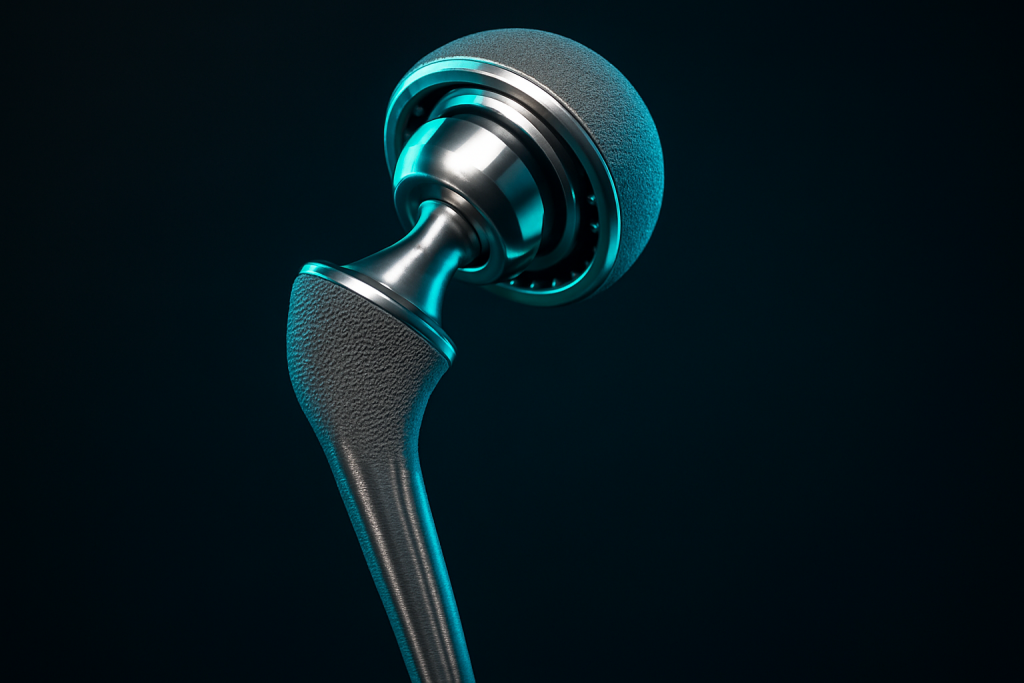
Image generated by AI
Every eleven seconds, someone in the world receives a hip replacement. Yet most people who walk on artificial joints have little idea how these marvels of engineering actually work—or why, after years of perfect function, some implants suddenly fail while others endure for decades. The hip joint, a ball-and-socket mechanism that bears the full weight of your upper body with each step, is one of the most engineered structures in modern medicine, and understanding why it sometimes requires replacement reveals something profound about the boundary between biology and physics.
As our population ages and younger, more active patients demand joint replacements earlier in life, the field faces mounting pressure to develop implants that last longer, integrate better with bone, and allow patients to return to the activities they love. At the same time, surgeons and engineers are grappling with fundamental questions: What materials work best? How do we prevent implant loosening? Can we grow new cartilage instead of replacing joints? The answers shape the quality of life for millions of people—and drive billions of dollars in healthcare spending annually.
What Is Hip Implants and Joint Replacement?
A hip replacement, also called hip arthroplasty, is a surgical procedure in which a damaged or diseased hip joint is removed and replaced with an artificial joint prosthesis. The hip joint naturally consists of a ball (the femoral head, the rounded top of the thighbone) that fits into a socket (the acetabulum, part of the pelvis), lubricated by cartilage and synovial fluid that allow smooth, nearly frictionless movement. When arthritis, trauma, or other conditions destroy this cartilage or damage the bone, the joint becomes painful, stiff, and difficult to move. A hip implant restores function by substituting synthetic components—typically made of metal, ceramic, or plastic—that mimic the natural joint’s structure and movement.
The modern hip replacement emerged in the 1960s, pioneered by British orthopedic surgeon John Charnley, who recognized that the hip joint’s large, repetitive loads required an exceptionally low-friction design. Charnley developed the first successful total hip arthroplasty using a small metal ball, a plastic socket (made of polyethylene), and a revolutionary bone cement called polymethylmethacrylate (PMMA) that acted like a biological glue. His work transformed orthopedic surgery; hip replacement evolved from an experimental, often-failed procedure into one of the most reliable surgeries in medicine, with success rates exceeding 95% in contemporary practice.
What the Research Shows
Hip implants work through a carefully calibrated balance of biomechanical and biological principles. The artificial femoral head, typically 28 to 32 millimeters in diameter (modern larger heads improve stability), rotates within the acetabular cup with a friction coefficient far lower than natural cartilage—sometimes approaching that of ice on ice. This low friction reduces wear, generates less heat, and minimizes the generation of microscopic debris particles. However, any implant still sheds particles over time, and the body’s immune response to these particles—whether metal ions from titanium alloys, ceramic fragments, or polyethylene bits—fundamentally limits implant lifespan.
Consider the hip joint like a door hinge: the ball-and-socket connection must allow multiple planes of motion (flexion, extension, abduction, internal and external rotation) while bearing forces that can reach three to five times body weight during normal walking. A 150-pound person taking a single step can generate 450 to 750 pounds of force through the hip. Traditional cemented implants rely on mechanical interlocking between the prosthesis and the surrounding bone, while cementless implants use a porous or textured surface that allows bone to grow directly onto the implant—a process called osteointegration. Modern surgeons often use hybrid approaches, cementing the cup but using a cementless stem, or employing bone-preserving techniques that maintain as much natural structure as possible.
What This Means for Patients and Science
For patients, hip replacement offers profound benefits: restoration of mobility, elimination of pain, and recovery of quality of life. Most patients can resume walking, swimming, cycling, and even golf after hip replacement, though high-impact activities like running or jumping are typically discouraged to extend implant lifespan. The procedure has become increasingly common among younger patients; whereas hip replacement was once reserved for patients in their sixties or seventies, surgeons now routinely perform the surgery on patients in their forties and even thirties who suffer from early-onset arthritis or trauma-related joint damage. This demographic shift has intensified pressure on the field to develop implants durable enough to last 30, 40, or even 50 years.
The technological landscape now includes hundreds of implant designs and material combinations: titanium alloys with polyethylene or ceramic liners, ceramic-on-ceramic bearings that reduce debris but carry slightly higher fracture risk, and metal-on-metal designs (now largely abandoned due to pseudotumor formation and ion sensitivity in some patients). Hospitals and surgeons choose implants based on patient age, bone quality, activity level, and other factors. The economic stakes are enormous: the global orthopedic implants market exceeded $15 billion in 2023, with hip and knee replacements accounting for roughly one-third of that revenue. Patient registries, such as the Swedish Hip Arthroplasty Register and the Australian Orthopaedic Association National Joint Replacement Registry, track millions of implants and have become invaluable tools for identifying designs with superior long-term outcomes.
Recent Breakthroughs in Hip Implants and Joint Replacement
The past few years have witnessed remarkable advances in material science, surgical technique, and implant design. Researchers have developed advanced polyethylene formulations with improved wear resistance, reducing particle generation by up to 70% compared to conventional polyethylene. Three-dimensional printing and computational modeling now allow surgeons to create patient-specific implants and practice complex procedures before operating, improving precision and reducing complications. Studies published in major orthopedic journals have demonstrated that robot-assisted hip replacement can achieve superior implant positioning, potentially extending implant lifespan and reducing revision surgery rates—though long-term follow-up data is still accumulating.
Perhaps most intriguingly, researchers are pursuing regenerative approaches that might eventually obviate the need for joint replacement altogether. Scientists are investigating how to use stem cells, growth factors, and three-dimensional scaffolds to regenerate damaged cartilage, with early clinical trials in other joints showing promising results. Biological implants—hybrid constructs combining synthetic materials with living cells or engineered tissues—represent another frontier. Additionally, advanced imaging techniques like high-resolution MRI and artificial intelligence-based analysis are improving early detection of joint disease, potentially allowing intervention before damage progresses to the point requiring replacement.
Why Hip Implants and Joint Replacement Matters for the Future
As global life expectancy increases and populations age, demand for joint replacement will surge dramatically. The World Health Organization projects that by 2050, more than 1.5 billion people will suffer from osteoarthritis, the leading cause of hip replacement. Simultaneously, the field faces the “revision crisis”: implants that successfully lasted 20 years in the 1990s will soon require replacement in patients who received them as young adults. Revision surgery is technically more challenging and often yields less favorable outcomes than primary replacement, creating a snowballing clinical problem. These pressures are driving innovation at an unprecedented pace, spurring investment in materials science, computational biology, and manufacturing technologies that promise safer, longer-lasting, and more personalized solutions.
Significant challenges remain. We still do not fully understand why some implants loosen prematurely while others remain stable for decades in similar patients; genetic factors, bone quality, activity level, and manufacturing variations all play roles, but the precise interactions remain elusive. The particulate and corrosion byproducts generated by implants continue to raise health concerns, particularly regarding metal ion accumulation and potential systemic effects. Manufacturing and quality control present additional hurdles, as several high-profile implant recalls have demonstrated that even well-designed prostheses can fail if production standards slip. Finally, equitable access remains problematic; hip replacement is accessible to wealthy patients in developed nations but remains prohibitively expensive for billions of people in low- and middle-income countries.
Key Takeaways
- Hip replacement is one of the most successful surgical procedures in modern medicine, having evolved from John Charnley’s pioneering work in the 1960s to become a routine operation that restores mobility and eliminates pain in millions of patients annually.
- Modern hip implants balance biomechanical engineering—creating low-friction bearing surfaces that can withstand forces three to five times body weight—with biological integration, allowing bone to incorporate the implant through cemented or cementless fixation.
- The most promising emerging applications include robot-assisted surgery for superior implant positioning, advanced polyethylene and ceramic materials with dramatically reduced wear, and regenerative approaches using stem cells and tissue engineering that might eventually prevent the need for replacement.
- Current research is focused on extending implant lifespan to meet the demands of younger patients, understanding why some implants fail prematurely while others endure for decades, and developing personalized implants using three-dimensional printing and computational modeling.
- As global populations age and osteoarthritis becomes increasingly prevalent, hip replacement will face unprecedented demand; simultaneously, the field must address the “revision crisis” of implants failing after 20-30 years, spurring innovations in materials science and regenerative medicine that will shape orthopedic care for generations to come.
Explore TED Talks on Hip Implants and Joint Replacement:
TED content is used under CC BY-NC-ND 4.0. © TED Conferences, LLC.
Frequently Asked Questions
Why do some hip implants fail after years of successful function while others last for decades?
Implant failure typically results from a combination of factors including material degradation, biological responses like inflammation, mechanical loosening due to repeated stress cycles, and wear debris generation that triggers bone loss around the implant. The durability depends on the specific materials used, the patient's activity level, body weight, and how well the implant initially integrates with the surrounding bone.
What materials are currently used in hip implants and how do they affect longevity?
Modern hip implants use combinations of materials including titanium alloys, cobalt-chromium alloys, and polyethylene for bearing surfaces, chosen for their strength, biocompatibility, and low friction properties. The selection of materials directly impacts wear rates, corrosion resistance, and the body's inflammatory response, all of which influence how long an implant remains functional.
How does the ball-and-socket design of the hip joint influence the engineering requirements for artificial replacements?
The hip's ball-and-socket structure must support the full weight of the upper body while allowing a wide range of rotational movement, requiring implants to balance extreme mechanical stress with minimal friction and excellent stability. This dual demand drives innovations in bearing surface design, such as ceramic-on-ceramic or metal-on-polyethylene combinations, to reduce wear while maintaining load-bearing capacity.
Why is preventing implant loosening a fundamental challenge in hip replacement engineering?
Implant loosening occurs when repeated mechanical loading causes micro-motion between the implant and bone, triggering inflammatory responses and bone resorption that gradually destabilize the implant. Engineers address this through improved surface coatings that promote bone growth, better cement formulations, and press-fit designs that maximize initial bone contact, but solving this remains challenging due to the constant dynamic forces acting on the joint.