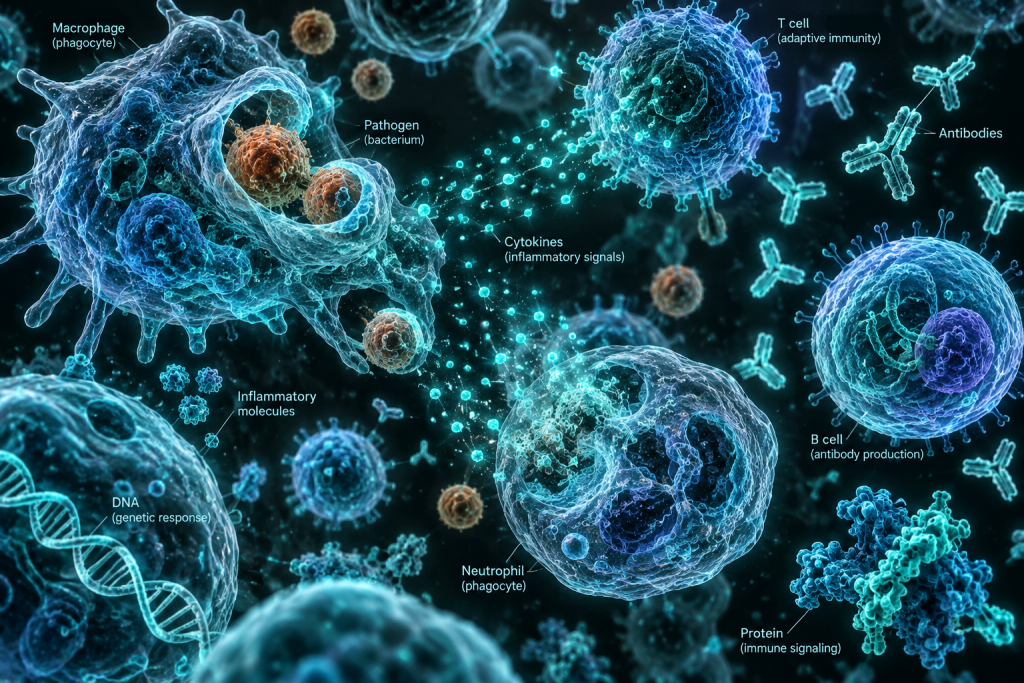
Image generated by AI
Your body is under constant siege. Right now, as you read these words, millions of microscopic invaders—bacteria, viruses, and other pathogens—are attempting to breach your defenses, and an elaborate biological army is mobilizing to meet them. Yet inflammation, the hallmark response of this army, has become something of a paradox in modern medicine: the very mechanism evolved to save us can, when dysregulated, become a silent killer. What makes inflammation both our greatest protector and our greatest threat?
Over the past decade, our understanding of how inflammation and immune response mechanisms operate has undergone a radical transformation. Advances in single-cell sequencing, computational biology, and intravital imaging have revealed that immunity is far more nuanced than immunologists once believed—not a simple on-off switch, but an intricate orchestra of cellular conversations and molecular signals. This knowledge has profound implications: today, inflammation-related diseases like rheumatoid arthritis, cardiovascular disease, Alzheimer’s, and cancer affect over a billion people globally, yet we’re only beginning to exploit our newfound understanding to develop better treatments.
What Is Inflammation and Immune Response Mechanisms?
Inflammation is your body’s immediate response to injury, infection, or irritation. When tissue is damaged or a pathogen invades, specialized immune cells detect danger signals and trigger a cascade of molecular events: blood vessels dilate, immune cells migrate to the affected area, and chemical messengers called cytokines coordinate the attack. This acute inflammatory response is a marvel of biological engineering—it walls off infections, clears debris, and initiates repair. However, when inflammation persists beyond its useful window, transitioning from acute to chronic, it begins to damage healthy tissue and contributes to nearly every major disease of aging, from heart disease to neurodegeneration.
The history of inflammation research spans centuries, beginning with Celsus in ancient Rome, who first described the cardinal signs of inflammation: redness, heat, swelling, and pain. In the 19th century, Rudolf Virchow added the fifth sign—loss of function—providing a framework that remained largely unchanged for over a century. The real revolution began in the late 20th century when researchers identified the molecular actors: cytokines like tumor necrosis factor (TNF) and interleukins, discovered in the 1980s and 1990s, proved to be master switches controlling inflammatory responses. This discovery opened the door to biologics—drugs that target specific inflammatory molecules—transforming treatment of autoimmune and inflammatory diseases.
What the Research Shows
Modern inflammation research reveals a system of staggering complexity. The immune response begins with pattern recognition: specialized cells called macrophages and dendritic cells possess molecular sensors that detect pathogen-associated molecular patterns (PAMPs)—essentially, the bacterial or viral “fingerprints.” Upon recognition, these sentries activate signaling cascades within their cells, most notably through inflammasomes—multiprotein complexes that produce interleukin-1 beta (IL-1β) and interleukin-18 (IL-18), two of the most potent inflammatory cytokines. These cytokines then broadcast an alarm signal, recruiting waves of neutrophils, natural killer cells, and adaptive immune cells to converge on the threat. What’s remarkable is that this entire sequence can unfold in minutes, yet the system possesses multiple feedback loops to prevent overreaction and self-destruction.
Consider what happens when you get a splinter. Within minutes, neutrophils—your body’s most abundant white blood cell—rush to the site, their molecular radar locked onto bacterial components and damage signals. These cells release antimicrobial peptides and reactive oxygen species, essentially weaponized molecules that incinerate invaders but also cause collateral damage to nearby tissue. Simultaneously, endothelial cells lining blood vessels receive signals to express adhesion molecules, acting like molecular velcro to trap circulating immune cells. The tissue swells as fluid leaks from dilated vessels, bringing in antibodies and complement proteins (a cascade of 30 proteins that tag pathogens for destruction). Over days, macrophages arrive to clean up dead cells and bacteria, releasing anti-inflammatory cytokines like interleukin-10 (IL-10) and transforming growth factor-beta (TGF-β) to dampen the response and promote healing. This choreography is so elegant that the swelling, redness, and pain of a splinter represent the controlled demolition and reconstruction of tissue—an essential biological process.
What This Means for Patients and Science
Understanding inflammation mechanisms has revolutionized clinical practice. Rheumatoid arthritis, once a disease of progressive disability, can now be halted or reversed with TNF inhibitors and other targeted biologics that arrived in the late 1990s and early 2000s. Patients who would have faced joint destruction and disability now enjoy normal lifespans and function. Similar breakthroughs have occurred in inflammatory bowel disease, psoriasis, and other autoimmune conditions. Yet chronic inflammation remains inadequately addressed in many domains: the inflammatory component of Alzheimer’s disease, long dismissed as a secondary feature, is now recognized as central to neuronal death; chronic cardiovascular inflammation, linked to atherosclerosis progression, affects millions despite statin therapy; and cancer-associated inflammation actively promotes tumor growth and metastasis, complicating treatment strategies.
Biotechnology companies like Amgen, Regeneron, and Roche have built multi-billion-dollar businesses on anti-inflammatory biologics. Monoclonal antibodies against TNF (infliximab, adalimumab, etanercept) generated over $50 billion in annual sales by the 2010s. More recently, therapies targeting IL-6, IL-17, and other cytokines have expanded treatment options. In cancer immunotherapy, researchers have paradoxically learned to harness inflammation: checkpoint inhibitors that unleash immune activation against tumors have transformed outcomes in melanoma, lung cancer, and other malignancies, though they risk triggering autoimmune complications. Emerging approaches include CAR-T cell therapies that engineer immune cells for heightened recognition and attack, and senolytic drugs designed to eliminate senescent cells that pump out inflammatory molecules.
Recent Breakthroughs in Inflammation and Immune Response Mechanisms
Over the past three years, several discoveries have reshaped inflammation research. In 2021-2023, researchers using single-cell transcriptomics revealed that immune cell populations are far more heterogeneous than previously thought—macrophages, for instance, encompass dozens of distinct subtypes with different functions and inflammatory profiles, existing along a spectrum rather than in discrete categories. This suggests that future therapeutics must be more precise, targeting specific immune subsets rather than broad inflammatory pathways. Simultaneously, the field has embraced “immunometabolism”—the recognition that immune cell function depends critically on cellular metabolism, with inflammatory macrophages using different metabolic pathways than anti-inflammatory ones. This has opened entirely new therapeutic avenues: modulating metabolism of immune cells, rather than just blocking cytokines, might achieve superior outcomes with fewer side effects.
Current research frontiers include understanding trained immunity—the phenomenon where innate immune cells develop long-term memory and heightened responsiveness after encountering certain stimuli, similar to adaptive immune memory—which could explain why certain vaccines provide broad protection. Researchers are also interrogating the gut microbiome’s role in controlling inflammation; dysbiosis (microbial imbalance) is now linked to inflammatory diseases from IBD to arthritis to depression. The tantalizing possibility that restoring microbial diversity could modulate systemic inflammation is driving investment in next-generation probiotics and microbiome-targeted therapies. Additionally, the emerging field of “neuroinflammation” is revealing how brain inflammation contributes to Alzheimer’s, Parkinson’s, and psychiatric diseases, opening potential new treatment windows before neurodegeneration becomes irreversible.
Why Inflammation and Immune Response Mechanisms Matter for the Future
As we confront the epidemiological tsunami of chronic disease, inflammation emerges as a central axis connecting seemingly disparate pathologies. Aging itself is increasingly understood as a state of chronic, low-grade inflammation—termed “inflammaging”—driven by accumulation of senescent cells, mitochondrial dysfunction, and loss of immune regulation. This framework unifies our understanding of why cardiovascular disease, cancer, dementia, and frailty cluster in elderly populations and suggests that targeting inflammation might be a master strategy for extending healthspan, not just lifespan. Personalized medicine approaches that profile an individual’s inflammatory state—measuring dozens of cytokines, immune cell compositions, and metabolic markers—could enable precision prevention, identifying high-risk individuals and intervening before disease manifests. Furthermore, understanding how pathogens exploit and manipulate inflammatory responses has become critical for pandemic preparedness; the COVID-19 pandemic revealed that severe disease often resulted from excessive inflammatory reactions rather than inadequate immune responses, spawning new therapeutic strategies.
Yet significant challenges remain. Most anti-inflammatory drugs, while effective, suppress immunity broadly, increasing infection risk and potentially enabling cancer. Achieving selective suppression of pathological inflammation while preserving protective immunity remains an unsolved problem. The complexity of inflammation networks means that blocking single cytokines often fails as redundancy allows compensation through alternative pathways. Furthermore, individual variation—driven by genetics, age, sex, diet, stress, and microbiome composition—means that one person’s therapeutic dose is another’s ineffective treatment or dangerous overdose. Finally, much inflammation research relies on simplified models; translating discoveries from animal models to human disease remains notoriously difficult, with most promising preclinical findings failing to replicate in clinical trials.
Key Takeaways
- Inflammation is an essential protective response to injury and infection, but when dysregulated and chronic, it contributes to nearly all major diseases of aging including heart disease, cancer, dementia, and autoimmune disorders.
- The inflammatory process involves pattern recognition by immune sentries (macrophages and dendritic cells), rapid amplification through cytokine signaling, recruitment of specialized immune cells, and eventual resolution through anti-inflammatory signals—a process that can unfold in minutes but often becomes pathological when regulation fails.
- Biologic drugs targeting specific inflammatory molecules like TNF and IL-6 have revolutionized treatment of rheumatoid arthritis and other autoimmune diseases, transforming previously disabling conditions into manageable chronic diseases.
- Current research emphasizes cellular heterogeneity (revealing that immune cell types are more diverse than previously recognized), immunometabolism (the link between cellular metabolism and immune function), microbiome influence on systemic inflammation, and the role of inflammaging in age-related disease.
- Future advances likely depend on developing therapies that selectively suppress pathological inflammation while preserving protective immunity, accounting for individual variation through precision medicine approaches, and leveraging systems-level understanding to target inflammation across multiple diseases simultaneously.
Explore TED Talks on Inflammation and Immune Response Mechanisms:
TED content is used under CC BY-NC-ND 4.0. © TED Conferences, LLC.
Frequently Asked Questions
How has our understanding of immune response mechanisms changed in the past decade?
Advances in single-cell sequencing, computational biology, and intravital imaging have revealed that immunity operates as an intricate orchestra of cellular conversations and molecular signals rather than a simple on-off switch. This nuanced understanding has fundamentally transformed how scientists approach inflammation-related diseases.
Why can inflammation act as both a protective mechanism and a harmful one in the body?
Inflammation evolved as a vital defensive response to injury and pathogens, but when dysregulated—meaning the inflammatory signals are not properly controlled or resolved—it can become chronic and contribute to diseases like rheumatoid arthritis, cardiovascular disease, and Alzheimer's. The same biological processes that protect us can cause tissue damage and disease when they persist abnormally.
What molecular and cellular mechanisms are involved when the immune system responds to a pathogen invasion?
The article indicates that immune response involves an elaborate biological system mobilizing millions of cellular components through complex molecular signals and cellular communications. While specific mechanisms aren't detailed in the excerpt, these processes collectively work to identify and eliminate pathogens while triggering the inflammatory response.
Are current medical treatments effectively addressing inflammation-related diseases despite new scientific knowledge?
Despite recent advances in understanding inflammation mechanisms, over a billion people globally still suffer from inflammation-related diseases, indicating that we are only beginning to exploit this newfound knowledge to develop better treatments. The gap between scientific understanding and clinical application remains significant.