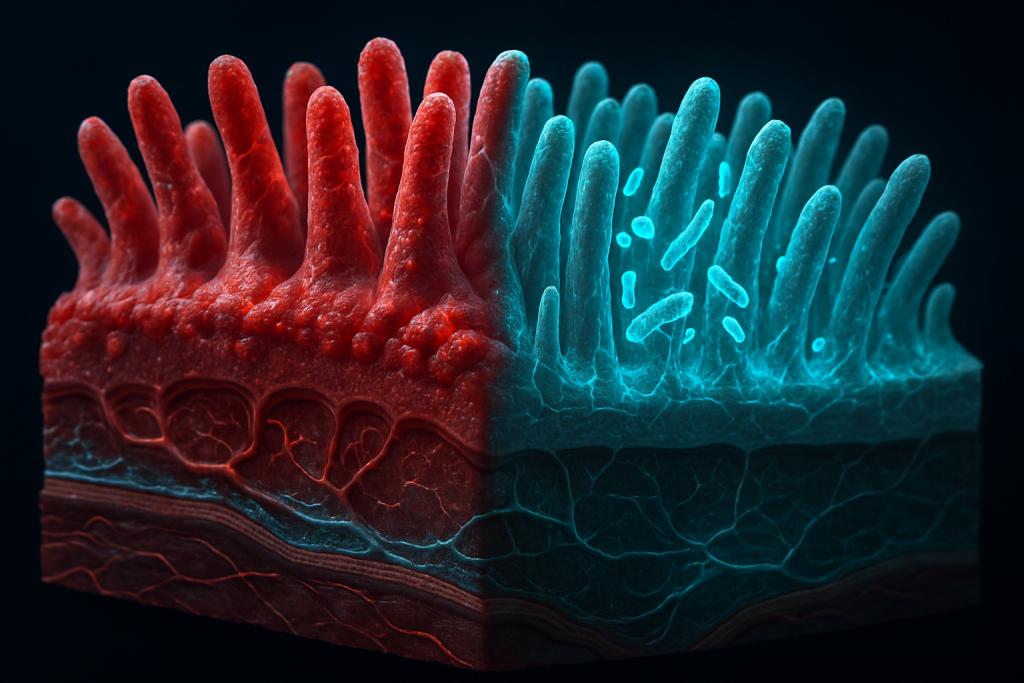
Image generated by AI
Your gut is home to trillions of microorganisms—a living ecosystem so complex that scientists now compare it to a rainforest in biodiversity. Yet for millions of people worldwide, this delicate microbial garden turns against them, triggering chronic inflammation that damages the very tissue it inhabits. Inflammatory bowel disease, or IBD, represents one of modern medicine’s most puzzling paradoxes: a condition where the immune system, designed to protect us, instead wages war against the intestines. Understanding why this happens, and how to stop it, has become one of the most urgent frontiers in gastroenterology and immunology.
Today, more than 3 million Americans live with inflammatory bowel disease, a figure that has climbed steadily over the past two decades. The economic burden exceeds $30 billion annually in the United States alone, and the condition strikes hardest during young adulthood, when careers and families are just beginning. Yet despite its prevalence and impact, IBD remains poorly understood compared to other chronic diseases, and treatment options remain frustratingly limited for many patients. Recent breakthroughs in microbiome research, immunology, and genetics are finally illuminating the mechanisms behind IBD—and pointing toward new therapeutic strategies that could transform patient outcomes.
What Is Inflammatory Bowel Disease and Gut Health?
Inflammatory bowel disease is a chronic condition characterized by recurrent inflammation of the gastrointestinal tract, primarily encompassing two main forms: Crohn’s disease and ulcerative colitis. In Crohn’s disease, inflammation can occur anywhere along the digestive tract from mouth to anus, though it most commonly affects the end of the small intestine and beginning of the colon. Ulcerative colitis, by contrast, is confined to the colon and rectum, and the inflammation occurs only in the innermost lining. Both conditions produce similar symptoms—chronic diarrhea, abdominal pain, bloody stools, weight loss, and fatigue—but their different anatomical distributions require distinct diagnostic and treatment approaches. A third, rarer form called indeterminate colitis presents features of both conditions.
IBD was formally identified as a distinct disease entity in the mid-twentieth century, though physicians have documented gastrointestinal inflammation for centuries. The first clear distinction between Crohn’s disease and ulcerative colitis emerged in 1932 when gastroenterologist Burrill Crohn and colleagues published a landmark paper describing the transmural inflammation (affecting all layers of the bowel wall) characteristic of what became known as Crohn’s disease. Before the mid-1900s, IBD was relatively rare, concentrated primarily in industrialized Western nations, a pattern that has only intensified in recent decades. This geographic and temporal distribution provides a critical clue: IBD is not simply a genetic disease, but rather a condition that emerges from complex interactions between genetic predisposition, environmental factors, and the composition of the gut microbiome.
What the Research Shows
The pathophysiology of IBD involves a breakdown in the intricate balance between three interconnected systems: the intestinal barrier, the gut microbiota, and the immune system. Under normal conditions, the single layer of epithelial cells lining the intestine acts as a selective gatekeeper, permitting nutrient absorption while blocking harmful pathogens and bacterial byproducts. In IBD patients, this barrier weakens through mechanisms that scientists are still unraveling—tight junctions between cells loosen, mucus production decreases, and the layer of antimicrobial peptides that normally protect the epithelium thins. Simultaneously, the composition of the gut microbiota shifts dramatically, with reduced diversity and altered ratios of bacterial species. These two changes trigger a cascade: bacterial metabolites that normally suppress inflammation decline, pathogenic or pro-inflammatory bacteria proliferate, and the immune system, detecting what it perceives as a threat, launches an excessive inflammatory response that damages the intestinal lining itself.
Think of the healthy gut ecosystem like a well-balanced coral reef: diverse species maintain equilibrium through intricate chemical and biological signaling, and the reef’s structural integrity protects the organisms within. In IBD, invasive species take hold, the reef’s structure begins to crumble, and the immune guardians that should protect the reef instead attack it indiscriminately. The bacterium Faecalibacterium prausnitzii, for instance, normally produces butyrate, a short-chain fatty acid that nourishes intestinal cells and suppresses inflammation. IBD patients typically show depleted levels of this keystone species, losing a critical line of defense. Simultaneously, bacteria like Adherent Invasive Escherichia coli (AIEC) increase in abundance and can penetrate the weakened epithelial barrier, amplifying immune activation. This represents not simply an infection—the immune system isn’t responding to an obvious pathogen—but rather a fundamental loss of the microbial-immune dialogue that maintains intestinal homeostasis.
What This Means for Patients and Science
The current understanding of IBD has shifted from viewing it as a primarily genetic or infectious disease toward recognizing it as an ecosystem disorder—a systems-level failure involving genetics, microbiota, environment, and immunity. This reconceptualization has profound implications for treatment strategy. Rather than seeking to simply suppress inflammation with immunosuppressants, researchers now explore how to restore the microbial community, reinforce the intestinal barrier, and recalibrate immune tolerance. Conventional treatments like corticosteroids and TNF-alpha inhibitors provide temporary relief for many patients but fail to induce lasting remission in roughly half, and long-term use carries significant risks including infections and malignancies. This therapeutic gap has motivated the search for disease-modifying approaches that address root causes rather than symptoms alone.
Leading medical centers now employ fecal microbiota transplantation (FMT) experimentally to treat refractory IBD, though results remain inconsistent and formal clinical protocols continue to evolve. Pharmaceutical companies are developing targeted biologics that modulate specific immune pathways, such as drugs targeting interleukin-23 and integrated alpha4-beta7 integrin, which showed efficacy in recent trials. Dietary interventions, including exclusive enteral nutrition and specific carbohydrate diets, have demonstrated promise in some patients, particularly children with Crohn’s disease. Simultaneously, diagnostic companies are advancing tests that characterize individual microbiota composition and immune profiles, aiming toward personalized medicine approaches where treatment selection matches the patient’s underlying pathophysiology rather than applying a one-size-fits-all strategy.
Recent Breakthroughs in Inflammatory Bowel Disease and Gut Health
In 2023 and 2024, several pivotal studies have reshaped our understanding of IBD mechanisms and opened new therapeutic avenues. Research published in major journals revealed that specific bacterial metabolites—particularly secondary bile acids produced by certain commensals—regulate immune cell populations in the colon through farnesoid X receptors, suggesting that restoring these bacterial functions might reduce inflammation without systemic immunosuppression. Simultaneously, single-cell RNA sequencing studies identified previously unknown subsets of immune cells in IBD patients, including specific dendritic cell populations that drive pathogenic T cell responses, providing targets for more precise immunomodulation. A landmark 2023 clinical trial demonstrated that a drug targeting the Janus kinase pathway (tofacitinib) achieved remission in a substantial portion of IBD patients who had failed TNF inhibitors, expanding options for treatment-resistant disease. Additionally, researchers using organoid technology have created three-dimensional intestinal tissue models derived from IBD patients’ own cells, enabling personalized testing of which therapies work best for individual patients.
The frontier of IBD research now extends into previously underexplored territory: the role of bacteriophages (viruses that infect bacteria) in shaping the microbiota and immune response, the contribution of fungal communities to IBD pathogenesis, and the mechanisms by which early-life exposures and diet program the developing microbiota and immune system for lifelong IBD risk. Researchers are investigating whether probiotics—live beneficial bacteria—can be engineered to produce therapeutic compounds directly in the colon, essentially converting commensal bacteria into living drug factories. The question of why IBD prevalence has exploded in the past fifty years remains partially unanswered, though leading hypotheses implicate reduced microbial exposure in childhood, antibiotic use, dietary shifts toward ultra-processed foods, and increased stress—all factors that disrupt the microbiota that our immune system evolved alongside.
Why Inflammatory Bowel Disease and Gut Health Matters for the Future
Inflammatory bowel disease serves as a critical model for understanding autoimmune and chronic inflammatory diseases more broadly, making advances in IBD directly relevant to conditions from rheumatoid arthritis to type 1 diabetes. The microbiota-immune axis that IBD research illuminates appears central to numerous diseases of modern civilization, from allergies to metabolic syndrome, suggesting that IBD represents just one manifestation of a broader epidemiological shift. As precision medicine advances, IBD patients are becoming pioneers in the integration of multi-omics data—combining genomics, metabolomics, proteomics, and microbiota analysis—to predict treatment response and identify disease subtypes. The financial incentives are substantial: the global IBD pharmaceutical market exceeds $25 billion annually, attracting investment from major biotech and pharmaceutical companies racing to develop next-generation therapeutics. Beyond individual patient benefit, controlling IBD reduces strain on healthcare systems and enables patients to maintain productivity and quality of life.
Significant challenges remain before the field achieves its ultimate goal of IBD prevention and cure. The extreme heterogeneity of IBD—even two patients with identical diagnoses may have completely different underlying pathophysiology—complicates research and makes biomarker discovery difficult. Long-term studies on interventions like FMT are limited, and the mechanistic understanding of why such treatments work in some patients but not others remains incomplete. The role of host genetics, increasingly recognized as critical, has not been fully integrated into functional treatment models; having an IBD-associated genetic variant confers risk but not certainty, implying that gene-environment interactions hold the key to understanding disease etiology. Furthermore, IBD predominantly affects populations in wealthy industrialized nations, creating disparities in research funding and clinical trial participation that skew our understanding toward these populations and limit the generalizability of findings to other geographic and cultural contexts.
Key Takeaways
- Inflammatory bowel disease results from a breakdown in the three-way relationship between the intestinal barrier, gut microbiota composition, and immune system regulation, not from a single genetic or infectious cause.
- The disease mechanism involves loss of protective bacterial species and their metabolites, weakening of the intestinal epithelial barrier, and excessive immune activation that damages intestinal tissue itself.
- Emerging therapies targeting the microbiota, intestinal barrier function, and specific immune pathways show greater promise for inducing lasting remission than conventional immunosuppression alone.
- Recent breakthroughs in single-cell immunology, organoid technology, and microbiota profiling are enabling personalized diagnosis and treatment selection for individual IBD patients.
- Understanding IBD mechanisms has broader implications for autoimmune disease and chronic inflammation generally, making advances in IBD research relevant to multiple diseases of modern civilization.
Explore TED Talks on Inflammatory Bowel Disease and Gut Health:
TED content is used under CC BY-NC-ND 4.0. © TED Conferences, LLC.
Frequently Asked Questions
Why does the immune system attack the intestines in inflammatory bowel disease instead of protecting them?
In IBD, the immune system mistakenly identifies the beneficial gut microbiota or intestinal tissue as a threat, triggering a chronic inflammatory response that damages the intestinal lining. This autoimmune dysfunction likely results from a combination of genetic predisposition, environmental factors, and microbial imbalances that dysregulate immune tolerance in the gut.
How does the gut microbiome's biodiversity relate to the development of inflammatory bowel disease?
A diverse microbiome maintains immune homeostasis by promoting regulatory T cells and producing short-chain fatty acids that strengthen the intestinal barrier; reduced microbial diversity in IBD patients correlates with impaired immune regulation and increased intestinal permeability. This loss of microbial biodiversity is both a consequence and contributing factor to chronic inflammation in IBD.
What recent scientific breakthroughs in microbiome research are changing how we understand IBD mechanisms?
Recent advances have identified specific microbial taxa and metabolic pathways—such as butyrate-producing bacteria—that regulate intestinal immunity, and have demonstrated how dysbiosis can trigger pathogenic immune responses in genetically susceptible individuals. These discoveries are shifting IBD treatment focus toward microbiome restoration and immunomodulation rather than symptom management alone.
How do genetic factors interact with environmental and microbial factors to cause inflammatory bowel disease?
Genetic variants affecting immune regulation and intestinal barrier function increase IBD susceptibility, but disease only develops when these genetic predispositions are triggered by environmental factors such as infections, diet, or dysbiosis. This gene-environment-microbiota interaction model explains why IBD prevalence varies geographically and why identical twins do not always both develop the disease.