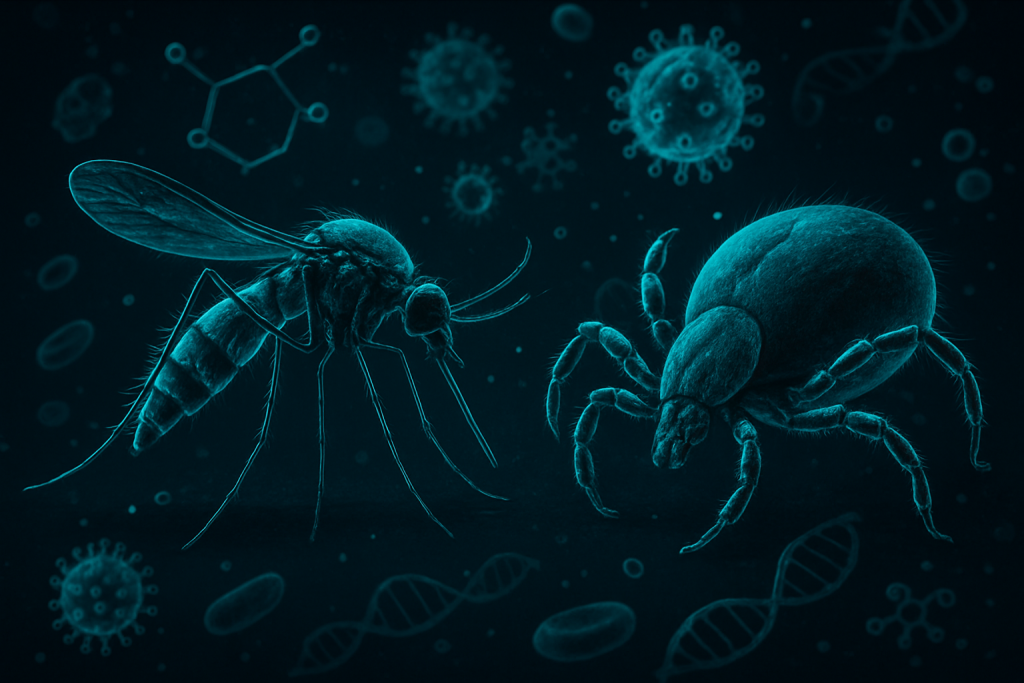
Image generated by AI
Every year, mosquitoes and ticks silently infect hundreds of millions of people with diseases that range from merely uncomfortable to catastrophically fatal. Yet despite their ubiquity and the suffering they cause, these tiny vectors remain master strategists of infection, having evolved sophisticated mechanisms to evade human immunity and transmit pathogens with remarkable efficiency. What makes these arthropods so devastatingly effective at spreading disease, and what new weapons are scientists developing to fight back?
The stakes have never been higher. Climate change is expanding the geographic ranges where mosquitoes and ticks thrive, pushing dengue fever, Lyme disease, and Zika virus into regions that were once considered safe. In 2022 alone, dengue infected an estimated 400 million people across the globe, while tick-borne illnesses in North America have quadrupled in the past two decades. Understanding the biology of these diseases and the innovations scientists are pursuing has become not just an academic exercise, but a public health imperative that will shape how we live in an increasingly warm world.
What Is Mosquito-Borne and Tick-Borne Diseases?
Mosquito-borne and tick-borne diseases are infections transmitted to humans through the bites of infected arthropods—primarily female mosquitoes and hard ticks that feed on blood. These vectors acquire pathogens (viruses, bacteria, or parasites) when they take a blood meal from an infected person or animal, and then transmit those pathogens to the next host they bite. The diseases themselves are not new afflictions: dengue, yellow fever, and malaria have plagued humanity for centuries, while Lyme disease and other tick-borne illnesses have emerged more recently as human populations have expanded into wildlife habitats. What distinguishes these diseases is their epidemiology—the pathways and patterns by which they spread—which depends entirely on the behavior and biology of their insect vectors.
The story of vector-borne disease discovery is intertwined with the birth of modern microbiology. In the late 1800s, scientists made the paradigm-shifting discovery that disease could be transmitted by insects rather than spontaneously generated or spread through miasma. British physician Ronald Ross demonstrated in 1897 that mosquitoes transmitted malaria parasites, work that earned him the Nobel Prize in Physiology or Medicine in 1902. Around the same time, American physician Walter Reed conducted his famous yellow fever experiments in Cuba, proving that a filterable agent (later identified as a virus) could be transmitted by the mosquito Aedes aegypti. These discoveries fundamentally changed how humanity understood infectious disease and laid the groundwork for modern epidemiology.
What the Research Shows
The transmission cycle of vector-borne diseases involves a intricate biological dance between pathogen, vector, and host. When an infected mosquito or tick takes a blood meal, it injects saliva containing the pathogen directly into the human bloodstream. For viruses like dengue and Zika, the pathogen must first replicate within the vector’s midgut, then cross the intestinal barrier and migrate to the salivary glands—a process called the extrinsic incubation period that typically takes 8 to 14 days. During this time, the mosquito is not yet infectious. Once the pathogen reaches the salivary glands, every subsequent bite becomes a potential transmission event. For tick-borne diseases like Lyme disease, caused by the spirochete bacterium Borrelia burgdorferi, the transmission mechanism is different but equally complex: the pathogen must migrate from the tick’s midgut to its salivary glands, and transmission typically requires 24 to 48 hours of feeding, which is why early tick removal can prevent infection.
Think of a mosquito as a living syringe with an extraordinarily specific biological agenda. The insect’s saliva contains a cocktail of anticoagulants, vasodilators, and immunosuppressive compounds that prevent blood from clotting and numb the sensation of the bite—evolutionary innovations that have made mosquitoes among the most successful blood-feeders on Earth. The pathogen travels along with this chemical arsenal, gaining entry to the host while the immune system is momentarily distracted. Similarly, a tick functions like a microscopic drilling platform, slowly embedding its mouthparts into the skin while secreting substances that dissolve tissue and suppress local immune responses. This extended feeding time, which can last days, gives pathogens the window they need to establish infection. Both strategies illustrate how vector-borne diseases represent not random acts of nature, but the products of millions of years of coevolution between parasites, vectors, and hosts.
What This Means for Patients and Science
The clinical manifestations of vector-borne diseases vary dramatically depending on the pathogen involved, but they share common features shaped by how these infections invade the human body. Dengue fever, transmitted by Aedes mosquitoes in tropical and subtropical regions, causes sudden onset of high fever, severe joint and muscle pain, headache, and a characteristic rash that appears after the fever subsides—symptoms so debilitating that dengue is sometimes called “breakbone fever.” Lyme disease, transmitted by Ixodes ticks in North America and Europe, often begins with a distinctive bull’s-eye rash at the bite site, followed by fever and malaise, but if untreated can progress to arthritis, neurological complications, and cardiac abnormalities weeks or months later. Zika virus, also transmitted by Aedes mosquitoes, is particularly notorious for its ability to cause severe birth defects including microcephaly when pregnant women are infected. Understanding these clinical patterns has direct implications for diagnosis and treatment: a patient presenting with fever and joint pain in a dengue-endemic region should be tested for dengue antibodies, while someone with a tick-borne illness presentation should receive empiric antibiotic therapy before test results confirm the diagnosis.
Current treatment approaches reflect the underlying biology of each disease. For most viral infections like dengue and Zika, treatment remains supportive—managing fever, preventing dehydration, and monitoring for hemorrhagic complications—because no specific antiviral drugs have proven effective in clinical trials. However, bacterial tick-borne diseases like Lyme disease respond well to early antibiotic treatment with doxycycline, amoxicillin, or cefuroxime, which is why prompt diagnosis and treatment-seeking behavior are crucial. Malaria, caused by Plasmodium parasites transmitted by Anopheles mosquitoes, has more sophisticated pharmaceutical options including artemisinin-based combination therapies that have dramatically reduced mortality rates in Africa and Southeast Asia. Vaccine development has also shown promise: dengue vaccines like Dengvaxia have been deployed in several countries, though with complicated safety profiles that require careful monitoring of vaccination history in recipients.
Recent Breakthroughs in Mosquito-Borne and Tick-Borne Diseases
The past three years have witnessed remarkable innovations in both our understanding of these diseases and our ability to combat them. In 2022 and 2023, researchers published groundbreaking studies revealing how dengue virus proteins manipulate human immune cells, discoveries that are informing the design of next-generation vaccines with broader protection against all four dengue serotypes. Simultaneously, scientists have made progress in understanding the genetic basis of tick-host interactions, identifying specific genes in Ixodes ticks that are essential for pathogen transmission—findings that open new avenues for controlling tick populations through genetic approaches. Perhaps most excitingly, several groups have successfully deployed gene-drive technology in laboratory populations of Aedes mosquitoes, creating insects that are unable to transmit dengue virus, representing a potential revolutionary approach to disease control if field trials prove successful and ethical concerns can be adequately addressed.
The research frontier is now pushing toward solutions that account for the rapid evolution of these pathogens and vectors. Scientists are investigating how climate change is altering mosquito physiology and expanding their geographic range, with models suggesting that dengue transmission zones could expand to temperate regions within decades. Researchers are also exploring novel diagnostic approaches, including rapid point-of-care tests that can distinguish between dengue serotypes and other co-circulating viruses in under an hour—a capability that could transform treatment decisions in resource-limited settings. Another active area involves understanding why some people develop severe disease while others have mild infections, a question that touches on immunology, genetics, and viral evolution, with implications for predicting and preventing severe outcomes.
Why Mosquito-Borne and Tick-Borne Diseases Matter for the Future
Vector-borne diseases represent one of the clearest intersections between infectious disease, environmental change, and global equity. As global temperatures rise, the geographic range of disease-transmitting mosquitoes and ticks will inevitably expand, potentially bringing dengue, malaria, and Lyme disease to populations that currently have no immunity and no healthcare infrastructure to manage outbreaks. This geographic reshuffling will not be uniform: wealthy nations will have resources to implement vector control, vaccination, and medical treatment, while low- and middle-income countries will bear a disproportionate disease burden. The future of human health, therefore, depends on our ability to develop vaccines and treatments that are not only effective but also affordable and accessible to the populations most at risk. Additionally, vector-borne diseases exemplify how human-driven environmental change—deforestation, urbanization, climate warming—accelerates disease transmission by bringing vectors and humans into closer contact.
Significant challenges remain even as scientific progress accelerates. Vaccine hesitancy, political instability in disease-endemic regions, and the logistical complexity of vaccination campaigns mean that even effective vaccines fail to reach those who need them most. Drug-resistant parasites and insecticide-resistant mosquitoes are emerging threats that could undermine our current arsenal of treatments and control measures. Perhaps most fundamentally, the unequal distribution of research funding means that diseases affecting poor populations receive far less investment than diseases affecting wealthy ones, creating a vicious cycle where solutions develop slowly and implementation remains incomplete. Breaking this pattern will require not just scientific innovation, but sustained political will and equitable allocation of global health resources.
Key Takeaways
- Mosquito-borne and tick-borne diseases affect hundreds of millions of people annually through biological transmission cycles refined over millions of years of evolution between pathogens, vectors, and hosts.
- These infections work by exploiting specialized vector biology—mosquito saliva contains immunosuppressive compounds while ticks require extended feeding periods—to establish infection in human hosts.
- The most promising near-term approaches involve developing broad-spectrum vaccines, deploying gene-drive technology to control vector populations, and implementing rapid molecular diagnostics in resource-limited settings.
- Current research is advancing rapidly in understanding viral-vector-host interactions at the molecular level, with multiple vaccine candidates in clinical trials and genetic approaches showing laboratory success.
- Future control of these diseases depends on equitable vaccine distribution, adaptation to climate-driven range expansion of vectors, and overcoming drug and insecticide resistance in a context of global health inequality.
Explore TED Talks on Mosquito-Borne and Tick-Borne Diseases:
TED content is used under CC BY-NC-ND 4.0. © TED Conferences, LLC.
Frequently Asked Questions
How do mosquitoes and ticks transmit pathogens to humans during a bite?
Female mosquitoes and hard ticks transmit pathogens by injecting infected saliva into the bloodstream while feeding on blood. The pathogens (viruses, bacteria, or parasites) acquired from previous hosts are then introduced directly into the human circulatory system through this feeding mechanism.
What mechanisms allow mosquitoes and ticks to evade the human immune system?
The article describes these vectors as having evolved sophisticated mechanisms to evade human immunity, though specific details aren't provided in the excerpt. These strategies likely include anticoagulants and immunosuppressive compounds in their saliva that prevent blood clotting and suppress local immune responses at the bite site.
Why is climate change causing mosquito-borne and tick-borne diseases to spread into new geographic regions?
Climate change expands the geographic ranges where mosquitoes and ticks can survive and reproduce by creating warmer temperatures and altered environmental conditions suitable for these vectors. This allows diseases like dengue fever, Lyme disease, and Zika virus to establish themselves in regions previously too cold to support vector populations.
What is the difference between how mosquitoes and ticks acquire and transmit pathogens?
Both mosquitoes and ticks acquire pathogens by feeding on infected blood and transmit them through their bites, but the article indicates they may differ in their transmission efficiency and the types of pathogens they carry. The excerpt notes that hard ticks specifically transmit tick-borne illnesses, while female mosquitoes transmit mosquito-borne diseases like dengue and Zika.