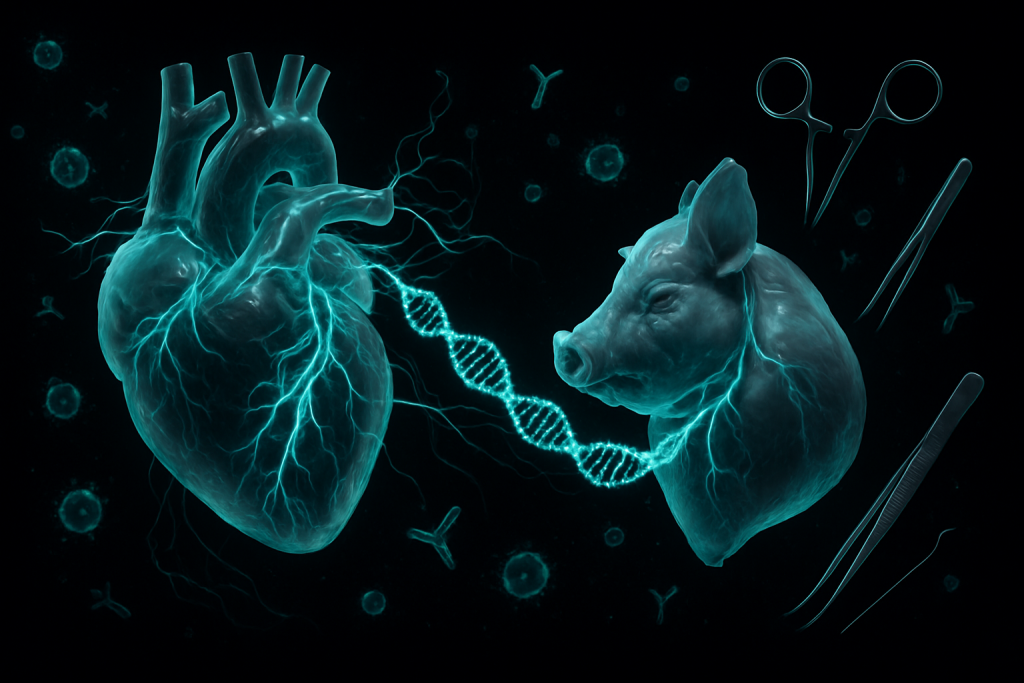
Image generated by AI
Every day, roughly 17 people die in the United States waiting for an organ transplant. This grim statistic has remained stubbornly constant despite decades of medical advancement, yet a radical solution is beginning to emerge from laboratories around the world: growing replacement organs in animals, or even engineering them from scratch in the lab. What was once pure science fiction—transplanting a pig’s heart into a human patient—actually happened in January 2022, when a 57-year-old man with terminal heart disease received the first xenotransplant in history. Though the patient survived only two months, the procedure marked a watershed moment in medicine, suggesting that the chronic organ shortage that has plagued transplantation for generations might finally have a solution.
The urgency of this challenge cannot be overstated. More than 100,000 Americans currently wait for lifesaving transplants, while only about 40,000 organs become available each year, creating an impossible arithmetic of need and supply. Organ transplantation itself has become a routine miracle of modern medicine—hundreds of thousands of transplants have been performed successfully worldwide—yet it remains fundamentally limited by the scarcity of willing donors and the logistical complexity of matching compatible organs with recipients in time. Xenotransplantation and other emerging approaches represent humanity’s attempt to transcend these biological and logistical constraints, potentially reshaping who can be saved and how we think about the boundaries between human and animal biology.
What Is Organ Transplantation and Xenotransplantation?
Organ transplantation is the surgical transfer of a healthy organ from one person to another, typically from a deceased donor, though living donors can provide kidneys, portions of liver, lung, or pancreas. The goal is to replace a diseased or failing organ with functioning tissue that will restore the recipient’s health and extend their lifespan. Traditional transplantation relies on complex immunological matching—ensuring that the recipient’s immune system recognizes the donor organ as “self” rather than foreign invader—and a logistical race against time, since most organs can only survive outside a body for hours before they begin to deteriorate irreversibly. The process has become so refined that kidney, liver, and heart transplants now routinely extend patient survival by years or decades, making transplantation one of modern medicine’s most transformative interventions.
Xenotransplantation, by contrast, involves transplanting an organ or tissue from a different species—most commonly from a genetically modified pig—into a human recipient. The practice is nearly as old as transplantation itself: in 1920, surgeons transplanted a chimpanzee kidney into a human patient, though it failed within hours. For most of the past century, xenotransplantation remained a speculative frontier, blocked by the profound immunological barriers that evolution erected between species. But recent advances in genetic engineering, particularly gene-editing tools like CRISPR, have made it possible to modify pigs in ways that reduce immune rejection and improve long-term compatibility with human recipients. The logic is compelling: pigs are physiologically similar to humans, they breed prolifically, and they can be genetically customized before birth, eliminating the unpredictability that haunts human-to-human transplantation.
What the Research Shows
The fundamental challenge in any transplantation—human or xenogeneic—is immune rejection, a process as old as the adaptive immune system itself. When a transplanted organ enters a recipient’s body, the immune system recognizes it as foreign through a process of antigen presentation, in which specialized immune cells display molecules from the donor organ to T cells and B cells, which then mobilize to attack the invader. In human-to-human transplantation, immunosuppressive drugs can dampen this response, but they remain imperfect: they carry their own serious side effects, and rejection can still occur months or years later as immune memory develops. In xenotransplantation, the immune barriers are exponentially higher. Even a genetically identical pig organ triggers a hyperacute rejection response, in which antibodies in the recipient’s blood immediately recognize pig proteins and activate the complement system—a cascade of immune molecules that punches holes in cell membranes and destroys the organ within minutes.
To visualize this, imagine a lock-and-key system where pig cells display proteins (keys) that the human immune system has evolved to recognize and destroy. The first xenotransplant surgeons attempted to tackle this by simply removing the locks—knocking out pig genes that code for particularly immunogenic proteins. But it proved to be like playing whack-a-mole: eliminating one target protein revealed another beneath it. The breakthrough came from combining multiple genetic modifications: knocking out pig genes that trigger rejection while simultaneously introducing human genes that send “don’t attack me” signals. The pig used in the January 2022 xenotransplant, for instance, had ten genetic modifications—four pig genes removed and six human genes added—creating a chimeric organ that confused the immune system into treating it as partially self.
What This Means for Patients and Science
For patients with end-stage organ failure, the implications are potentially transformative. Currently, the standard treatment for those who cannot find a donor organ is continued dialysis for kidney disease or palliative care, both of which represent slow decline rather than cure. Xenotransplantation could, in theory, provide an unlimited supply of organs, customized to each patient’s needs and available on demand rather than through the lottery of donor availability. Even more ambitiously, genetically modified animal organs could be optimized beyond the baseline of human biology—a pig heart could be engineered to be larger, more durable, or better adapted to prolonged life outside the body. The ripple effects would reshape medical practice: transplant surgeons could schedule procedures in advance rather than operating in the middle of the night on an emergency basis, and recipients could receive immunosuppressive therapy before surgery rather than after, potentially reducing rejection further.
The technology is already finding applications in the clinic and laboratory. Beyond whole organ xenotransplantation, pig cells and tissues are being tested for treating diabetes, heart disease, and neurological conditions. In 2023, researchers at University of Pennsylvania published work showing that bioengineered pig hearts could function in human recipients for extended periods with careful immunosuppression. Simultaneously, companies like Revivicor and Moderna are developing complementary approaches: Revivicor focuses on whole organ xenotransplantation while Moderna is exploring genetic modification strategies that could reduce the number of modifications needed, potentially easing regulatory approval and manufacturing complexity.
Recent Breakthroughs in Organ Transplantation and Xenotransplantation
The 2022 pig-heart xenotransplant, performed by surgical pioneer Bartley Griffith at the University of Maryland Medical Center, represented the culmination of decades of laboratory work and the first authorized clinical trial of a whole-organ xenotransplant in a living patient. Though recipient David Bennett died after two months, autopsy revealed that his immune system, suppressed by a regimen of novel immunosuppressive drugs, had not rejected the organ; instead, he succumbed to a virus (porcine cytomegalovirus) lurking in the pig tissue. This finding was simultaneously sobering and illuminating—it revealed a previously underappreciated challenge, but one that researchers believe can be addressed by further screening of donor pigs and antiviral therapy. Since then, additional xenotransplant attempts have been conducted globally, including a pig kidney transplant into a brain-dead donor at NYU Langone in 2021 and subsequent procedures in other countries, each adding critical data about immunological responses and surgical techniques.
The research landscape is now focused on several key questions. How can we reliably prevent not just hyperacute and acute rejection, but chronic rejection—the slow decline that can afflict even well-matched organs over years? Can we engineer pigs with additional genetic modifications to express more human-like genes, potentially reducing immunosuppression requirements? And how do we scale xenotransplantation ethically and practically, ensuring that donor pig herds remain healthy and that the technology reaches patients worldwide rather than only the wealthy elite? Simultaneously, traditional organ transplantation continues to improve: machine perfusion technology—keeping organs warm and functional outside the body using pulsatile perfusion systems—is expanding the donor pool by allowing organs from less-ideal sources to be revitalized and assessed before transplantation.
Why Organ Transplantation and Xenotransplantation Matters for the Future
The success of xenotransplantation would represent one of medicine’s greatest achievements: the practical conquest of a fatal scarcity that has constrained human longevity for generations. Beyond the immediate benefit to transplant recipients, xenotransplantation would reshape healthcare economics, potentially reducing the devastating costs of long-term dialysis and organ replacement surgery. It would also raise profound philosophical questions about the human-animal boundary and our moral relationship with other species. If we can engineer pigs to donate organs to humans, what other modifications become ethically permissible? Should we engineer pigs with human neural tissue, or create chimeras with human-animal hybrid organs? These questions will likely define bioethics discussions for decades.
Yet formidable obstacles remain before xenotransplantation becomes routine clinical practice. Regulatory pathways are still being developed—the FDA granted breakthrough device designation to xenotransplantation, but full approval requires extensive data on safety and efficacy. Manufacturing and quality control challenges are significant: developing standardized protocols for genetically modifying pig herds, screening for pathogens, and maintaining the genetic and health standards of donor animals across multiple production facilities will require unprecedented coordination. Public acceptance is uncertain; surveys show variable enthusiasm for xenotransplantation depending on how the question is framed and what cultural or religious context the respondent inhabits. And the possibility of zoonotic disease transmission—pathogens jumping from pigs to humans—remains a concern that will require ongoing vigilance even if the organ engraftment problem is solved.
Key Takeaways
- Organ transplantation is one of modern medicine’s greatest achievements, but faces a persistent supply crisis: more than 100,000 Americans wait for organs while only 40,000 become available annually.
- Xenotransplantation—transplanting genetically modified animal organs into humans—works by reducing immune rejection through targeted genetic modifications that eliminate pig antigens and express human-compatible signals.
- The most promising near-term application is pig-to-human whole organ transplantation for end-stage heart, kidney, and liver disease, potentially eliminating dialysis and transplant waiting lists.
- Current research is actively moving from laboratory proof-of-concept toward clinical trials, with early xenotransplant procedures already performed in humans, though long-term success remains to be demonstrated.
- Success in xenotransplantation could extend human longevity significantly, reshape transplant medicine globally, and raise new ethical questions about human-animal biology and the limits of genetic engineering.
Explore TED Talks on Organ Transplantation and Xenotransplantation:
TED content is used under CC BY-NC-ND 4.0. © TED Conferences, LLC.
Frequently Asked Questions
Why is organ transplantation currently limited by donor availability rather than surgical technique?
Organ transplantation has become a routine and successful procedure, with hundreds of thousands performed worldwide, but the fundamental bottleneck is biological: only about 40,000 organs become available annually in the U.S. while over 100,000 patients wait for transplants. This supply-demand gap cannot be solved through improved surgical skills alone, requiring new sources of organs like xenotransplantation.
What is xenotransplantation and how does it differ from conventional organ transplantation?
Xenotransplantation is the transplantation of organs from one species to another—specifically, growing replacement organs in animals (like pigs) for human recipients—whereas conventional organ transplantation uses organs from human donors. The January 2022 pig-heart-to-human transplant represented the first clinical xenotransplant procedure, demonstrating this approach as a potential solution to the chronic human organ shortage.
Why might pig organs be considered suitable for xenotransplantation into humans?
While the article does not detail the specific biological reasons, the fact that a pig heart was successfully transplanted into a human patient in 2022 suggests that porcine organs may have sufficient anatomical and physiological compatibility with human recipients. The procedure's occurrence indicates that pig organs can function in human patients, though rejection and other complications remain significant challenges.
Are lab-engineered organs mentioned as an alternative to animal-based xenotransplantation?
Yes, the article references "engineering organs from scratch in the lab" alongside xenotransplantation as an emerging radical solution to address the organ shortage. This suggests that synthetic or bioengineered organs represent a parallel scientific approach to solving the transplantation crisis, though the article provides limited details on this method.