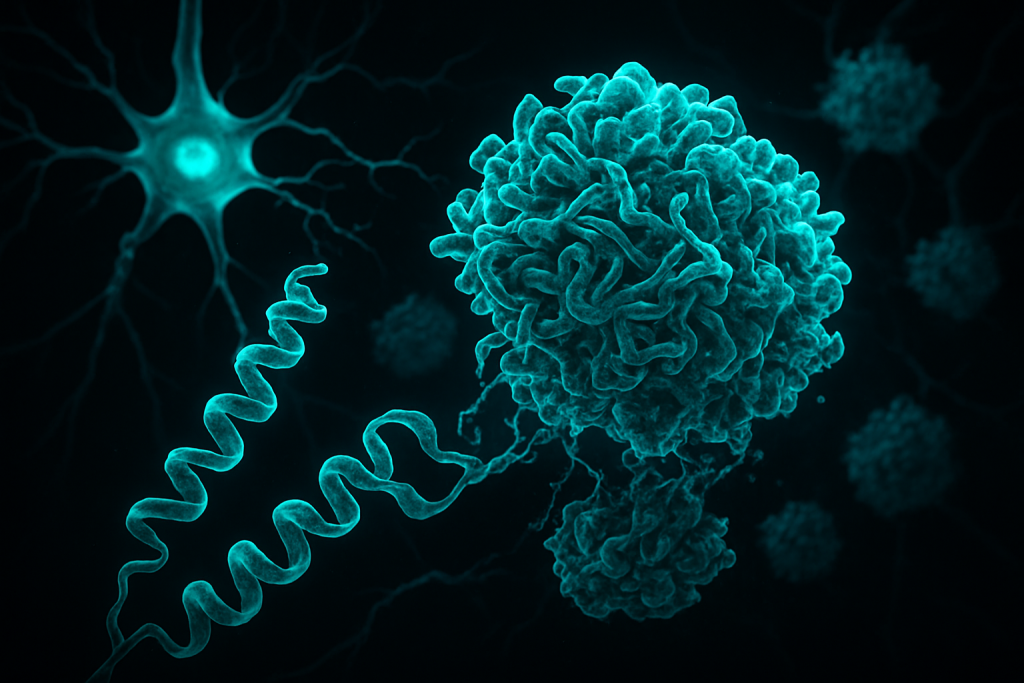
Image generated by AI
Inside your brain, proteins are folding into the wrong shapes right now—and in some people, this silent molecular catastrophe will eventually lead to tremors, memory loss, or paralysis. Protein misfolding sounds like an obscure biochemical curiosity, but it sits at the heart of some of humanity’s most devastating neurological conditions: Alzheimer’s disease, Parkinson’s disease, Huntington’s disease, and amyotrophic lateral sclerosis (ALS). What makes this process so insidious is that a single misfolded protein can trigger a chain reaction, spreading corruption through the brain like dominoes falling in slow motion.
For decades, scientists treated protein misfolding as a curious byproduct of neurodegeneration. Today, the view has inverted entirely. Misfolded proteins are now understood as the primary drivers of disease, not mere bystanders, and this reframing is revolutionizing how researchers approach treatment. With an aging global population and no cures yet available for these conditions, understanding protein misfolding has become one of the most urgent challenges in biomedical science. Recent breakthroughs in imaging, genetics, and drug design are finally giving us tools to intervene in ways once thought impossible.
What Is Protein Misfolding and Neurodegenerative Disease?
Proteins are molecular machines that do almost everything in your cells: they catalyze reactions, build structures, transmit signals, and fight infections. Their ability to function depends almost entirely on their three-dimensional shape. A protein folds into this shape as it’s being synthesized, guided by the laws of chemistry and aided by specialized cellular helpers called chaperones. In healthy neurons, proteins misfold occasionally, but quality-control systems called the proteasome and autophagy quickly identify and destroy these malformed molecules. But when misfolded proteins accumulate faster than the cell can clear them—or when the misfolded protein resists degradation—trouble begins. These wayward molecules can clump together into aggregates, forming tangles and plaques that damage neurons and trigger inflammatory cascades. The cell’s protective mechanisms, overwhelmed and frustrated, begin to fail, and the neuron eventually dies.
The connection between misfolded proteins and neurodegenerative disease was established over decades of painstaking detective work. In 1906, the German psychiatrist Alois Alzheimer observed plaques and tangles in the brain of an Alzheimer’s patient, though he didn’t know they were made of protein. It wasn’t until the 1980s and 1990s that scientists identified the specific proteins involved: amyloid-beta in Alzheimer’s and alpha-synuclein in Parkinson’s. The turning point came in the late 1990s when researchers discovered that these diseases could be triggered by introducing misfolded protein seeds into otherwise healthy brains—proof that misfolding itself was transmissible and pathogenic, not merely correlative.
What the Research Shows
The mechanism of protein-driven neurodegeneration operates like a molecular fire that spreads through tissue. The process begins when a protein misfolds—perhaps due to genetic mutation, environmental stress, or simple bad luck in the folding lottery. This malformed molecule becomes toxic in several ways: it can poison the cellular machinery, trigger aberrant signaling, or, most dramatically, serve as a template for other proteins to misfold in the same way. This templating phenomenon, where one misfolded protein recruits properly folded proteins to adopt its wrong shape, is called prion-like propagation. It’s what makes neurodegenerative diseases so pernicious. A handful of misfolded proteins at age 40 might not cause symptoms, but over 30 years of exponential spread, they accumulate to a threshold where neurons can no longer function. By the time symptoms appear, the damage is often irreversible.
Consider amyloid-beta in Alzheimer’s disease. Imagine a line of dominoes arranged in a circle: each domino is a normal amyloid-beta protein, folded correctly and minding its business. A single domino falls—it misfolds. As it topples, it hits the next domino, which also tips into the wrong shape. That domino hits the next, and the next. Soon you have a cascade of fallen dominoes, which pile up in corners of the brain, forming plaques. These plaques don’t just sit passively; they irritate nearby neurons, triggering inflammation and oxidative stress. Tau proteins, another central character in Alzheimer’s, form tangles inside neurons through a similar mechanism. The combined assault of amyloid plaques and tau tangles systematically dismantles the neural circuits that support memory and cognition.
What This Means for Patients and Science
The identification of misfolded proteins as disease drivers has transformed the therapeutic landscape. Rather than trying to treat symptoms—temporarily boosting neurotransmitters or reducing inflammation—researchers can now target the root cause: preventing misfolding, clearing existing misfolded aggregates, or blocking their spread. This represents a fundamental shift in strategy, analogous to the difference between treating fever in an infection versus killing the pathogen itself. Several drugs now in clinical use or advanced trials take these approaches. Lecanemab, approved by the FDA in 2023, is a monoclonal antibody that binds to amyloid-beta aggregates and clears them from the brain, showing modest but meaningful slowing of cognitive decline in early Alzheimer’s patients. Similar approaches are being developed for tau, alpha-synuclein, and other disease proteins.
Beyond antibodies, researchers are pursuing complementary strategies. Small-molecule drugs that stabilize protein folding or enhance cellular quality-control systems are in development. Gene therapies aim to reduce the production of disease proteins in the first place. And a growing field is investigating how to boost the brain’s own clearance mechanisms—essentially training the brain’s janitors to work harder. Companies like Eli Lilly, Biogen, and Roche have invested billions in these approaches, transforming neurology from a field of palliative care into one with potential disease-modifying treatments. Academic centers like MIT, Stanford, and the UK’s Dementia Research Institute are pushing the boundaries further, exploring how to deliver large molecules across the blood-brain barrier and how to predict who will develop disease before symptoms emerge.
Recent Breakthroughs in Protein Misfolding and Neurodegenerative Disease
The years 2022 through 2024 have brought a succession of achievements that have reinvigorated the field. Lecanemab’s FDA approval represented the first disease-modifying treatment for Alzheimer’s, despite modest effect sizes—a symbolic and practical victory after decades of failed drug trials. Simultaneously, structural biologists using cryo-electron microscopy have resolved the three-dimensional structures of disease-related protein aggregates at atomic resolution, revealing how they form and what makes them toxic. This knowledge is enabling rational drug design rather than trial-and-error screening. In Parkinson’s disease, researchers have identified biomarkers—measurable signs of alpha-synuclein misfolding—that can detect disease years before motor symptoms appear, opening the door to preventive interventions. Studies published in 2023 and 2024 have also uncovered unexpected links between protein misfolding and neuroinflammation, suggesting that immune cells in the brain play a larger role in disease progression than previously appreciated.
The field is now grappling with several tantalizing open questions. Why do different misfolded proteins cause different diseases, even though the underlying mechanism is similar? Why do some people with extensive amyloid plaques never develop Alzheimer’s symptoms—what protective factors are at work in their brains? Can we develop preventive treatments for people with genetic risk factors before they show any signs of disease? Researchers are also investigating whether misfolded proteins originating in the gut or other organs might travel to the brain and seed disease—a hypothesis that, if proven, could lead to entirely new prevention strategies.
Why Protein Misfolding and Neurodegenerative Disease Matters for the Future
As the global population ages, neurodegenerative diseases are becoming one of the defining health challenges of the 21st century. Alzheimer’s disease alone affects 6.9 million Americans today and is projected to nearly triple by 2060 if no cures are developed. The economic burden is staggering: dementia care costs the U.S. healthcare system over 300 billion dollars annually. But the human cost is immeasurable—the loss of memory, identity, and independence that defines these diseases. Success in treating protein misfolding diseases could have ripple effects across medicine. The fundamental biology of protein quality control, prion-like propagation, and aggregate toxicity may also illuminate other conditions, from certain forms of cancer to metabolic disease. And the technological advances emerging from this research—new imaging modalities, drug delivery systems, and biomarkers—will strengthen medicine broadly.
Significant challenges remain before these discoveries can help most patients. Many experimental drugs fail to cross the blood-brain barrier or produce unwanted side effects. Most therapies work best when disease is caught early, yet we lack sensitive diagnostic tests available outside specialized research centers. The cost of these new biologics will be prohibitive for many patients without major advances in manufacturing or pricing policy. And for many neurodegenerative diseases—particularly those in developing countries with limited access to diagnostic imaging—we’re still gathering basic data about protein involvement and disease mechanisms. The scientific consensus is clear: protein misfolding is central to neurodegeneration, but translating that knowledge into widely available, effective treatments remains an ongoing struggle.
Key Takeaways
- Protein misfolding is the primary driver of major neurodegenerative diseases including Alzheimer’s, Parkinson’s, Huntington’s, and ALS, not merely a side effect of neuronal degeneration.
- Misfolded proteins spread through the brain via prion-like propagation, where one malformed protein recruits others to adopt its aberrant shape, creating self-perpetuating cascades of damage.
- The most promising treatment approach uses monoclonal antibodies like lecanemab to clear misfolded aggregates from the brain, showing potential to slow cognitive decline in early Alzheimer’s disease.
- Recent breakthroughs in cryo-electron microscopy, biomarkers, and immune biology have dramatically accelerated drug discovery, though treatments remain limited in availability and effect size.
- As the global population ages and neurodegeneration becomes an epidemic, mastering the biology of protein misfolding may unlock preventive therapies and reshape how we understand aging itself.
Explore TED Talks on Protein Misfolding and Neurodegenerative Disease:
TED content is used under CC BY-NC-ND 4.0. © TED Conferences, LLC.
Frequently Asked Questions
How does a single misfolded protein trigger a chain reaction in the brain?
A misfolded protein can act as a template that causes correctly folded proteins to adopt the same abnormal shape through a self-propagating process, similar to dominoes falling in sequence. This creates an exponential accumulation of misfolded proteins that spreads through neural tissue and disrupts cellular function.
Why were scientists previously dismissive of protein misfolding as merely a byproduct rather than a cause of neurodegeneration?
Early research lacked the sophisticated imaging, genetic, and molecular tools needed to establish direct causation between misfolded proteins and disease pathology. The paradigm shift occurred as technology advanced, revealing that misfolded proteins are actually the primary drivers initiating the cascade of neuronal damage.
What structural role do proteins normally play in the brain that makes their misfolding so consequential?
Proteins function as molecular machines that perform virtually all cellular operations, including enzyme catalysis, structural support, and cell signaling. When proteins misfold, they lose their proper three-dimensional structure and can no longer perform these critical functions, leading to cellular dysfunction and neuronal death.
Are the misfolded proteins involved in Alzheimer's, Parkinson's, Huntington's, and ALS the same molecular species or distinct variants?
Each neurodegenerative disease involves misfolding of different specific proteins—amyloid-beta and tau in Alzheimer's, alpha-synuclein in Parkinson's, huntingtin in Huntington's, and SOD1 or TDP-43 in ALS—though the underlying mechanism of pathogenic misfolding and propagation is mechanistically similar across all conditions.