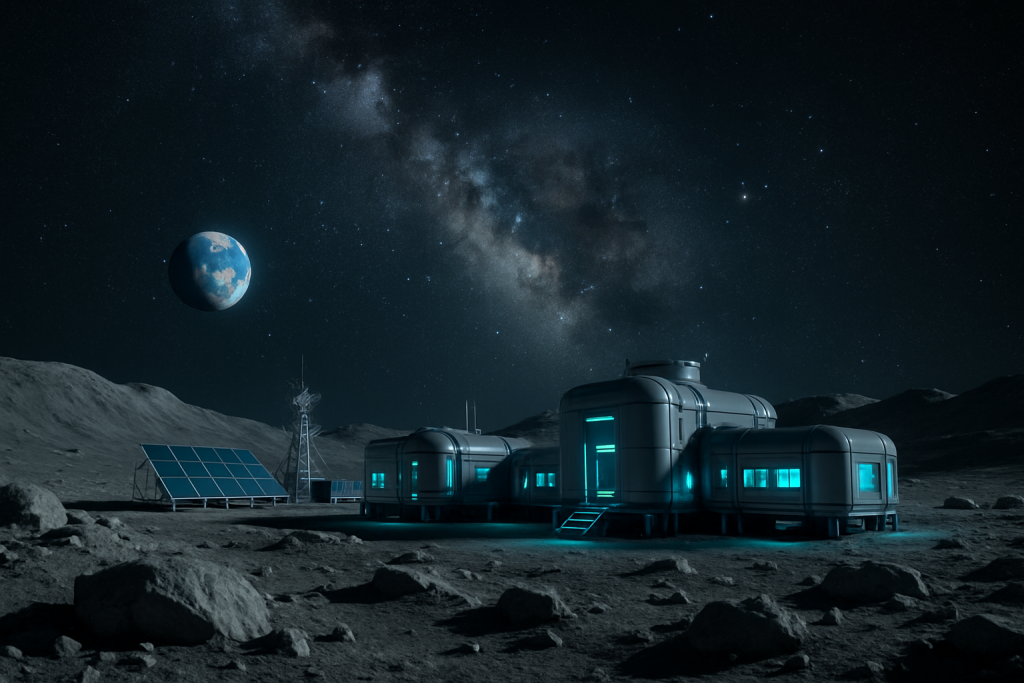
Image generated by AI
AI Insight
Moon bases are permanent or semi-permanent human settlements planned for the lunar surface to conduct research, extract resources, and serve as staging points for deeper space exploration. Recent discoveries of water ice at the lunar poles and advances in life-support technology make sustained lunar habitation scientifically feasible, with NASA's Artemis program and international efforts targeting establishment of operational bases within this decade.
Why it matters
Moon bases could revolutionize space exploration by reducing launch costs through local resource extraction, testing technologies for Mars missions, and potentially creating new industries through lunar resource mining and low-gravity manufacturing. The lower gravity and accessible water ice make the Moon an economically viable stepping stone for humanity's expansion beyond Earth.
Understand the Science
Humanity is preparing to return to the Moon—not just for brief visits, but to stay. Moon bases represent humanity’s next giant leap: permanent or semi-permanent settlements on the lunar surface that could serve as research stations, fuel depots, and stepping stones to Mars. Unlike the Apollo missions of the 1960s and 70s, which lasted days, modern lunar bases are designed to support continuous human presence and scientific discovery.
What We Know So Far
A Moon base is fundamentally a facility designed to sustain human life and conduct scientific research on the lunar surface. These bases would house astronauts for extended periods—potentially months or years—and include laboratories, habitats, power systems, and resource-extraction equipment. The Moon’s harsh environment presents enormous challenges: temperatures swing from 260°F in sunlight to minus 280°F in shadow, the surface is bombarded by cosmic radiation and micrometeorites, and there’s no atmosphere for protection. However, recent discoveries make lunar habitation more feasible than ever. NASA’s Lunar Reconnaissance Orbiter has confirmed water ice exists in permanently shadowed craters near the lunar poles—a game-changing resource that could provide drinking water, oxygen, and rocket fuel. Additionally, the Moon’s lower gravity (one-sixth of Earth’s) makes it easier to launch spacecraft toward deeper space destinations.
The history of lunar exploration shows remarkable progress. The Soviet Union’s robotic Luna missions first reached the Moon in 1959. NASA’s Apollo program landed humans there between 1969 and 1972. Since then, robotic orbiters and landers from multiple nations have mapped the surface and identified resources. Today, space agencies and private companies are designing the technologies needed for sustained presence.
The Future of Exploration
NASA’s Artemis program aims to establish a “lunar gateway”—a space station in lunar orbit—and land astronauts, including the first woman on the Moon, by the mid-2020s. These missions will test life-support systems, habitat designs, and in-situ resource utilization techniques needed for permanent bases. China has announced plans for a lunar research station, while private companies like SpaceX are developing cargo-delivery systems. A functioning Moon base could transform space exploration by serving as a testing ground for technologies bound for Mars, a hub for scientific discoveries about lunar geology and the early solar system, and a demonstration of humanity’s capacity to thrive beyond Earth. The economic implications are significant too: mining lunar resources and manufacturing in low gravity could eventually create entirely new industries.
Key Takeaways
- Moon bases represent permanent human settlements on the lunar surface, designed to support research and resource extraction
- Water ice at the lunar poles and the Moon’s low gravity make sustained habitation scientifically and technically feasible
- NASA’s Artemis program and international efforts are racing to establish the first operational lunar bases within this decade
Explore TED Talks on Moon Base/Lunar Missions:
TED content is used under CC BY-NC-ND 4.0. © TED Conferences, LLC.
Frequently Asked Questions
How do extreme temperature swings on the Moon affect the design of lunar base structures?
Moon bases must use insulation, thermal regulation systems, and materials that can withstand temperature fluctuations from 260°F in sunlight to minus 280°F in shadow without becoming brittle or failing. These thermal challenges require specialized construction materials and active heating/cooling systems to maintain safe habitats for equipment and astronauts.
Why is water ice in permanently shadowed lunar craters considered a game-changing resource for Moon bases?
Water ice can be extracted and used to produce drinking water for astronauts, oxygen for breathing and fuel production, and hydrogen for rocket fuel, reducing the need to transport these critical resources from Earth. This local resource availability dramatically decreases launch costs and increases the sustainability of long-term lunar settlements.
How does the Moon's lower gravity affect spacecraft launches from a lunar base?
The Moon's gravity being one-sixth of Earth's requires significantly less energy and fuel to launch spacecraft from its surface, making it an ideal staging point for missions to Mars and deeper space destinations. This gravitational advantage reduces the propellant needed for deep-space missions and increases payload capacity.
What cosmic and micrometeorite hazards must lunar bases protect against, and why?
Without a protective atmosphere, the lunar surface is exposed to cosmic radiation and micrometeorite impacts that can damage equipment and pose health risks to astronauts. Bases must incorporate shielding, radiation protection systems, and structural reinforcement to ensure crew safety and equipment longevity during extended stays.