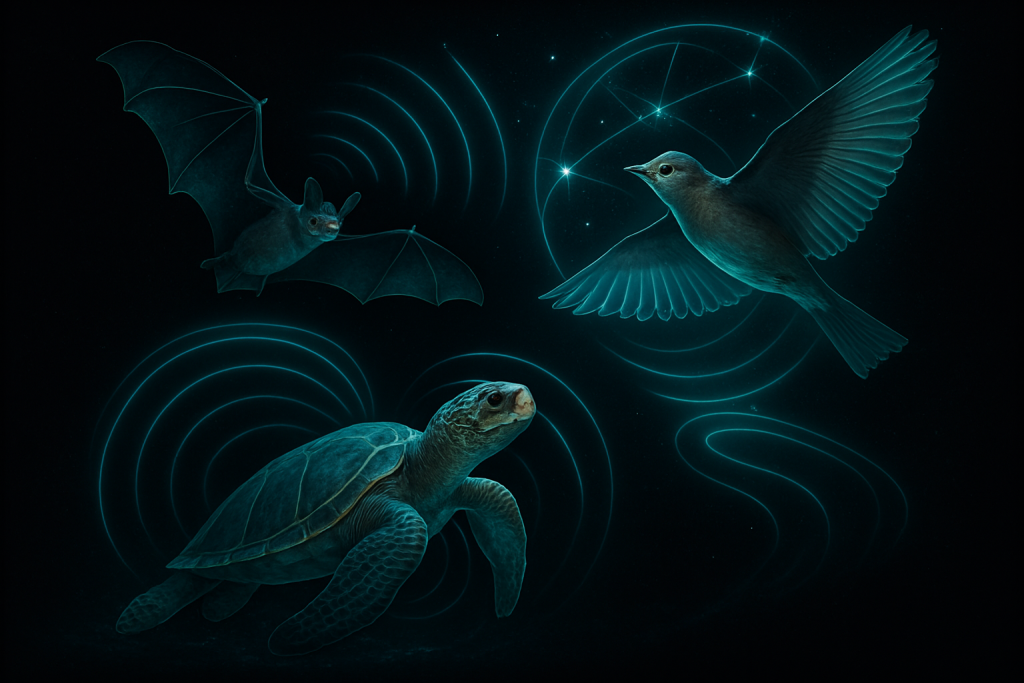
Image generated by AI
Every spring, a tiny Arctic tern embarks on a journey that would exhaust most creatures: a 44,000-mile round-trip migration from pole to pole, navigating over open ocean with no landmarks to guide it. Yet this bird, weighing barely four ounces, arrives at its destination with remarkable precision. How does it know the way? The answer lies in an intricate biological GPS system that combines multiple sensory cues—magnetic fields, celestial coordinates, and even smell—into a unified navigational map that exists nowhere else in nature. This feat of animal navigation reveals something profound: life has evolved solutions to finding its way through the world that rival and sometimes surpass our own technological achievements.
The study of animal navigation and sensory mechanisms has emerged as one of the most vibrant frontiers in biology, with implications extending far beyond academic curiosity. As climate change alters the landscapes and atmospheric conditions that animals depend on, understanding how creatures navigate becomes critical for conservation. Simultaneously, researchers are mining animal sensory systems for insights that could revolutionize human technology—from GPS-free drone navigation to treatments for spatial disorientation and Alzheimer’s disease. The question is no longer merely academic: in a rapidly changing world, decoding the sensory genius of animals may hold keys to human survival and flourishing.
What Is Animal Navigation and Sensory Mechanisms?
Animal navigation refers to the biological processes by which organisms determine their location, orient themselves in space, and move purposefully from one place to another. Sensory mechanisms are the specialized biological systems that gather and process environmental information—light, magnetic fields, sound, chemical signals, and tactile cues—which animals integrate into coherent spatial awareness. Together, these systems allow an organism to build an internal representation of its world and plan routes through it, whether that world is a forest, an ocean, or the night sky. Unlike human navigation, which relies heavily on visual landmarks and instruments, animal navigation typically employs multiple sensory channels simultaneously, creating a redundant, robust system that works even when individual cues fail.
The systematic study of animal navigation began in earnest during the early 20th century, when scientists like Karl von Frisch observed that honeybees communicate the location of food sources through a precise dance that encodes direction and distance. By the 1960s and 1970s, researchers discovered that many animals could detect the Earth’s magnetic field—a finding that seemed almost implausible at the time. The pioneer ethologist Konrad Lorenz demonstrated that geese imprint on their parents during critical early periods and use this information to navigate across continents. Since then, technological advances in genetics, neuroscience, and satellite tracking have revealed that animal navigation relies on a sophisticated suite of sensory capabilities, some of which humans entirely lack.
How It Works in Nature
Animal navigation systems typically integrate information from multiple sensory channels, each providing complementary information about location and direction. The most fundamental navigational cues derive from celestial navigation—the position of the sun, moon, and stars relative to time of day or season. Many animals possess an internal circadian clock that allows them to compensate for the sun’s movement throughout the day, effectively using it as a compass. Magnetic field detection, mediated by specialized proteins called cryptochromes or iron-based compounds in the inner ear or beak, allows birds, sea turtles, and even some bacteria to sense Earth’s magnetic poles as a directional reference. Beyond these primary mechanisms, animals layer in olfactory maps—mental charts of chemical signatures distributed across their environment—visual landmarks, and even infrasound cues (sounds below human hearing range) that can carry across vast distances.
Consider the loggerhead sea turtle, which spends years navigating the open Atlantic Ocean, then returns to the exact beach where it hatched to lay its own eggs. Young turtles use magnetic field detection to orient themselves, but as they mature and enter ocean currents, they develop an olfactory map by correlating specific chemical gradients—salt concentrations, nutrient signatures from coastal upwellings—with their magnetic position. This creates a three-dimensional chemical map that a turtle can consult decades later, literally following its nose home. The system is so precise that researchers have found slight variations in turtle populations returning to different beaches can be predicted by subtle differences in local magnetic declination. Similarly, migratory songbirds combine star navigation (using constellations relative to magnetic north) with visual landmarks and polarized light patterns in the sky to maintain course across thousands of miles of unfamiliar terrain.
Medical and Scientific Relevance
Understanding animal navigation mechanisms has profound implications for human health and neuroscience. The brain structures and neural circuits that support spatial navigation in animals closely parallel those in humans, particularly the hippocampus—a seahorse-shaped structure crucial for memory and spatial reasoning. In fact, research on how rats navigate mazes and how birds create cognitive maps of their territories has directly informed our understanding of human memory disorders. Patients with Alzheimer’s disease often experience spatial disorientation long before other cognitive symptoms appear, and neuroscientists are now investigating whether interventions that support the “place cell” and “grid cell” systems observed in animal brains might preserve spatial cognition in aging humans. Additionally, individuals suffering from vestibular disorders, which disrupt the inner ear’s role in balance and orientation, could potentially benefit from therapies derived from understanding how other animals solve similar navigational problems without functional ears.
The commercial and technological applications are equally compelling. Roboticists are now developing autonomous systems modeled on insect navigation—specifically, how honeybees and desert ants navigate using optic flow (the apparent motion of the environment) and minimal cognitive overhead. Companies like AeroVironment and academic labs are building drones inspired by bee navigation that can operate in GPS-denied environments, valuable for disaster response and reconnaissance. Agricultural scientists are studying bird magnetoreception to develop non-toxic animal deterrents that won’t harm crops. Meanwhile, pharmaceutical researchers are investigating whether certain compounds that enhance the magnetic sensing abilities of migrating birds might help treat human inner ear disorders or restore vestibular function in astronauts returning from zero-gravity environments.
Recent Breakthroughs in Animal Navigation and Sensory Mechanisms
The past three years have witnessed remarkable advances in understanding the molecular basis of animal navigation. In 2023, researchers at the University of Tokyo identified specific proteins in the eyes of migratory birds that function as quantum sensors, detecting the Earth’s magnetic field through quantum entanglement effects—a finding that upgrades our understanding of how sensitive biological systems can become. Simultaneously, studies on the olfactory navigation of Pacific salmon revealed that these fish possess an extraordinary ability to detect amino acid signatures in water at concentrations as low as one molecule per billion, creating olfactory maps of river systems at a sensitivity that challenges our previous understanding of biological detection limits. Perhaps most intriguingly, research published in 2024 demonstrated that fruit flies—organisms with brains smaller than a sesame seed—construct and update three-dimensional cognitive maps of their environment in real time, a finding that suggests sophisticated spatial cognition may be far more widespread in the animal kingdom than previously believed.
Current research frontiers are exploring several fascinating questions: Do animals update their navigational maps in response to climate-driven environmental changes, and if so, can we identify the learning mechanisms underlying this adaptation? Can we identify the neural “code” by which the brain converts magnetic, olfactory, and visual information into a unified spatial representation? Neuroscientists at institutions like Cambridge and Stanford are using advanced imaging techniques to observe entire populations of neurons as animals navigate, seeking to understand not just that navigation occurs, but how the brain computes it. The emerging picture suggests that animal navigation is not a rigid instinct but a flexible, learned system that integrates prediction, memory, and continuous sensory updating.
Why Animal Navigation and Sensory Mechanisms Matters for the Future
As climate change reshapes migration corridors and alters magnetic declination, understanding animal navigation becomes a cornerstone of conservation biology. Many species face unprecedented challenges: songbirds arriving in spring to find no insects; sea turtles navigating to beaches eroded by rising seas; whales following acoustic cues to feeding grounds disrupted by ocean shipping noise. By understanding the sensory mechanisms these animals depend on, conservationists can identify the most critical interventions—whether that means protecting acoustic corridors for marine mammals or maintaining the dark-sky conditions nocturnal migrants require. Beyond conservation, the principles underlying animal navigation offer templates for human technology in an increasingly GPS-unreliable world. Military agencies and tech companies recognize that as adversaries develop GPS-jamming technologies, alternative navigation systems inspired by biology become strategically vital.
Yet significant challenges remain. Many animals navigate using sensory channels humans cannot directly measure or perceive—the Earth’s magnetic field, infrasound, or polarized light—making it difficult to fully recreate these systems in technology. The interplay between nature and nurture in navigation remains poorly understood; determining which navigational abilities are innate and which are learned remains an active area of investigation. Additionally, we still lack comprehensive understanding of how individual animals differ in navigational ability, whether through genetic variation or developmental experience, and whether these differences might explain why some populations adapt to environmental change while others do not. Climate research particularly needs this understanding: as ecosystems shift, the question of whether animals can adaptively modify their navigational strategies faster than their habitats change may determine which species survive the coming century.
Key Takeaways
- Animal navigation relies on integrated sensory systems—magnetic field detection, celestial cues, olfactory mapping, and visual landmarks—that create redundant, robust spatial awareness exceeding single-channel human navigation.
- Animals such as Arctic terns, sea turtles, and migratory birds demonstrate that biological systems can achieve navigational precision rivaling or surpassing human technology, across distances spanning entire ocean basins.
- Understanding animal magnetoreception and cognitive mapping directly informs treatment approaches for human disorders including Alzheimer’s disease, vestibular dysfunction, and spatial disorientation.
- Recent breakthroughs reveal quantum biological effects in bird magnetoreception and extraordinarily sensitive olfactory navigation in salmon, suggesting animal sensory capabilities operate at the limits of physical and chemical detection.
- As climate change disrupts migration corridors and GPS technology becomes vulnerable to jamming, understanding animal navigation mechanisms becomes critical for both conservation and the development of bio-inspired autonomous systems.
Explore TED Talks on Animal Navigation and Sensory Mechanisms:
TED content is used under CC BY-NC-ND 4.0. © TED Conferences, LLC.
Frequently Asked Questions
How do Arctic terns use multiple sensory cues like magnetic fields and celestial coordinates simultaneously to navigate?
Arctic terns integrate multiple sensory inputs into a unified navigational map by processing magnetic field detection, sun/star position (celestial cues), and olfactory information through neural integration in their brains. This multi-modal system provides redundancy and accuracy, allowing them to maintain precise navigation even when individual cues become unreliable.
What biological mechanisms allow animals to detect Earth's magnetic field for navigation purposes?
Animals use specialized proteins called cryptochromes in their eyes that undergo quantum-level changes in response to magnetic fields, or they possess magnetite crystals in tissues that physically align with magnetic forces. These mechanisms generate neural signals that the brain interprets as directional information.
Why is understanding animal navigation becoming critical for conservation efforts?
Climate change is altering the environmental cues—such as atmospheric conditions, seasonal timing, and celestial patterns—that migratory animals depend on for navigation, potentially causing them to arrive at breeding grounds at wrong times or become disoriented. By understanding these sensory mechanisms, scientists can better predict how species will respond to environmental changes and develop targeted conservation strategies.
Can animal sensory navigation systems be applied to develop human technology like GPS-free navigation?
Yes, researchers are studying animal sensory mechanisms to create bio-inspired navigation systems that function without GPS by combining magnetic field detection, visual landmark processing, and directional sensing. These principles could improve autonomous drone navigation and help develop treatments for human spatial disorientation disorders like Alzheimer's disease.