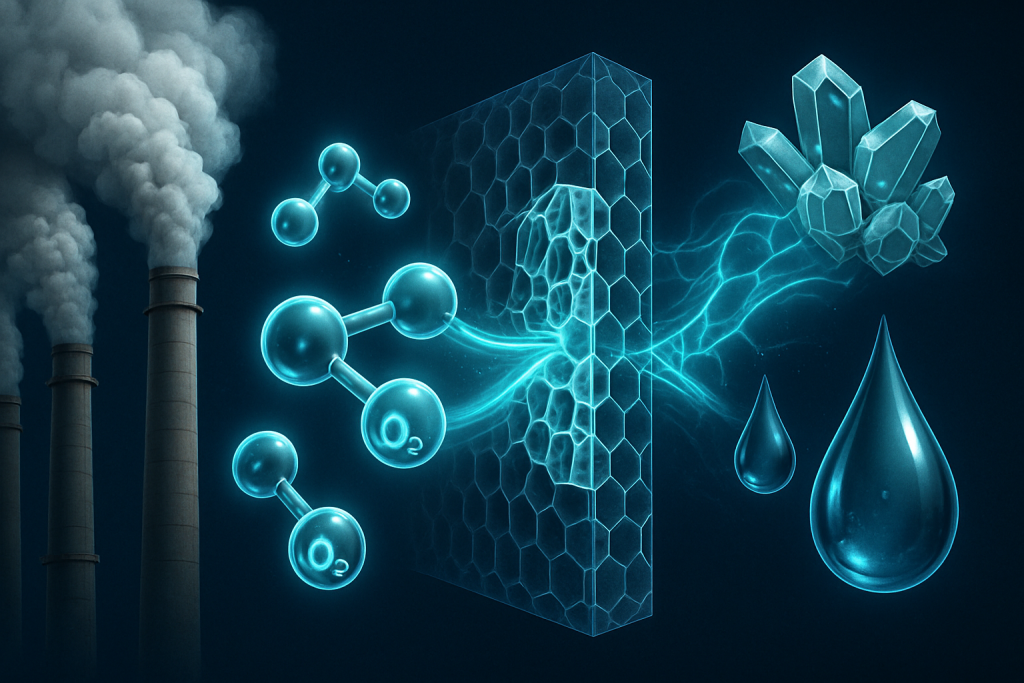
Image generated by AI
Every year, humanity pumps roughly 37 billion metric tons of carbon dioxide into the atmosphere, yet we’ve only begun to seriously consider removing it. Carbon capture technologies, once dismissed as too expensive and impractical, are now attracting billions in investment and operating at industrial scales around the world. But what exactly happens when we “capture” CO₂, and can this technology actually make a dent in the climate crisis?
The answer lies at the intersection of chemistry, engineering, and economics—a space where scientists are discovering that removing carbon from the air is not only possible but increasingly profitable. From capturing emissions straight from power plants to pulling CO₂ directly from ambient air, these technologies are reshaping how we think about fighting climate change. Understanding how they work reveals both their remarkable potential and the formidable challenges still ahead.
What Is Carbon Capture and CO₂?
Carbon capture refers to a suite of technologies designed to separate carbon dioxide from its surroundings—whether from industrial exhaust streams, power plant emissions, or even the open air itself. Once captured, the CO₂ can be permanently stored underground, used in industrial processes, or converted into new products like chemicals, fuels, or building materials. The fundamental goal is simple: prevent greenhouse gases from reaching the atmosphere, or extract them once they already have. This distinguishes carbon capture from other climate solutions like renewable energy or forest conservation, which prevent new emissions rather than dealing with existing ones.
The concept of capturing carbon isn’t entirely new. Scientists and engineers have been removing CO₂ from gas streams for more than a century, primarily for industrial purposes like producing beverages and chemicals. The modern emphasis on climate-scale carbon capture, however, began in earnest in the 1990s and early 2000s, when researchers recognized that simply preventing future emissions wouldn’t be enough to meet climate targets. Organizations like the International Energy Agency have since determined that large-scale carbon capture and storage will likely be essential for limiting global warming to 1.5 degrees Celsius above pre-industrial levels. Today, the field encompasses everything from retrofit systems for existing power plants to experimental machines designed to extract CO₂ directly from the atmosphere.
The Chemistry Behind It
At its core, carbon capture relies on the principle that CO₂ molecules can be selectively separated from other gases through chemical or physical processes. The most common approach uses chemical solvents—substances that bind to CO₂ molecules preferentially, allowing them to be isolated. Imagine a crowded room where one type of person is magnetically attracted to a particular chair; the solvents work similarly, seeking out and bonding with CO₂ while leaving other gases alone. Once the CO₂ is bound to the solvent, heat or pressure changes can cause the bond to break, releasing pure CO₂ gas that can then be compressed and stored. This process, called regeneration, is crucial because it allows the solvent to be reused repeatedly, making the technology economically viable.
The most widely used solvent in industrial carbon capture is amine, an organic compound with nitrogen atoms that have a strong affinity for CO₂. When CO₂-laden gas passes through an amine solution, the chemical reaction is nearly instantaneous: the amine molecules grab hold of the carbon dioxide, forming new compounds called carbamates and bicarbonates. To release the captured CO₂, engineers heat the solution to around 120 degrees Celsius, which breaks the chemical bonds and vaporizes the pure CO₂ gas. Think of it like a chemical sponge: the amine soaks up CO₂ readily, but wringing it out requires just the right amount of heat. Alternative solvents, including more advanced amines and even solid materials called sorbents, are being developed to improve efficiency and reduce the energy costs of regeneration.
Where It Is Used Today
Carbon capture technology is currently deployed across three distinct sectors, each with different motivations and economics. Point-source capture, the most mature application, targets emissions directly from industrial facilities—coal and natural gas power plants, cement factories, steel mills, and oil refineries are prime candidates because they produce highly concentrated CO₂ streams. Direct air capture (DAC), the most ambitious approach, uses enormous machines to pull CO₂ directly from the ambient atmosphere, where concentrations are far lower and the thermodynamic challenge is immense. A third application, called bioenergy with carbon capture and storage (BECCS), combines the burning of biomass with carbon capture, theoretically creating a carbon-negative energy source. Each approach addresses different parts of the emissions landscape and faces distinct technical and economic hurdles.
Several operational facilities demonstrate the viability of these approaches. In Norway, the Sleipner gas field has injected captured CO₂ underground continuously since 1996, proving that long-term geological storage is safe and effective. In the United States, numerous industrial facilities use carbon capture to enhance oil recovery—the captured CO₂ is injected into depleted oil fields to push out remaining crude. Switzerland’s Climeworks operates the world’s largest direct air capture facility near Zurich, pulling CO₂ from the air and either using it to enhance plant growth in greenhouses or storing it permanently in basalt rock. In Canada, Quest, another major facility, captures CO₂ from oil sands operations. Meanwhile, companies like Carbon Engineering and Global Thermostat are scaling up direct air capture technology, with backing from major tech companies and governments that see the potential for climate impact.
Recent Breakthroughs in Carbon Capture and CO₂
The past three years have witnessed accelerating innovation and commercialization in carbon capture. In 2023, the U.S. Department of Energy announced major funding initiatives specifically targeting cost reductions, aiming to bring direct air capture costs down from current levels of around $600 per ton to $100 per ton by 2030. Simultaneously, researchers have made progress on alternative sorbent materials—specially designed solids that can capture CO₂ more efficiently than traditional chemical solvents. Some of these materials, based on metal-organic frameworks and polymers, show promise for capturing CO₂ at lower temperatures and with less energy input than conventional amine-based systems. The broader regulatory landscape has also shifted dramatically, with carbon pricing mechanisms and tax credits in jurisdictions worldwide making capture economically attractive for the first time.
Scientists are currently investigating several cutting-edge directions. Electrochemical carbon capture, which uses electricity to separate CO₂ from gases, could potentially be powered by renewable energy, reducing the carbon footprint of the capture process itself. Enzyme-based systems that mimic how nature captures carbon are being developed and tested at laboratory scales. Researchers are also exploring how to better utilize captured carbon by developing new uses—converting it into sustainable fuels for aviation, producing durable chemicals, or even creating building materials that sequester carbon permanently. The fundamental open question remains: can we scale these technologies fast enough and cheaply enough to make a meaningful dent in global emissions while the world simultaneously decarbonizes its energy system?
Why Carbon Capture and CO₂ Matters for the Future
Carbon capture occupies a curious and contested position in climate strategy. It is neither a silver bullet nor a distraction—it’s a tool that will likely play an essential supporting role in decarbonization. Most climate scenarios consistent with limiting warming to 1.5 degrees Celsius incorporate significant amounts of carbon capture, particularly for hard-to-abate sectors like aviation, heavy industry, and cement production. Yet the technology is energy-intensive and expensive, making it unsuitable as a primary climate strategy; renewable energy expansion and efficiency improvements must remain the centerpiece of climate action. Carbon capture’s value lies in its ability to address emissions that other technologies cannot easily eliminate, buying time while we transform global energy systems and providing a fallback for atmospheric CO₂ removal if climate impacts prove worse than anticipated.
The challenges ahead are formidable. Currently, global carbon capture capacity is tiny—less than 50 megatons of CO₂ annually, a rounding error compared to global emissions. Scaling to the gigatons per year that climate models suggest we’ll need requires not only technological breakthroughs but also dramatic cost reductions, permanent geological storage infrastructure, and supportive policy frameworks. The energy requirements remain a thorny problem: capturing, compressing, and storing CO₂ requires substantial electricity, and unless that power comes from renewable sources, the climate benefit is diminished. Additionally, questions linger about the permanence of geological storage over centuries, the potential for leakage, and whether building a carbon removal industry might create perverse incentives that weaken efforts to prevent emissions in the first place.
Key Takeaways
- Carbon capture technologies separate CO₂ from other gases using chemical solvents or solid materials, with the captured carbon then stored underground or utilized in new products.
- The chemistry relies on molecules—particularly amines—that selectively bind to CO₂ and release it when heated, allowing for repeated use of the capture medium.
- Current applications range from point-source capture at industrial facilities to direct air capture from the atmosphere, with operational facilities already proving feasibility and long-term storage safety.
- Recent breakthroughs in sorbent materials, electrochemical methods, and enzyme-based systems are driving down costs, though significant scaling challenges remain before the technology can meaningfully impact global emissions.
- Carbon capture will likely play a crucial supporting role in meeting climate targets, particularly for hard-to-decarbonize sectors, but must be paired with aggressive emissions prevention and renewable energy expansion to be truly effective.
Explore TED Talks on Carbon Capture/CO₂:
TED content is used under CC BY-NC-ND 4.0. © TED Conferences, LLC.
Frequently Asked Questions
How does carbon capture chemically separate CO₂ from other gases in industrial exhaust or ambient air?
Carbon capture uses chemical solvents, solid sorbents, or membranes that selectively bind to CO₂ molecules based on their molecular properties, allowing them to be separated from other gases through absorption or adsorption processes. Once concentrated, the CO₂ can be released through heating or pressure changes, leaving behind purified gas streams.
What are the main differences between point-source capture and direct air capture in terms of chemical efficiency?
Point-source capture targets concentrated CO₂ streams directly from power plants or industrial facilities (5-15% CO₂ concentration), making the separation process chemically more efficient and cost-effective. Direct air capture pulls CO₂ from ambient air where concentrations are only 0.04%, requiring significantly more energy and chemical processing to achieve the same mass of captured CO₂.
Once CO₂ is captured, what chemical or physical processes convert it into usable products like fuels or building materials?
Captured CO₂ undergoes chemical reactions such as hydrogenation (combining with hydrogen) to produce synthetic fuels, or carbonation reactions to create cement and concrete-like building materials. These conversion processes require energy inputs and catalysts to break the stable CO₂ molecule and recombine its atoms into new compounds with commercial value.
Why is permanently storing captured CO₂ underground considered chemically safer than other storage methods?
Underground storage (geological sequestration) keeps CO₂ in a dense, immobile state under high pressure and low temperature, where it remains trapped in rock formations for geological timescales. This prevents the gas from re-entering the atmosphere, unlike surface storage or temporary containment methods that risk leakage through chemical degradation or physical containment failure.