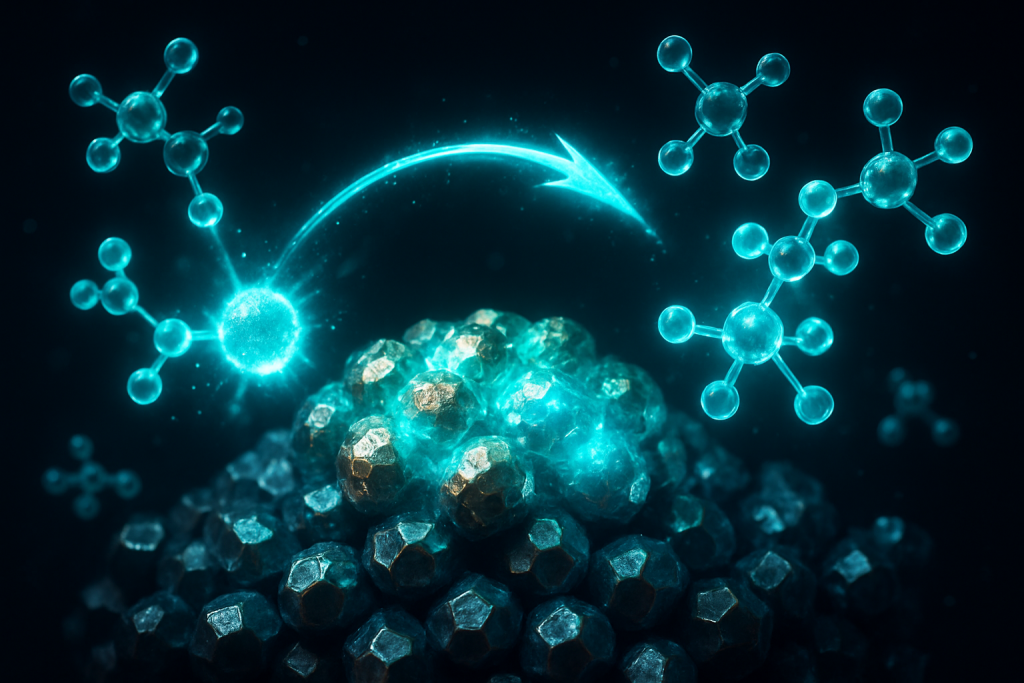
Image generated by AI
Every time you drive a car, breathe clean air, or take an aspirin, you’re benefiting from catalysis—a phenomenon so fundamental that it touches nearly every aspect of modern life. Yet most people have never heard the word. Catalysts are invisible chemical matchmakers that speed up reactions without being consumed in the process, enabling transformations that would otherwise take centuries to occur in mere seconds. They are the engines of the chemical industry and increasingly, the key to solving some of humanity’s most pressing environmental challenges.
As global demand for sustainable energy intensifies and industries seek cleaner production methods, catalysis has become one of the most actively researched fields in chemistry and materials science. Scientists around the world are designing novel catalysts to capture carbon dioxide, produce green hydrogen, and synthesize life-saving pharmaceuticals more efficiently. Understanding how catalysts work isn’t just academic curiosity—it’s essential for grasping how modern civilization manufactures everything from fertilizer to fuel to medicine, and how we might reimagine industrial chemistry for a carbon-constrained future.
What Is Catalysis and Chemical Conversion?
Catalysis is the acceleration of a chemical reaction by a substance—called a catalyst—that is not permanently altered by the reaction itself. In essence, a catalyst is a chemical facilitator. It lowers the activation energy, the barrier that reactant molecules must overcome to transform into products, making reactions proceed faster at lower temperatures and with less energy input. The catalyst participates in the reaction mechanism but emerges at the end unchanged, ready to participate in another cycle. This recyclability is what makes catalysts so economically attractive: a small amount of catalyst material can facilitate the transformation of enormous quantities of starting materials.
The history of catalysis stretches back surprisingly far. Swedish chemist Johann Wolfgang Döbereiner discovered in 1823 that platinum could mysteriously accelerate the recombination of hydrogen and oxygen without itself being consumed—a phenomenon he couldn’t explain at the time. The term “catalysis” itself was coined by Jöns Jacob Berzelius in 1835. However, the mechanistic understanding of how catalysts work remained murky for over a century. It wasn’t until the 20th century, particularly through the work of chemists like Paul Sabatier (who won a Nobel Prize in 1912 for catalytic hydrogenation) and later through advances in surface chemistry, that scientists began to understand the atomic-scale choreography underlying catalytic reactions.
The Chemistry Behind It
To understand catalysis at a deeper level, we need to think about what happens at the molecular level during a chemical reaction. For molecules to react, they must collide with sufficient energy and proper orientation. Most molecules, however, lack enough thermal energy to overcome the activation energy barrier—the mountain they must climb to break apart and recombine into new forms. A catalyst works by providing an alternative pathway with a lower peak. Rather than forcing reactant molecules to scale the original energy mountain, the catalyst creates a side route with gentler slopes. This might involve the catalyst temporarily bonding with reactant molecules, stabilizing the transition state where bonds are partially broken and reformed, or compartmentalizing reactants in ways that favor their interaction.
Consider an analogy: imagine a group of dancers trying to execute a complex synchronized move. Without instruction, they collide awkwardly, their energies dissipate, and few successfully complete the transformation. But a skilled choreographer (the catalyst) shows them the step-by-step path, breaking the complex motion into manageable intermediate positions. With this guidance, dancers transition fluidly through the move, and crucially, the choreographer remains unchanged after the performance, ready to guide the next group. The dancers are the reactant molecules, the final synchronized move is the product, and the choreographer is the catalyst—present, essential, but not consumed.
Where It Is Used Today
Catalysis is woven into the fabric of industrial chemistry. The petroleum refining industry relies on catalytic cracking and reforming to transform crude oil into gasoline, diesel, and chemical feedstocks. The production of ammonia through the Haber-Bosch process—which synthesizes nitrogen fertilizer feeding roughly half the world’s population—depends critically on iron catalysts operating at high pressure and temperature. Catalytic converters in automobiles use precious metal catalysts (platinum, palladium, and rhodium) to convert toxic nitrogen oxides, carbon monoxide, and unburned hydrocarbons into harmless nitrogen, water, and carbon dioxide before they exit the tailpipe. Pharmaceutical manufacturing relies on catalytic reactions to construct complex drug molecules efficiently and selectively.
The pharmaceutical industry has become increasingly sophisticated in deploying catalysis. Companies use metallic and enzymatic catalysts to perform selective transformations that would be difficult or impossible through conventional chemistry, enabling the synthesis of active pharmaceutical ingredients with fewer steps and less waste. Fine chemical manufacturers employ catalytic oxidation and hydrogenation extensively. The food industry uses catalysts in processes from vegetable oil hydrogenation to high-fructose corn syrup production. Even in emerging fields, catalysis is crucial: the conversion of biomass into biofuels, the synthesis of biodegradable polymers, and the production of specialty chemicals all depend on carefully designed catalytic systems.
Recent Breakthroughs in Catalysis and Chemical Conversion
The last few years have witnessed remarkable advances in catalysis driven by the urgent need for climate solutions and sustainable chemistry. Researchers have developed highly active catalysts for the electrochemical reduction of carbon dioxide, converting a potent greenhouse gas into useful chemicals and fuels. These catalysts, often composed of copper, nickel, or cobalt compounds, can selectively produce various products—formic acid, methanol, ethylene—depending on their precise composition and structure. Simultaneously, scientists have made significant progress in water electrolysis catalysis, developing non-precious-metal catalysts (containing iron, cobalt, or nickel instead of platinum or iridium) that can efficiently split water into hydrogen and oxygen, making green hydrogen production more economically viable.
Machine learning and artificial intelligence are beginning to transform catalyst discovery. Researchers are using computational methods to predict catalyst properties before synthesizing them, dramatically accelerating the screening process. New materials like single-atom catalysts—where individual metal atoms are anchored to support materials—are showing exceptional efficiency and selectivity. Photocatalysis research has advanced significantly, with scientists developing materials that harness sunlight to drive chemical transformations, from water purification to hydrogen production. The field is grappling with important open questions: How can we design catalysts that are not only efficient but also robust enough for industrial scales? How can we replace rare metals like platinum with Earth-abundant alternatives without sacrificing performance?
Why Catalysis and Chemical Conversion Matters for the Future
Catalysis stands at the intersection of climate change mitigation, resource efficiency, and economic competitiveness. As governments worldwide commit to carbon neutrality, catalytic technologies for capturing and converting carbon dioxide become increasingly critical. If we can develop catalysts that efficiently convert atmospheric CO2 into valuable chemicals or fuels, we move from seeing carbon as waste to treating it as a resource—a fundamental shift in industrial thinking. Similarly, as the world transitions to renewable energy, catalysts that enable efficient hydrogen production and storage will be essential for storing intermittent solar and wind power. Beyond energy, catalysis enables circular economy principles by facilitating the conversion of waste and biomass into useful materials, reducing dependence on finite petroleum reserves.
Yet significant challenges remain. Most industrial catalysts are still designed through trial-and-error experimentation, a time-consuming and resource-intensive approach. Scaling laboratory catalysts to industrial reactors often proves difficult; conditions that work beautifully in a test tube may fail when operating at thousands of tons per year. Many promising catalysts rely on rare and expensive metals, constraining their widespread adoption. Catalyst deactivation—where catalysts lose activity over time due to poisoning, sintering, or fouling—remains a major practical problem, especially at the scales and temperatures required for industrial processes. Bridging the gap between academic breakthroughs and industrial reality requires not just better catalysts, but better fundamental understanding of how catalysts work at the atomic and molecular level.
Key Takeaways
- Catalysts are substances that accelerate chemical reactions by lowering activation energy barriers without being permanently consumed, enabling transformations at lower temperatures and faster timescales.
- Catalysts work by providing alternative reaction pathways with lower energy barriers, often through temporary bonding with reactants or stabilization of transition states.
- The most promising near-term applications involve catalysts for carbon dioxide conversion, hydrogen production, and sustainable ammonia synthesis—all critical for addressing climate change and energy transitions.
- Recent breakthroughs in machine learning-guided catalyst design, single-atom catalysts, and photocatalysis are accelerating the field, though scaling challenges and the need for rare metals remain significant hurdles.
- Catalysis will be essential for a sustainable future, enabling circular economy principles, efficient renewable energy storage, and the transformation of industrial chemistry toward carbon-neutral processes.
Explore TED Talks on Catalysis and chemical conversion:
TED content is used under CC BY-NC-ND 4.0. © TED Conferences, LLC.
Frequently Asked Questions
How can a catalyst speed up a chemical reaction without being consumed or permanently altered?
A catalyst works by lowering the activation energy required for a reaction to occur, allowing reactant molecules to convert to products more easily and quickly. It achieves this by providing an alternative reaction pathway, then releases itself unchanged at the end so it can be reused repeatedly.
What is the difference between catalysis and chemical conversion?
Chemical conversion refers to the transformation of reactants into products through a chemical reaction, while catalysis is the specific mechanism by which a catalyst accelerates that conversion without being permanently consumed. Catalysis is thus a means to achieve faster and more efficient chemical conversion.
Why are catalysts essential for producing pharmaceuticals and industrial chemicals like fertilizers?
Catalysts enable these reactions to proceed at commercially viable speeds and temperatures, dramatically reducing energy costs and reaction times that would otherwise be impractically long. Without catalysts, many synthesis routes would be economically unfeasible or technically impossible at industrial scales.
How do scientists design novel catalysts to address environmental challenges like carbon dioxide capture?
Scientists engineer catalysts by selecting materials and structures that can selectively bind CO₂ molecules and lower the activation energy for converting them into useful products like fuels or chemicals. This involves understanding reaction mechanisms at the molecular level and testing how surface properties, composition, and geometry affect catalytic performance.